I tried it in an 8h coding session. It performs worse than Claude 4 for me, and it’s slower. It made me wait for 10 minutes at a time. Eventually, I gave up, used my brain to understand the problem properly, and hand held Claude to a solution, which took about 1h. I think I lost most of my time with GPT-5 in loops where it fixes one thing at the expense of another while the general approach looked sufficiently sound to fool me but not sufficiently sound to eventually work in all cases.
This might be due to high traffic and not because the model is worse. I’ll give it another chance when the hype fades.
Second is that any word posted anywhere, from websites to DMs, may be used to train models, and then later retold and sold as AI
Third is that the lack of transparency of how the models work is a fertile ground spreading precisely controlled lies (in the shape Generative Engine Optimization – GEO)
While the first and third don’t bother me much yet, the second bothers me a lot. I feel like Google broke the pact it made with the Internet to provide neutral web search in exchange for profiting from paid search. Now website owners need to pay so their content is crawled, so the different AI tools can present it as universal knowledge. Useful or not, many AI tools feed from the web and give content creators nothing in return. Here’s Cloudflare’s product idea – to charge crawlers, make it less unfair.
However, even though this is a step in the right direction, it still doesn’t feel right, even if there was a way to enforce it.
When BMW designs a car, they charge per car sold, not per car design stolen.
Sofia has lots of gambling ads. What recently made an impression on me is that 100% of the men advertising gambling are somewhat recognizable humans. 100% of the women advertising gambling look AI.
Flying coins, flying red things, oddly shaped arms, airbrushed flawless faces with exaggerated features. AI.
From left to right:
Marian Valev – actor, famous with his role in the successful Bulgarian TV show Undercover
For whatever reason, I mostly watch videos about tricky math but this one caught my eye despite being so out of my element. It’s wonderful. John Oliver talks about generative AI spam.
I also no longer read blog posts that use AI imagery as long as I can recognize it as AI, which normally takes me a few milliseconds. I know the image may represent an idea and it might be clever, good, it can be anything. I just stop and move on with my life.
It’s time for the EU and other regulators to reconsider the deal we’ve made with search engines and how companies like Google are redefining it without consent.
Originally, we allowed Google and other search engines to index our content for free in exchange for traffic. This made sense: we paid for hosting, created content, and in return got visitors from search. They profited from ads and reordering the search results in favor of advertisers. But the rise of generative AI has changed the terms.
Now, Google uses our content not just to link to us, but to generate full answers on its platform, keeping users from ever visiting our sites. This shift erodes the value we once received. Meanwhile, Google and a small group of others continues to monetize the interaction through ads and AI subscriptions.
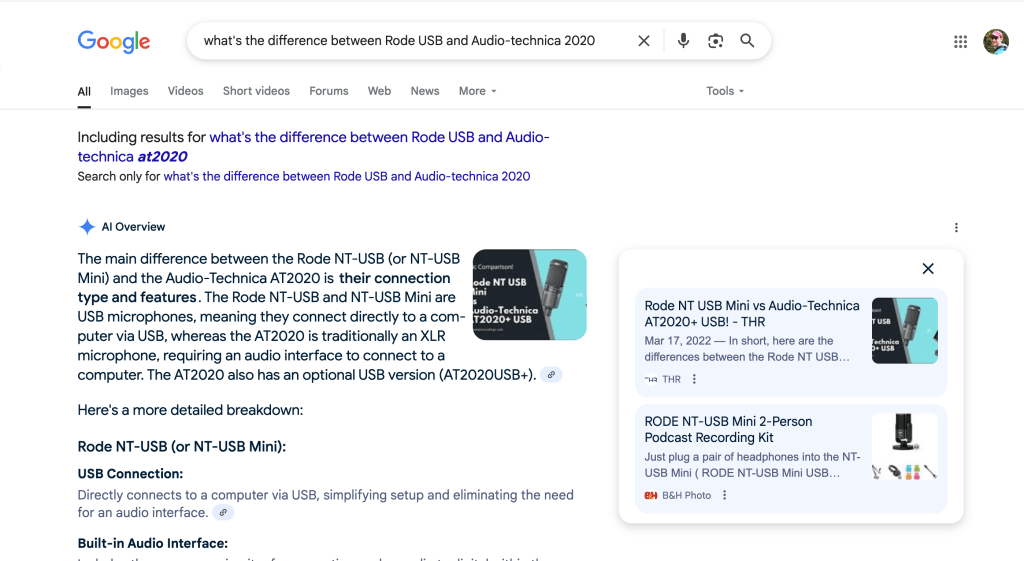
Google Search results these days barely feature any links and highlight internal content
SEO experts talk about “GEO” (Generative Engine Optimization), but the reality is that no clear playbook exists for it, and most content creators are seeing less and less return. There’s no proven way to optimize for Gemini or OpenAI’s models, especially when those tools don’t send much traffic back. The only instance of GEO I’ve seen was with a meme. Some prankster optimized (on purpose or not) a tweet about the size of Blue Whale’s vagina in comparison with a specific politician and Gemini picked it up.
At the same time, website owners still bear all the costs: paying for hosting, paying for content creation, and now even for AI tools that were trained on their own data. This suffocates the open web so that the LLM companies can sustain a hokey-stick growth to the trillions of valuation.
Should crawling be free in the AI era?
OpenAI at least pays for access to datasets. But many of these datasets were built through unrestricted crawling or by changing terms of services after the fact. Google doesn’t even do that. It simply applies its AI to search and displays that back to the user.
Regulation is needed yesterday. The EU’s Digital Markets Act already limits self-preferencing. Why not extend rules like it to web data? Possibilities include:
A licensing system for crawlers
Mandatory transparency around crawling and training data
A revenue-sharing model for publishers
And GEO will likely turn out to be more of the same endless content spam generation to feed it into the models, exploiting knowledge about how these models scrape data. It doesn’t feel useful yet and if that’s the future, we can only expect the enshittification of generative AI.





 Veselin.blog