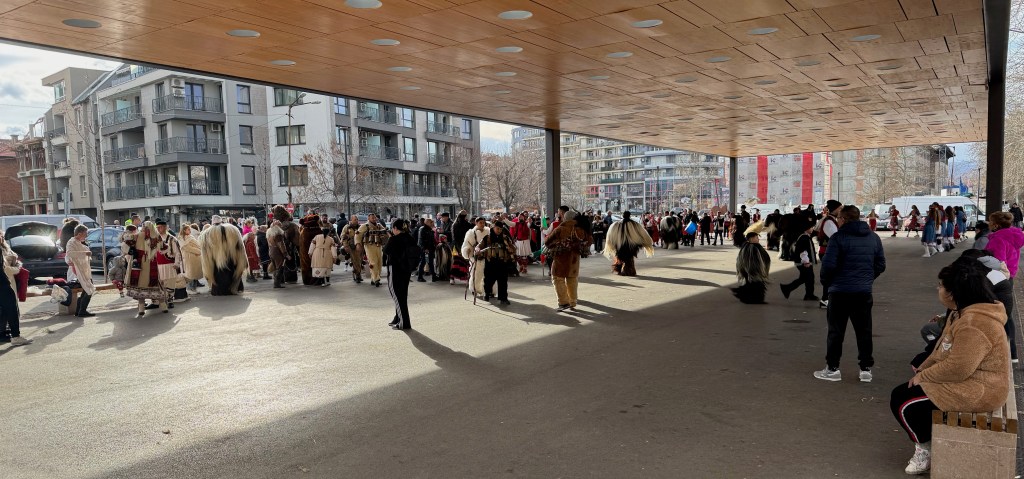
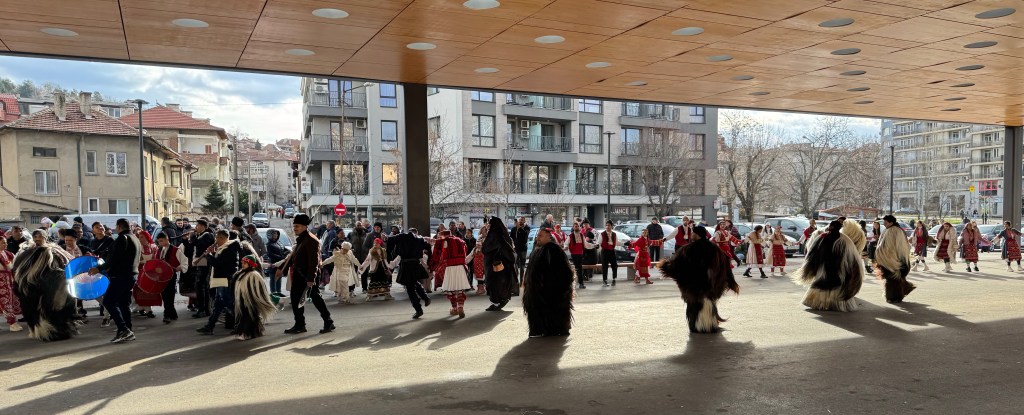
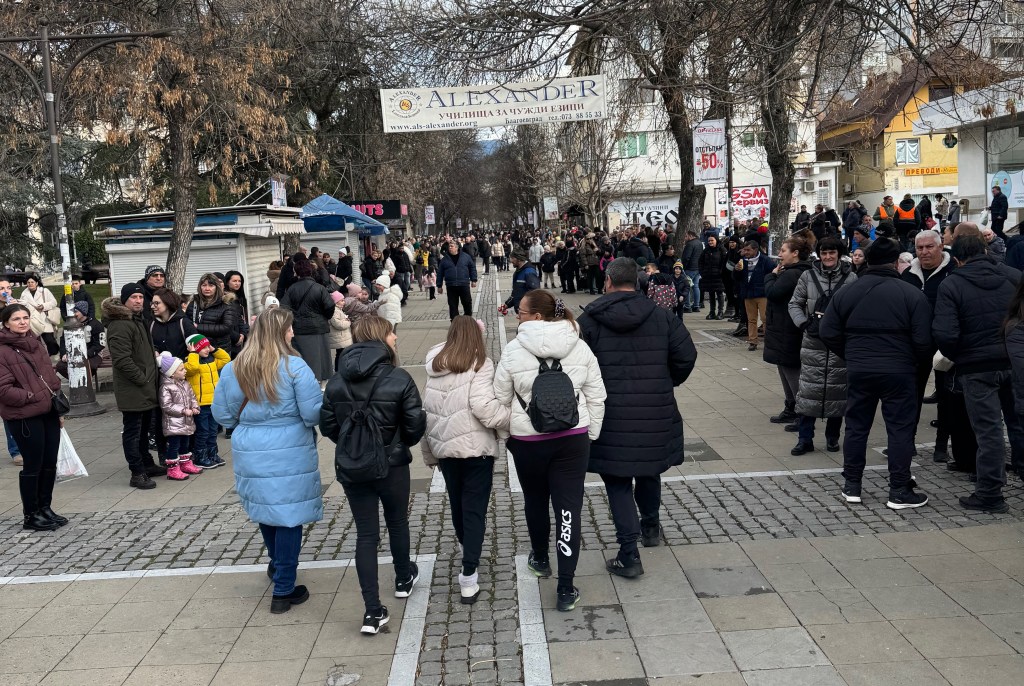
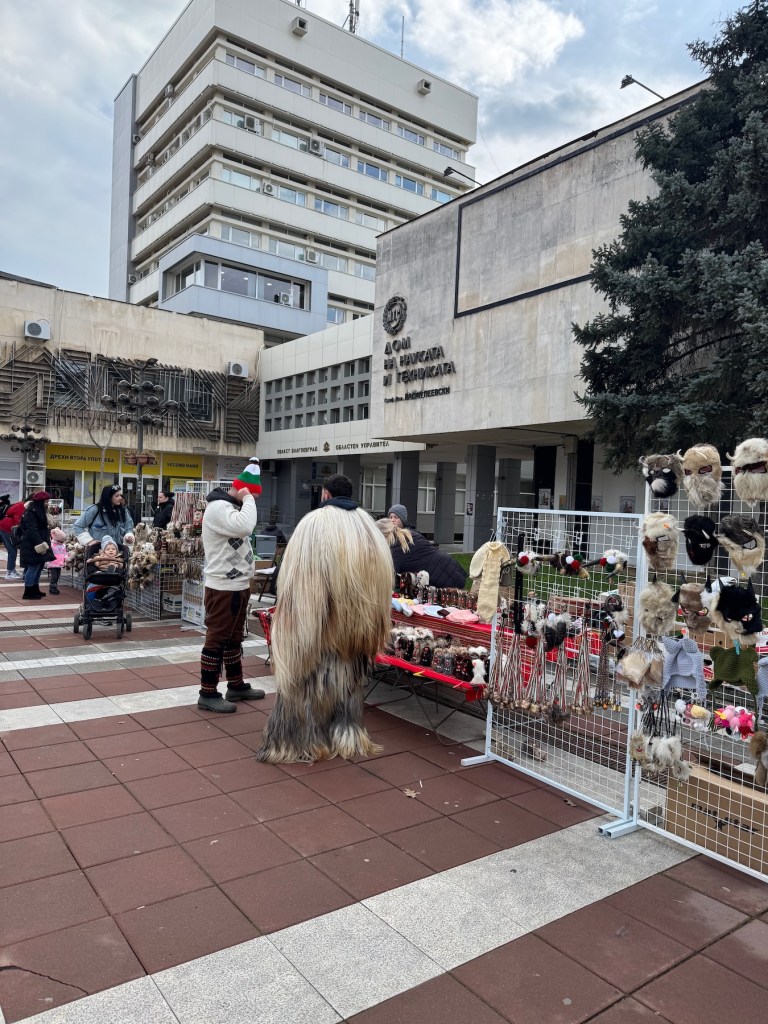
This Saturday, we had a chance to see the actual main event for the Kukeri in Blagoevgrad. They were thousands. The video and the photos can’t describe the sensory shock of getting close to these people. I’m glad to have had the chance to experience it, we normally leave Blagoevgrad earlier and miss it.
One can only imagine how terrifying the national event in Pernik called Surva is.
This post is part of the series about communist Bulgaria between 1979 and 1989. I already wrote posts about my cat and about ice cream. Now it’s time for a revenge trope.
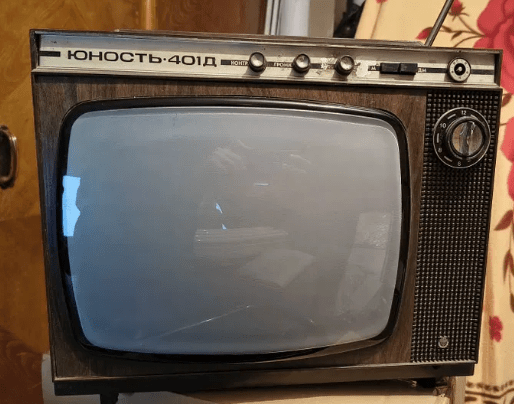
My parents had a Junost TV. This beast is 12.2″, black and white. It had two inputs for antenna cables on the back.
Bulgaria during my childhood had two TV stations, called First and Second Program. Both were part-time: they aired for 5–6 hours on workdays and full days (8 am to midnight) on weekends, with the Second Program being shorter. Both had maybe 1–2 watchable kids’ movies per week, and maybe another 1–2 watchable regular movies, usually on Saturday or Sunday. You had to switch between the channels to find the good stuff, and we always had the TV program published in the newspaper to guide us through this, so we didn’t miss anything foreign.
But I wanted to talk about switching between channels.
The way switching with this TV worked was:
You pulled out the antenna cable on the back of the TV from one of the sockets and put it into the other
Then you pushed a button indicating which antenna was in use
And then this big rotary dial, I think it was also used to click a few times, but maybe not. Why would it exist otherwise?
Whatever the ritual was, I mastered it quickly and did it thousands of times.
Then my parents and grandparents got color TVs and moved the Junost to the kitchen. My parents didn’t let me touch their TV, but my grandparents didn’t mind. My grandfather was nearly blind and couldn’t do it himself, so I had the right kind of encouragement. These TVs had a more complicated system with stored channels that was essentially the same dial and the same button, multiplied by 16 stored “channels” through 16 dials.
So, by the end of the 80s, I was the master of setting up TVs to play First Program, Second Program, the Russian TV, and, in some parts of the country, the Serbian TV. Now I’ll have a short break, and please don’t switch the channel.
The way people went on vacation during communism and shortly after was mostly through “cards” provided by their employer or another institution. My parents got a card for 20 days in the mountains, in a health resort with mineral water in Velingrad. By health resort, think of a 4-story building with modest rooms, with four single beds each, a canteen on the ground floor, baths with a pool in the basement, and a TV area on the second floor. The TV had 30-ish soft chairs arranged in front of it. The area was comfy, and the kids spent lots of time playing there. Given that TV mostly aired in the afternoon and evening, there were no people watching TV before, let’s say, 4 pm.
It’s a weekend day, and the kids’ movie will be at 3 or 4, on channel one. An hour later, an episode of some soap opera will air on channel two. The TV is an older model with a dial, a cable that needs manual moving, and a button that needs to be pushed to switch the antenna, not that much different than our old Junost. So all the old people were already there by 2, even before our kids’ episode, so they could get good seats for the soap opera later. There weren’t enough seats, but kids would leave after our movie, freeing some.
So when the time came, the king of the dial executed the clicking, pulling, and rolling sequence to change the channel so the kids’ show would show up. By the time I was done, my seat was taken. “Hi, I was sitting here?” “Oh, you’re so young, you can sit on the floor.” Uh. True. I can. I sat there, and when the kids’ show was over, I ran back to our room.
One hour later there was a revolt in the TV area. None of the adults had any clue how to switch the channel. The TV got all messed up. The adults figured out that I was upset because someone took my seat and that’s why I left the area without switching the channel. So they freed it, and sent a delegation of a few friendly grandmothers to our room to invite me to take my seat back, and please switch the channel. I switched it two minutes before their episode started. Not sure if any lessons were learned but the kids didn’t have problems with watching our afternoon episodes after that.
I’m mildly embarrassed by the story but we can’t change the past.
This post is part of the series about communist Bulgaria between 1979 and 1989. The first part covered a cat story.
I have two first cousins who are older than me and Hungarian. My uncle moved there in the 50s, and Hungary was not as isolated as Bulgaria.
One day, maybe around 1984 or 1985, they came to visit and we chatted, which wasn’t too easy because of mild the language barrier. The conversation was about ice cream. My cousin tried to convince me, that there are more than 50 types of ice cream in Hungary. I insisted that there were only three. By the end of the conversation, I was sure my cousin is exaggerating. 5-6 okay, but 50? No way.
In communist Bulgaria, almost all businesses were run by the government. Grocery stores didn’t sell ice cream. They didn’t have freezers at all, only coolers. So ice cream could only be purchased from private stands, where you paid for a waffle cone with a ball of ice cream on top.
Stara Zagora, a city of over 100k inhabitants at the time, had one stand I knew about that worked about half of the summer. It had one or two types of ice cream, usually one. The possible choices were white, brown, or yellow. Most of the time we would walk past the stand and it would be covered with cloth, not working.
So, what were the three?
White was vanilla. Yellow was supposed to be lemon, and brown was supposed to be chocolate. However, the country as a whole had issues with flavoring. It was very difficult to buy cocoa that tasted like cocoa, for instance. Our only source of good tasting cocoa was my Hungarian uncle. He would bring one or two packs of Nestlé when he visited, and that was it for the year. I’m sure the person who somehow assembled the ice cream at home also didn’t have a source of cocoa or lemon that tasted accordingly. Lemons and other citrus fruits were available for several days per year, in the winter.
As a result, the three types of ice cream were different in color but not that different in taste, at least according to my fading memories. I think they were all mostly vanilla. The yellow and brown were just a bit worse.
My imagination at that time couldn’t imagine another taste of ice cream, only another color. How could there be 50 types of ice cream if there were only six or seven colors? I wasn’t able to imagine more colors either.
I don’t remember when I first saw modern ice cream; it must have been years after the fall of communism. Communism withdrew slowly, and the riches of consumerist society didn’t become widely available until 1997. But at some point, I saw a Delta fridge, perhaps around 1992-3.
Oh. That’s how you get 50 types of ice cream. My cousin didn’t lie to me.
I consider starting a new post series on my blog about my experience with the communist Bulgaria, between 1979 and 1989. The idea is inspired by a book I’m currently reading, but more about the book once I finish it.
The story today is about my first cat. She was a tabby with lots of white, not as much as the cat above but you get the idea. The year is 1987 or 1988.
My brother got her from a friend without permission, let her home, and she hid behind some furniture for hours. She was probably 4-5 months old at the time. Our parents weren’t too happy about it but played cool and let us have her. We were super happy, must’ve played with her for hours every day. She loved playing, loved chasing walnuts, and was overall a very energetic animal who seeked attention. My hands had some constant 10-20 scratches at any time as she was always sharp and ready for battles.
Our plays didn’t sit well with the neighbor from the floor below. Now that I have kids of my own, I can imagine the noise we made with the cat and all these walnuts and tennis balls. The neighbor’s response to the issue, however, was that he would yell at us, threaten us, and he tried to enter our place several times. One time, he kicked the door while my brother was on the other side, and opened a large wound on his forehead. My parents called the police. A very large officer showed up and interviewed us, then left. I still remember some very uncomfortable questions for my age, like exact words of the insults the neighbor was screaming. Also, the size of that officer was stunning for us. Obesity in communist Bulgaria was uncommon because people didn’t have all that much food. We were all thin.
There were no follow-ups, we reduced the number of rolling toys, and the neighbor banged on the door less often after that. My brother’s would healed. Cat kept finding walnuts for months after, I guess she had a secret stash in difficult to reach places.
She disappeared about a year later, apparently she got sick or poisoned during our summer break. Looking back, I suspect her diet might not have been very healthy as we didn’t have cat food. She would eat things like bread, milk, yogurt, and occasional canned fish. Wouldn’t be surprised if she suffered the health consequences for eating bread and not enough taurine. We were unaware of any of that at the time, Internet didn’t exist, and there were no vets for pets anywhere to be found either. Cat food as a concept didn’t exist either. Stores would sell essentials only – bread, milk, flower, sugar, and so on, and they would run out, so you’d have to wait on a queue or go at specific days or hours.
Having another cat after I became an adult showed me how much food a healthy cat needs and how large they can get. So poor thing, didn’t last long with us but at least, she was loved and played a lot.


 Veselin.blog
