I will ruffle your hair

The text at the very top, after being censored, means “I will ruffle your hair”. I really wonder about the thought processes that produced this copy. Perhaps it meant something else and got redacted. The redacted part must’ve been offensive.

Aksakov street, Sofia.

Cats, Cakes, and Skyscrapers

I had a chaotic walk this morning, here’s a bit of Sofia and my path for the day.

Skyscrapers

I walked past 3 of the tallest buildings in Sofia. The first photo shows Capital Fort (147 meters) and Sky Fort (202 meters, with parts of it disappearing into the clouds). The second shows the Millennium Center’s tower 2 and 3 (~112 meters). By height, these rank as the city’s first, second, and third tallest buildings. The final photo is one of the tallest socialist buildings, which looks like a dwarf next to the Millennium Center, despite standing at 70 meters.

What the first 3 buildings have in common, apart from being tall, is that they all got stuck and remained unfinished for a long time. Capital Fort and the Millennium Center were eventually covered in glass and put into operation, but Sky Fort still lacks windows on its top four floors, which may take years to resolve.

Cake

The goal of my walk was to get a birthday cake from Vila Rosiche. Somehow, they’ve survived the gentrification and the enshittification of the city center brought on by the ever-growing number of tourists, and they’re still baking excellent cakes. Dropping a casual recommendation, as for whatever random reason, people find this blog on Google, searching for local experiences.

Looking for well-kept secrets in Sofia? Have a cake in Vila Rosiche. They have a small and well-hidden garden, which makes them fine for tourists as well.

Cat

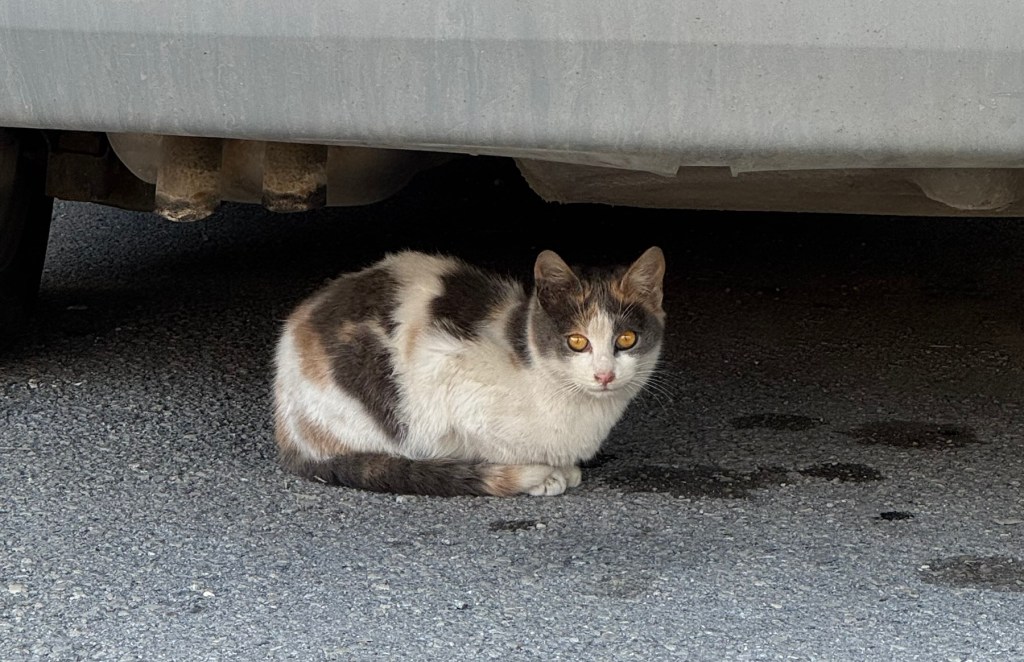
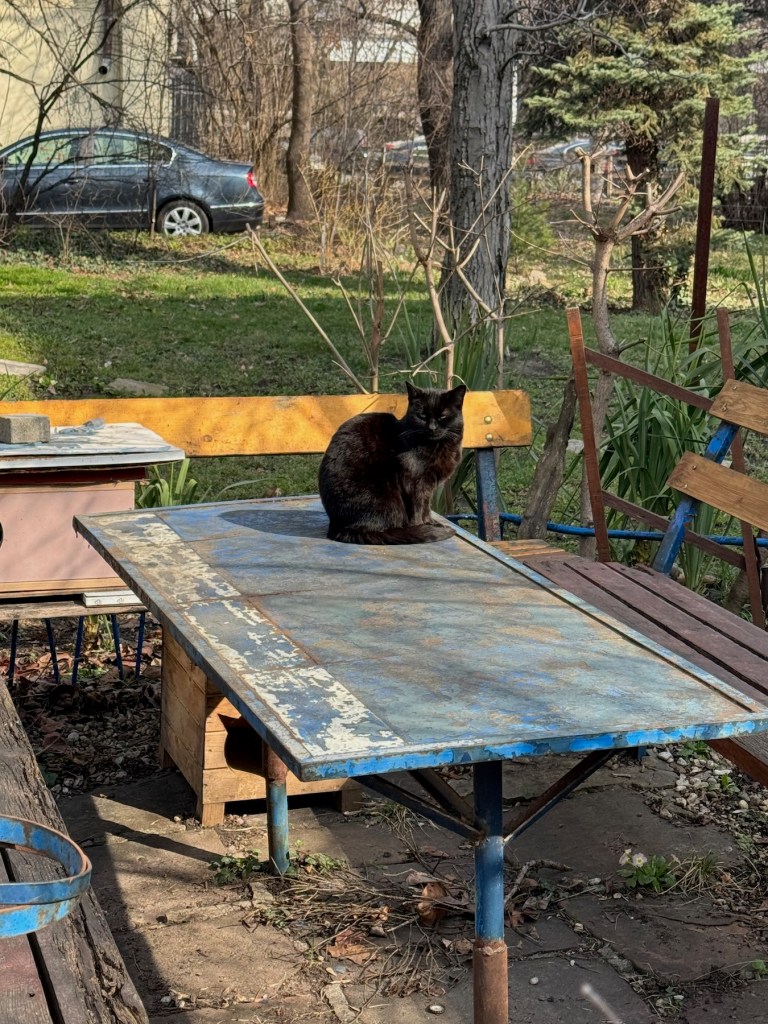
This little fellow wanted to explore the internals of my car. Thankfully, she eventually came out for some pets and let me take a photo.

The Museum of Socialist Art

I visited the Museum of Socialist Art in Sofia today. It’s very small and oddly located, right next to the parking lot where new cars are registered. The surroundings are chaotic, with all the cars. Inside are a handful of powerful cult objects from the past. Not many, but still worth seeing. That said, the museum is probably best visited with a tour guide. Without context, it feels less like a curated collection and more like a dumping ground for socialist garbage. A tour guide can help with the significance of these things, otherwise they’re just ugly random items and decapitated statue heads.

Petoluchkata

The star, now hidden behind a parking, (bumper of a car still visible), was once put on top of the present-day parliament. The photos two and three show you the pilon, it used to be on top of that. The most centrally located element in Sofia.

The legend said it was maid of ruby. Clearly not but that’s what we believed during Socialism. It was removed and tossed behind the central bath shortly after the change of the system.

Malchika

Adalbert Antonov aka Malchika, one of the Five of RMS (workers youth union). He was part of the anti-fascist movement and was executed in 1942, which turned him to a Socialist martyr. The biggest producer of sweets in Sofia, the Happiness factory, was nationalized and renamed after him, and then became Nestle Bulgaria. This particular statue is of no particular importance, there are still many, spread accross the country and still standing. However, it represents one of the important foundational legends for the Bulgarian communism.

Marx, Engels, Lenin

Socialism tended to worship some ultra-smart old men as as gods, always in groups of three. However, the groups of threes kept changing, depending on the current geopolitical climate and the shape of the clouds. Marx, Engels, Lenin was one of the threes, but also Lenin, Stalin, Dimitrov. I had zero knowledge of who these people were and what they did to become Communist Gods, and we didn’t study them too much, perhaps because that would lose the flexibility to replace one of them with a more modern figure on demand.

I knew them primarily from statues, billboards, murals and so on, which were everywhere.

Zhivkov and Brezhnev

Building statues of living people was considered fine by communists. Todor Zhivkov, who was the acting dictator for a period of 33 years, also built statues of himself. Someone recovered a head, which likely used to be attached to a body, and placed it behind a staircase, oddly located and assymetrical. I suspect sure it was done on purpose, humiliating the dictator, rather than celebrating him.

The painting was more interesting. It looks almost AI-generated but is full of symbolism. Zhivkov is behind the USSR leader Brezhnev, has only 3 stars, while Brezhnev has 4. Brezhnev is with a red tie, while Zhivkov isn’t. They’re of equal height, despite being different in real life. Anything to please the masters, and to indicate that Zhivkov is very important but not the most important. Frendly old fellows.

Some Art I Liked

Famous painters were no shy of doing communist art. They painted workers, building the socialist dream. Women with dresses, men with flat caps and strong arms, everyone out there, under the sun.

The last painting by Liliana Ruseva, called The Teacher, shows Pioneers – essentially kids with red ties. We were all supposed to go to school with these red ties and approved haircuts. If one was off – without a tie or with too much hair – they could be sent back home. The school had an official tie-fighter at the doors. There were no uniforms, though, it’s just for the painting.

Overall, a good start, however a lot more work is needed to turn this museum into a quality toursit trap.

Dark Winter Day

I had a walk today and according to some of the photos, the sky was actually visible. It felt sad and gloomy.

Mladost

This is from my neighborhood, I want to go to that place and just paint over. However, there’s a school nearby, so it’s a lost cause.

This is what I think about the weather

Essentially me.

Moskva

Moskva means Moscow in Bulgarian. The owners didn’t dare to remove these socialist signs. This was once a cinema. However, when I first went to a cinema in the mid-80s, I think it had already closed. There used to be another cinema on the opposite side of the street, which functioned until the early 90s, and was fine. It’s now a supermarket.

Overall, had a nice walk of almost 15K steps. Couldn’t capture any optimistic photos but I think these are pretty in their own way.