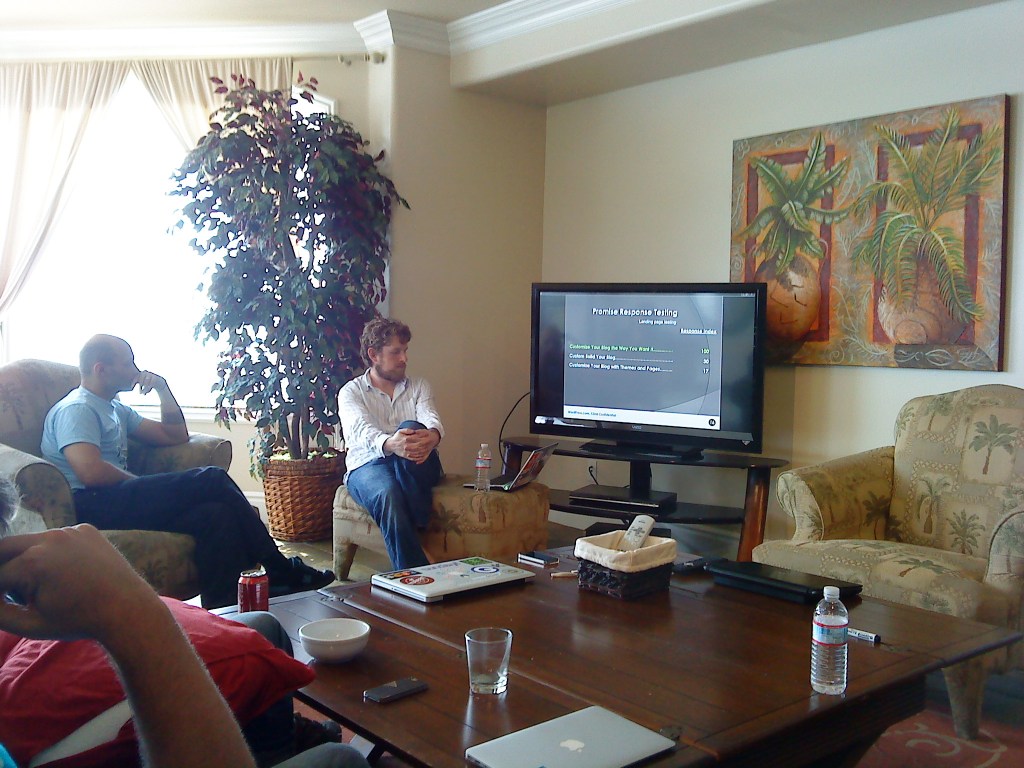
Happy 20-year work anniversary to Donncha — the very first person to join the company, even before Matt! His post brings back the early days and shows the small group of people who started it all. They all look so young! It’s amazing to look back and see how far we’ve come. Here’s to the next 20!
I remember joining in 2011, and blaming the already 6-years-old codebase to always find Donncha’s username in the oldest corners of the code.
Photo by Mark Ralev. Thanks to Mark, I have some photos of myself from 2011.
This was the computer I used when I joined Automattic. I did my trial with it and bought a new one for my first team meetup.
And 3 of the only 4-5 photos I still have from the said meetup in 2011. The last photo features Matt and I think Stephane Daury but with the photo quality of my 2011 camera, it could also be Jason Statham.
We had a small birthday party, organized by DevriX and celebrated 22 years of WordPress with cupcakes, snacks, and beer.
I remember the days of building custom CMSs from scratch for every project. Each one came with the same recurring challenges: handling forms, fighting spam, scaling images, building a page editor, and so on. WordPress—and a few of its competitors—helped democratize this process. It made web publishing and commerce accessible to everyone and created fertile ground for the open web to thrive.
I have some ideas to share with you, based on my last 24 hours of blogging.
Add Images as Galleries
Have you noticed that when you blog a single image, it’s not clickable and stays small? Like this:
It’s a very large and pretty image but nope, can’t click.
And this is clickable (well, at least clickable from the website veselin.blog):
I used the Image block for the first and the Gallery for the second. So if you want your image to be clickable, use the Gallery instead of Image for single images as well.
You can type /gallery in the editor to quickly find the block. It will appear after /ga or /gal.
You Can Post Photo Comments
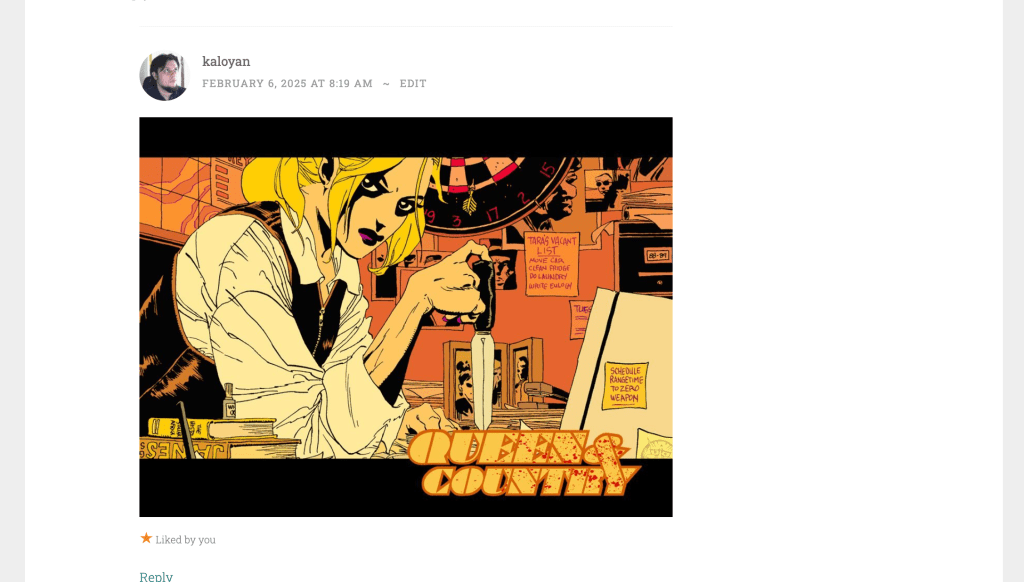
This only works when you go to the person’s site and post a comment from WordPress, and not the Reader or the comment notification. The Gutenberg Editor for comments supports adding an Image block where you can copy/paste an address pointing to an image. Just select reputable sources for your images or they might go away soon.
Use Featured Images for Your Posts
The latest version of the Jetpack Mobile app no longer uses the first image from the post on the Mobile Reader and this will likely cause lower engagement with your posts on Mobile if you don’t manually add featured images. The following screenshot shows 2 posts with a featured image, and two without. Despite having a photo on your site, it will only be viewed after a click. Will anyone click a post called “Stesi” with no explanation and no photo? Probably not.
Note that the web Reader is unaffected and will still show your first image as featured without doing this.
Resize Images Before Uploading
It’s very easy to consume all of your space if you don’t resize the photos before uploading them. The default photos that my phone generates are 5-9MB each. Scaling them down to 2000x1500px makes one photo under 1MB and I can upload more than 1000 photos per GB of used space.
Do you have any tips about using images on your blog?
Seeing one cockroach under the sink usually means an infestation. Roaches like to hide. It only showed up because the hiding spots were overcrowded.
I like to apply this generalization to software engineering—especially over beer.
If you receive a single bug report about a feature you just launched, it likely means the feature is completely broken. Users tend to work around UX issues and only reach out to support when things are really bad and they have no other options.
That one security, usability, or other issue you noticed in a pull request? If there’s one in the PR, there are probably more in the adjacent code.
A missing space in a code change? That usually means there’s no linting in place.
A missed edge case? It might indicate something is off in our testing process.
The way I defined this Cocroach Rule matches the definition of a Hasty Generalization. After all, one cockroach—or one bug—is a sample size of one. There’s always a chance that a reported issue is an extreme outlier, something no one else will ever encounter. Maybe a high-energy particle hit a chip somewhere. It happens.
But my long-term experience shows that the Single Cockroach Problem largely holds true. It applies in many areas where the difference between zero and one is significant.
I challenged myself to do a 365-day blogging streak last year and managed to do it. I have to admit that I messed it up a few times mostly during trips, most recently 2 weeks ago in Agaete.
The blogging streak doesn’t work very well with timezone changes. You can be on a streak, come back home, and the streak is broken 5 times over the last 7 days. So I had to change post dates and slightly cheated to keep it going.














 Veselin.blog