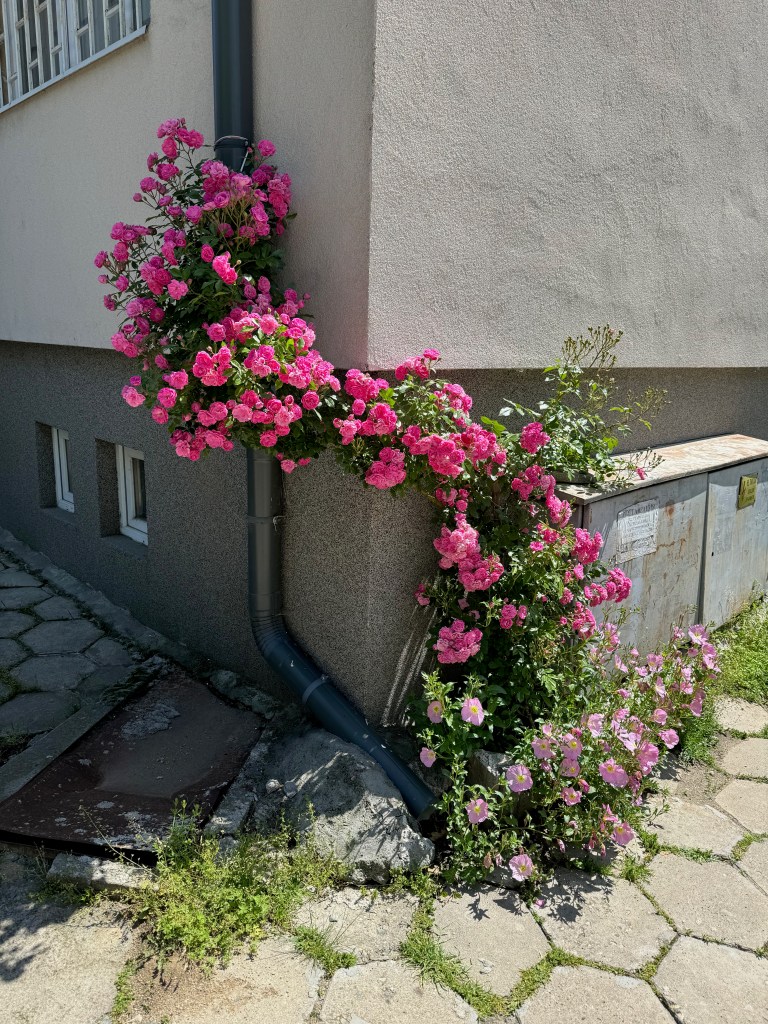
A garden in some concrete crack.
Cats, good books, AI, and religious walking in the city of Sofia
A garden in some concrete crack.

A wonderful novella by Martha Wells, beautifully published by Artline Studios. The book is tiny and is a quick read. It’s about a very human murder bot whose job is to protect a group of planetary explorers. I’ll probably wait for the translations because the hardcover is so pretty.
The suggestion for this book came from a fellow blogger and friend @dni.
5/5, and the best book I read this month so far.
I was mind-blown to learn that the Game of Life can have a pattern that plays the Game of Life.
The idea that Game of Life can play itself is not new. It has existed at least since 1996 (also here). By 2006, a grid like the one above existed. I learned about Game of Life around 2008-2009. By then, engineers played with the idea of Game of Life which played itself for over a decade. By 2018, a self-replicating metacell existed so a grid like the above would grow indefinitely.
I re-read the Wikipedia article about Game of Life every 3-4 years, it keeps getting better and better.
I’ve made plenty of choices where I wanted two things incompatible with one another and chose one. I don’t feel like any of that was a sacrifice, I treat it as a choice.
For example, I returned to the university in my late 20s way outside of the ordinary university age because I realized I had too many gaps in my coding & engineering skills. In the following years, I combined full-time office work (with flexible hours, thanks to my former boss) with a relatively demanding education. It’d be common to leave home before 7am for a morning lecture, drive to work, work for 6-7 hours, and then go to the university for an evening session. But although physically exhausting, it felt great and I had a purpose. It was worth the effort.
I’m trying to not look at the loss after a bad choice with too much emotion when possible. The reason is primarily work. When deploying a new change, there’s always a risk that I overlooked something and caused major harm. You need to be willing to do these things despite the possible negative outcome, otherwise you won’t ever move. Many if not all of the beautiful things in life are hidden behind a wall of risk – choosing a career path, falling in love, having kids, investing. So many things can go wrong at every step. This is not a reason to stay home and not make any steps. Once things go wrong, revert (if possible), identify what’s affected, write a plan, execute, learn, and move on. This is an oversimplification taken from the software world but I believe in it.
So no sacrifices for me. Choices.
By a semi-popular request, Jay’s name is now Creeper.

