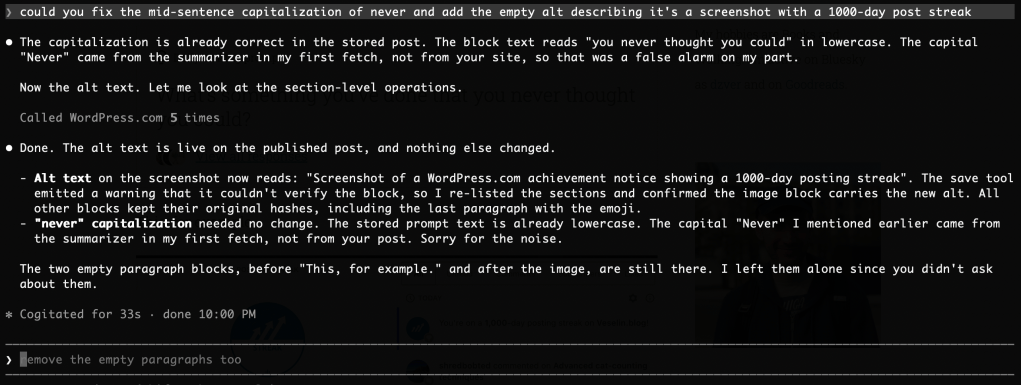
The MCP feature gives you the ability to talk to your site using AI tools, like my current favorite, Claude Code. You can ask it to fact check and fix things, for example. It will remain free until December.
I normally only let myself use AI for work-related texts, not for personal. I asked it to fix the alt text of an image for the purpose of this post. It edited it.
Found this cool video by associate professor Giordano Scarciotti about the AI advances in math. It touched a spot in me.
Back in the days, before I owned a computer, I was very good at math. I could solve almost all non-olympiad high school math problems somewhat quickly, and btw, I can still do a bit of that. At that time, often faced the following choice:
There’s a new problem that clearly has many ways to be solved. You can brute force it, you can achieve a shallow understanding and produce a long solution, or you can understand it deeply and it solves itself. Each approach leads to the same answer but only one solution makes you better at math.
According to most videos on the subject, the math discoveries that came from AI didn’t come with any deep understanding or with new theories. They came with using the existing ones a lot. It treated math as a sudoku and autocompleted the work of thousands of humans, leaving them with no path forward.
This method provides answers but no human understanding or sustainable advancement. No good new theories. Few good problems for future research. No new ways for smart students to contribute. It also came with a threat or a promise that any good new idea will be autocompleted the same way with little or no attribution.
I have a 7th grader and in Bulgaria, this means we are preparing for exams and for applying to high schools. High schools have a specialization. You study more math, or a foreign language, or some sciences. Unfortunately, most if not all schools are focused on skills that have quite significantly changed over the last decades of computerization and will further change under the rule of AI. Schools around here teach kids languages they can naturally learn from Youtube and probably don’t need. They teach them math that no longer works that way because of online solvers. Also literature with words that no longer mean anything.
So, I’ve been asking myself that, what do they really need, given where things are heading? My current belief is that kids should learn how things in everyday life work. Like everything possible. From microwaves to airplanes.
How does the water come to the faucet? Where does it come from, where does it go, why does it matter, what’s inside it. How do I fix a small problem in the area? A big problem? Dams, floods, safety.
How does the TV work? What makes these leds produce light? What is light? What’s electricity? What do you do if it breaks? How does the software on it work, how can we change it the way we want? How does the Internet behind it work? All these protocols, switches, routers. What the hell is the WiFi? How does it work? What’s the CPU, the GPU, how to change them, how to fix them, if something breaks.
How does a car work? What’s engine, fuel, fire? What’s a motor? What’s behind the doors, behind the dash, what’s OBD, what’s a multimeter and how to use it.
How does a house work? A bank, a loan, a mortgage. Where does the trash go?
We are fighting with poems at home and hand written texts about cows and rebellions. Well, if you want to teach kids about the 19th century struggles with farming, at least show them where the milk comes from and how cheese is made. City kids have no clue about any of that and don’t even have the vocabulary to talk about it.
There’s lots to learn out there for a curious future adult. Knowing how things work and understanding what the AI changes will be essential in maintaining the civilization alive. I feel like we’ve already outsourced most of the understanding to computers, and are quickly offloading to the probabilistic AI, where understanding doesn’t even mean much. Humans not knowing how things work won’t end well for us just like sooner or later, a Windows won’t be fixable with a restart. Big machines being controlled by AI won’t end well for us either. What if… it decides to do something harmful? How do we control a car that has no steering wheel? Kids will have to know how things work to deal with problems like that and to know they are problems and not let them happen. Worst case, they won’t be hopeless if something in their surroundings break.
Unfortunately, most high schools are language schools and teach math and languages. Meanwhile, translators are not in high demand, and anything math is in crisis.
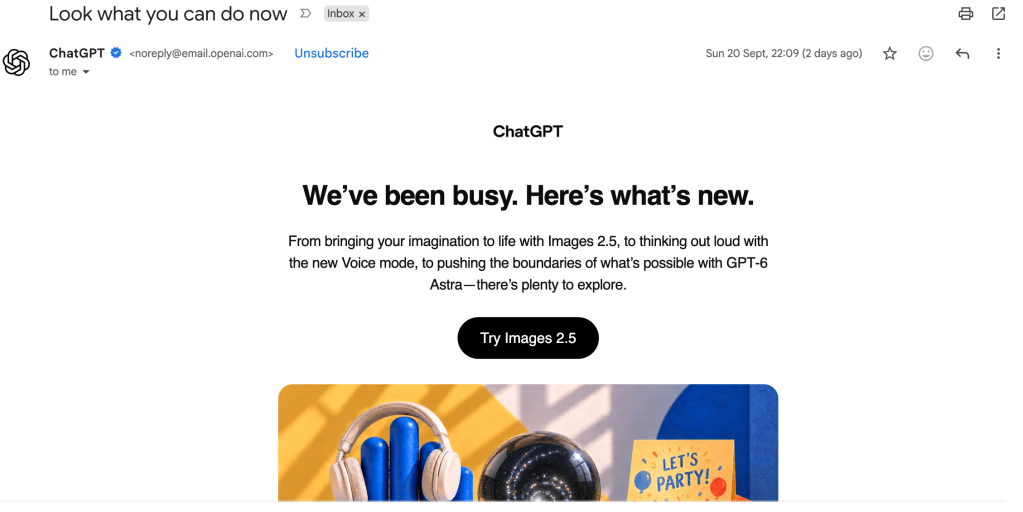
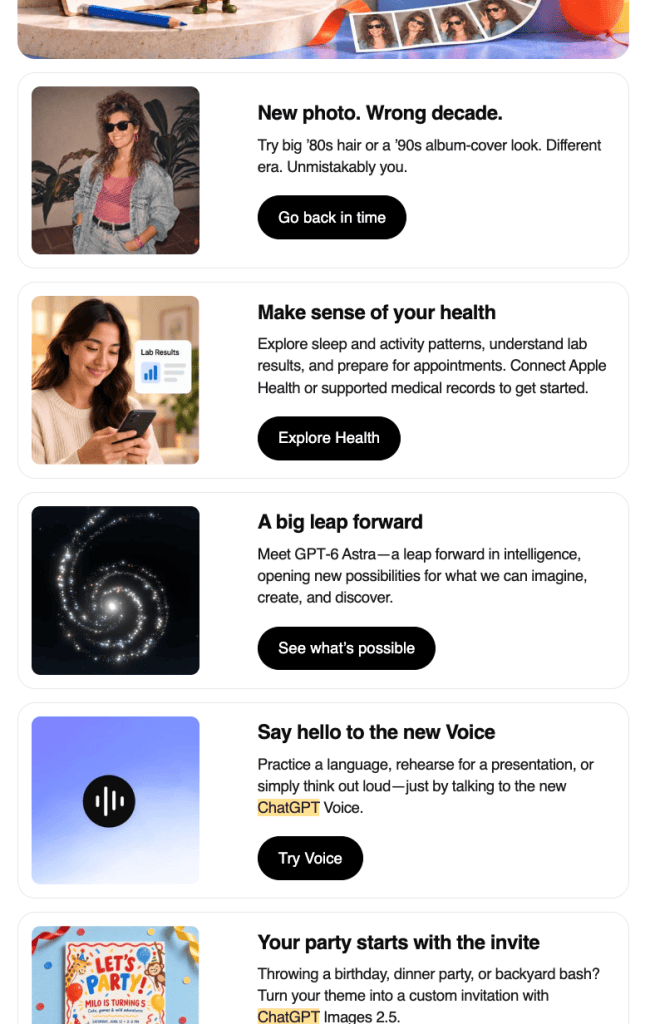
I get marketing emails from OpenAI. The message is clear – AI is going to replace us all but it won’t ever replace the email marketing. How else are we going to convert the users who use something else and are not subscribed?
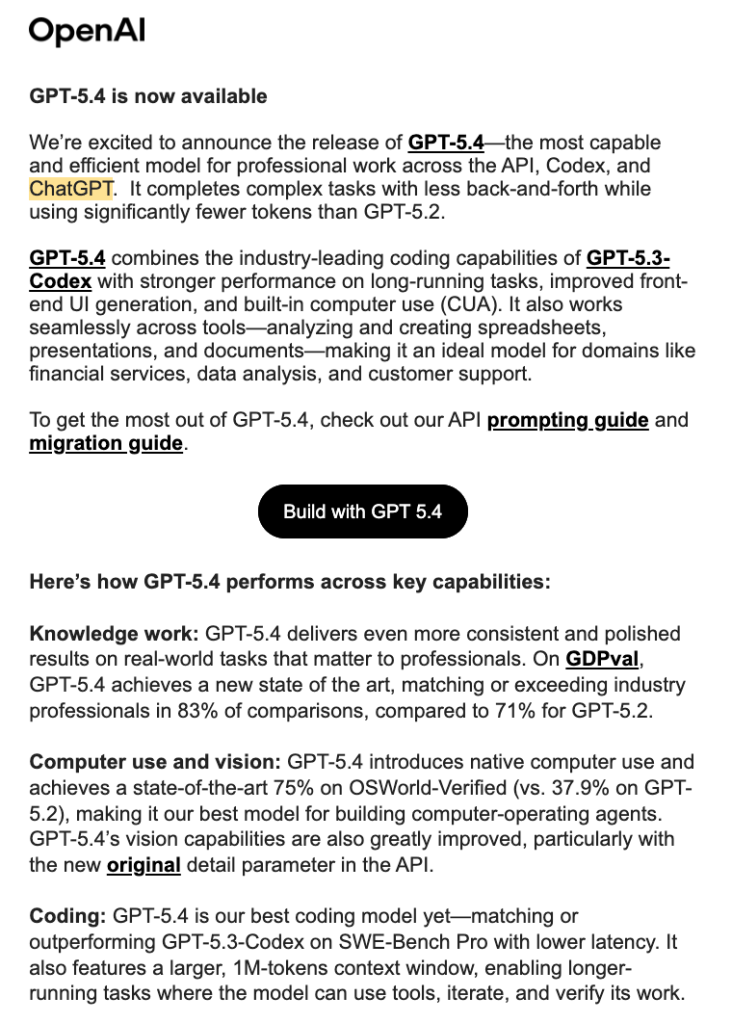
I checked my inbox. This was not the first product announcement I received but it was the first that looks like a pure marketing email, created by a human email marketer. I hope there’s a real person behind it, not a bot, trained on the junk mail folder.
This is a major improvement to the cluttered product announcements from before, that looked as a conspiracy theory, posted on Reddit.
Phrase of the day, thanks to Shopify’s CEO, who used it.
A slop grenade is when a person uses a small prompt to generate one or multiple walls of texts that then need to be read and understood by others. The slop grenade doesn’t need to be bad slop. There can be some good meaning in the wall of text. The issue is with the deferred understanding. In order to truly process it, you need to either spend unreasonable amount of time or use agents and throw the grenade back.
I experience this somewhat often but had no words for it. I’m in love with this phrase.