I have video proof that this happened. May upload it later 🙂
Cats, good books, AI, and religious walking in the city of Sofia
I have video proof that this happened. May upload it later 🙂
One of my annual goals was to do three real hikes in 2026. A week ago, I did a semi-unplanned hike to the highest peak in Bulgaria, Musala, which is 2925 meters high. Kids couldn’t come with me because one got motion sickness, and the other didn’t want to come out of solidarity. However, they got inspired and wanted to go to the peak as well.
So this week, we attempted a retry. This time, phones were banned in the car, I drove extra carefully, nobody vomited in the car, and all four of us managed to get to about 2500 meters. Then the big kid got signs of altitude problems and had to give up.
The little one (aged 7) kept going, flying ahead of me for the most part, and we reached the top. Took us 3h, only 20-30 minutes slower compared to doing it on my own. He didn’t want to do any breaks. I’m not sure what to do now because I have one of the kids achieving this relatively difficult goal, and the other – not. Maybe we need to come for a third time this summer. We can still improve the organization because we lost 1h waiting for the gondola. The optimal hike would start with buying the tickets the day before and then going to the line at 8:15. Does it matter all that much if you start at 8:30 or 9:30 – probably not. You need to be super slow to miss the lift, which works until 18:30.
The final step count for the day was almost 30K, which is my personal best since I started tracking. I couldn’t imagine I would ever be able to do that 3-4 years ago, when I had trouble walking up to the 4th floor without a break.

Experiments in the context of software involve showing different groups of people different UIs or features and measuring the impact. This is one way to make informed decisions based on data rather than opinions. If experiments aren’t used, decision-making is usually subjective and prone to errors.
Humans are not good at predicting the future. We may be able to guess where the bus will stop next, but try guessing the price of Bitcoin next year. Being able to properly evaluate the outcome of decisions has real value, while relying on opinions can lead to irreversible losses.
Experiments are one way to get that data, and they’re something I’ve practiced a lot over the last two decades. I can say I have some experience, good or bad. But how far did I get with my own understanding of what a mature experimentation system should be?
The book I’m reading introduces a very interesting metric for experimentation maturity, based on the number of experiments, run per year. Metrics like this can certainly be criticized as superficial, it’s comparable to lines of code written or numbers of PRs. But having a metric is better than not having one, so here’s the maturity model from Trustworthy Online Controlled Experiments, Chapter 4. Numbers apply for large online services, like Google.
The book isn’t exactly clear about when you’re out of Run and into Fly, given that one is around 250 experiments and the other is 1,000+, but it at least gives you a way to estimate roughly where you are if you’re running experiments.
It also doesn’t talk much about metric classification. As experimentation matures, metrics should be grouped into categories, with drill-downs for important characteristics. Some of the examples of what should be available felt very strong, like things I wish I knew sooner.
This book is great. I’m about 20 pages away from the end, and I have enough notes to write a chapter rather than a blog post. The last chapters are full of formulas and take time, as some of the formulas are not something I’ve encountered before. I learned stats with pen and paper, making countless calculations of averages, standard deviations, p-values, and such by hand. When I encounter a new stats formula, my brain wants to see the tables behind it, the charts behind it, the history behind it, and it refuses to move on by just accepting it.
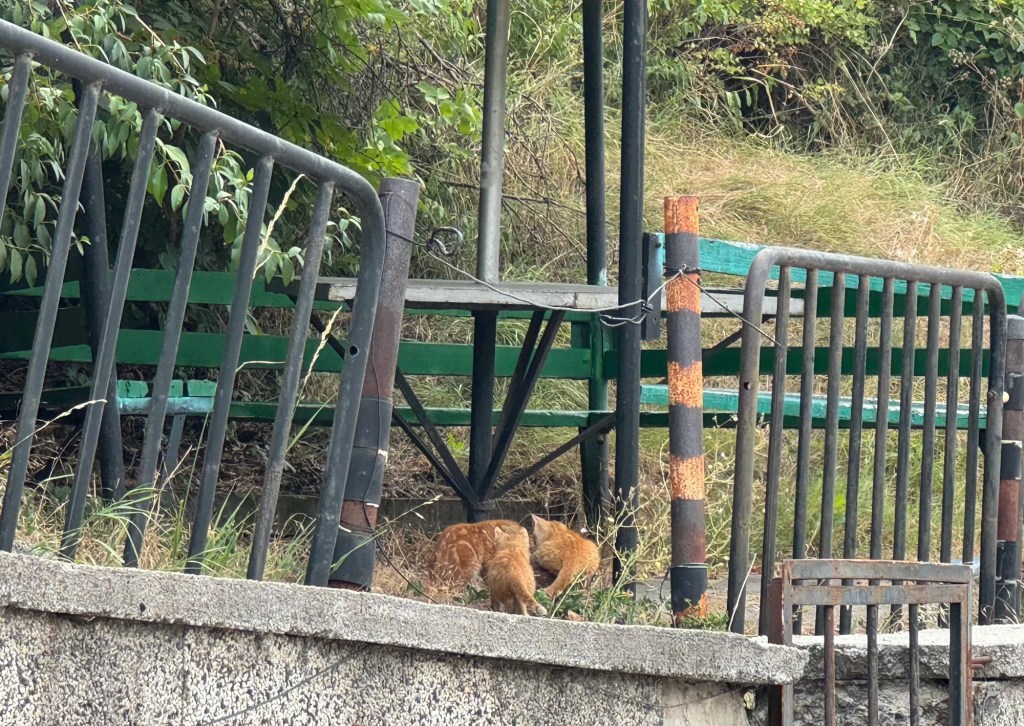
My recent theory that I found an orange mom + an orange dad cat family is no longer entirely viable. That tiny colony has at least 8 cats and while at least 5 are orange, some are grey tabbies. Here’s a photo of two nearly identical 3-4-5 month old kitten at the same spot. Their real size is tiny.

A few weeks ago, I posted a photo of two orange cats hiding in the bushes. I walked past the same area today and spotted three orange kittens playing together.
I think this is an uncommon case of a male and female orange cat producing a fully orange litter. I couldn’t get closer because they were playing in an area with restricted access, so I took the photo from outside. The three kittens appeared to be around 3-4 months old.