This is the 4th book of the series for the round former battle mage Thraxas and his fierce friend Makri. I reviewed the first one here and then read #2 and #3. Part 4 felt like the best and most balanced of all. It is the best mystery and the one with the least battles. Still zero drama.
Thraxas is invited to an Elven island to help with a murder case. Elves have no crime and no detectives. Murder on their island is a big thing. Asking questions, on the other hand, is not appreciated. On top of it, it looks like people are under some kind of spell, the murderess is inadequate, and the high elves do not drink beer.
From a character development point of view, have a chance to learn about Makri’s Orkish kendoka origins. She will wield some wooden swords this time.
Back in 1992, I had the chance to read a series of 4 gamebooks called The Way of the Tiger. It was the second-best series after Blood Sword, captivating the young mind’s imagination with both its well-crafted fantasy world, and the feeling of challenge. Little did I know that the original series had 6 books. It required completing the first two for a successful read. The series has a secret kick called “Kwon’s Flail” that is only available in the first chapter. My friends and I didn’t know that, so we searched the 4 books from 1992-3 for any hint on how to find that. It remained a mystery for some years.
The local community figured out the Kwon Flail problem in the Internet age and published books 1 and 2 sometimes over the last decade. I managed to find a copy of book 1 last week and read it this weekend. It was a nice refresher. Got me back to my teenage years.
The book itself is in a magic world where Gods compete with each other and use humans as puppets. The main character is a ninja who follows the good god Kwon. There’s magic, taverns, warriors, monks, a Barbarian, arenas, and whatnot. The authors describe it as Middle Earth with Ninjas. What makes it good is that the choices actually make sense. You need to pay attention while reading it, and take notes, and there’s a strong chance you’ll succeed in the mission with 4-5 failures. It has some hidden gems, not all of which need to be uncovered. The book allows for collecting unnecessary items and fighting dormant enemies.
Overall, 5/5, first true 5/5 for a gamebook this year. I have book 2 on my shelves, waiting for me but do not have the final book 7. It might turn out to be a hard find.
I read this book with the intent to read a classic sci-fi from the times when the skies were still tempting and the Solar system felt within our reach. The book felt close to that but to my surprise, it turned out it was written in 1993. It’s still a 1960s book, just one that ignores large areas of the emerging tech and focuses on the dreams from the past. It has neuralink but the data transfer reminds me of floppies. The propulsion methodologies remained in the 60s as well, or at least sounded that way.
I found the prediction of societal changes more interesting than the tech area. The biggest one in the book is that Christianity and Islam merge and form a new hugely influential religion – Chrislam. Artur Clarke predicted that the massive mixture of people from these two faiths would lead to the birth of a prophet who will merge the faiths in one. Okay, this idea is cool, but how would that happen? There are so many problems that would need a resolution and remained unaddressed. Religion is not just about faith, it’s also about history and tradition and these have gained thousands of years of divergence. How do you undo something like that?
Perhaps some other book will imagine an answer while addressing at least some of mismatching historical claims, the spiritual differences, and the cultural problems. The common ancestry is not good enough. The whole asteroid approaching Earth problem didn’t help and was probably unnecessary.
The challenge to blog daily got me motivated to read more and shorter books. I read 15 last month, which I’ve not done since the day(s) I read The Chronicles of Amber. I didn’t blog about most of them, though. Didn’t feel right.
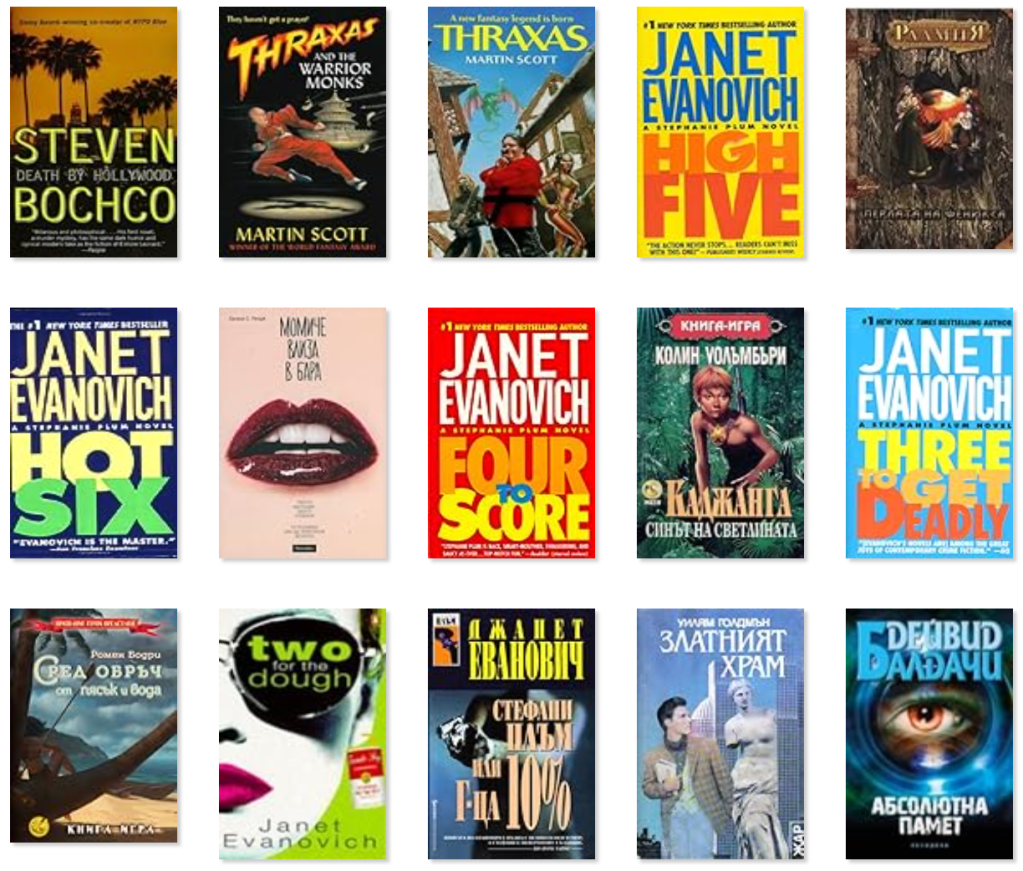
The best books for the month were Five and Six by Janet Evanovich and the two Thraxas. Number Seven is already lined up in my phone, and the next two Thraxas arrived as a paperback from a second-hand shop.
The worst by a wide margin was David Baldacci’s Memory Man. I awarded it 3* but it doesn’t sit well in my memory. The way I remember it, it’s already a hard 1*.
I did it! I successfully read a book with a Goodreads rating of 3/5. Given that most people give 5s by default, the 3 is a pretty big deal. It’s like an IMDb rating of 4 for a movie.
What grabbed my attention was the writing style of the first few pages. It sounded like the writer knew the world he was describing very well, and I wanted to learn more. A screenwriter witnesses a crime and decides he’ll write a script based on it instead of reporting it to the authorities. He inserts himself into the lives of the victim, the killer, and the detective. A world of corruption, sin, and hypocrisy uncovers where everyone is greedy and nobody is spared.
The book is not linear. It has a dog named Bob. Half of the books I read in February feature a prominent canine supporting character Bob. Is that even a reasonable dog name? Bob is a very clever dog, so clever that the book leaves the realm of crime and enters the urban fantasy. Bob makes this book a 5 rather than a 4. 4 would be fair – the book is fresh but not that fresh – there is not much to like, except for Bob. It’s difficult to finish and the non-linear nature introduces 2 or 3 brief throw-away-the-book moments. I bet this is what happened to most people who voted 3 or under – they just gave up at the first difficult moment.
TL;DR – 5/5 but the book is unusual and many didn’t like it. It keeps on giving if you don’t give up. Goodreads link


 Veselin.blog