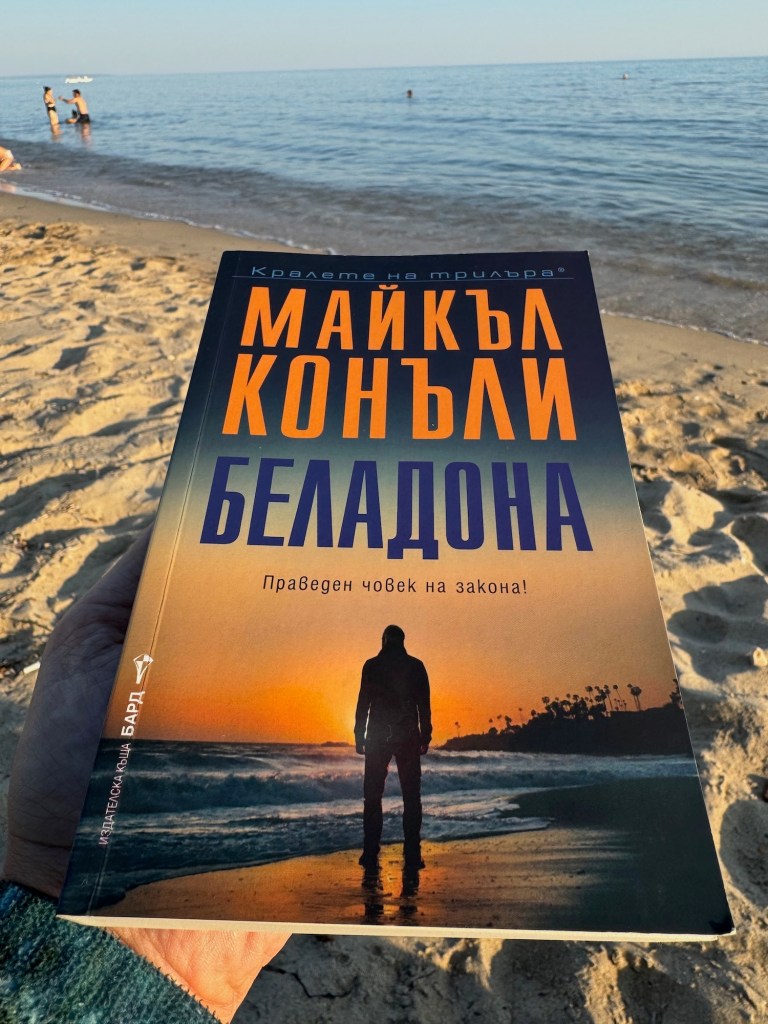
Nightshade by Michael Connelly, Book Review

Michael Connelly is one of my favorite crime/thriller authors. I’ve read almost everything he’s written (probably everything but I’m not sure about one book). He is producing high quality books pretty consistently. However, he has flops. Nightshade is one of the books I did not like.

Los Angeles County Sheriff’s Detective Stilwell has been moved to Catalina Island, after a series of questionable life choices. Within the book, he has three tasks:

  • Investigate the murder of a protected buffalo
  • Get statements from some suspicious character who hit a police officer with a bottle
  • Keep his partner Natasha happy

This is not what he does, so in a sense, he continues with the questionable life choices and is surprising that the police didn’t transfer him to the North Pole. He jumps in to investigate a murder, and of course, one murder leads to another, so there are many murders.

Had the killer or the multiple killers stayed put, none of the book would’ve happened as Detective Stilwell’s entire game is to find clues in the exceptional overreaction by the suspects, giving them away over and over. Remove that and there’s no book. The original clues get compromised or are mostly ignored by the detective. For example, the body found in the beginning of the book – the book itself makes it very clear the first body should’ve been found elsewhere or never found.

Now, Natasha. Detective Stilwell is in love, according to the pages. He will manipulate, lie to, and ignore Natasha “Tash” Dano over and over. His treatment towards her is reckless, irresponsible, and borderline abusive. Although it is completely fine to describe an abusive relationship in a fiction book, the term for what we see is fridging. Fridging is when a character is introduced for the sole purpose of being killed and placed in a fridge, so the detective has business to do. I felt that the female protagonist only exists to increase the difficulty level to Detective Stillwell. The character development for her felt superficial but it is like that for the rest of the characters as well, except maybe the main victim, whose life and dreams we’ll explore in greater depths.

The best part of the book is the cover. It is beautiful and was one of the reasons to read it last week.

I rated Nightshade with 2*/5. One of the stars is a bonus for the cover and the whole Catalina idea. The content is perhaps the worst I’ve read by Michael Connelly.

Books I Read in April

April was not a great month for reading for me. I missed the first 10 days and then read a few short ones for the number. Nevertheless, some mind blowing books came out of it. Few but good.

Best Books

  1. Gideon the Ninth by Tamsyn Muir – the sad story about necromancers who face too much magic and a universe that’s 10K years after the apocalypse. I think some love is lurking in there but it’s not a romance. It’s deeply touching, well written, engaging, interesting, and memorable. It was by far the best book I read this month, and I keep thinking about it.
  2. Careless People by Sarah Wynn-Williams – a former director from Facebook reveals dark secrets from her past work. Mixed feelings here. Her story is awful and at the same time, the genie is not going back to the lamp.
  3. Harrow the Ninth by Tasmyn Muir. A book where the imaginary and the reality are so mixed that I needed Wikipedia to explain the events to me. However, despite the 4*, I feel this book was far more memorable than the next books on the list that I can forget quickly. I plan to get the 3rd part as well but maybe after a break.
  4. The Narrow Road Between Desires – Patrick Rothfuss is a modern classic with his incredible skill of arranging small and tiny events into a larger puzzle. I’d say, a good member of the Cozy Fantasy family.
  5. Cursed by Alex Kosh – 5* but pretty much unavailable anywhere, I was the lucky first reviewer on Goodreads. And also, thematic, it is about ghosts and in line with Gideon, Harrow and the unfortunate sixth book.

Worst Book

  1. Five Broken Blades – ironically, almost identical plot with Gideon the Ninth, which I liked so much. The story is about 6 (no kidding) people trying to assault an immortal king who is both the enemy and the ally. However, unlike Gideon the Ninth, it’s constantly annoying, and none of it makes sense. For example, why 5 blades if it’s about 6 people, and why broken, if nothing is broken? The book doesn’t answer. Maybe the sequel will.

Careless People by Sarah Wynn-Williams, Book Review

Sarah Wynn-Williams wrote a memoir about her times as a very ambitious young executive, working on international policies at Facebook. She was close to but not close with Mark Zuckerberg, Joel Kaplan, Sheryl Sandberg, and Elliot Schrage.

First half of the book describes her work. It was what I hoped to read when I took that book. It describes hard-working people, self-absorbed, ambitious, awkward, making honest mistakes, stupid mistakes, moving on, forgiving. Lots of internal politics, relationships, some favoritism and harassment. I managed to extract a positive idea out of it and wrote a post- Think Wrong, Move Fast and Break Things. I wish the book stopped there and the shocking airplane bed was the last chapter.

The second half is like swimming in a pool full of excrements with an occasional crocodile. All of the mentioned names lose their souls in the pursuit of goals, which seems to be humanly random and randomly human but completely unacceptable. One wants to promote a book probably filled with lies. Another wants to sleep with everyone from the opposite gender using his authority as a leverage. A third wants to be the emperor of Rome but realizes he’s already surpassed that. And all of them show the empathy of a hungry crocodile. But that’s only the beginning of the dreaded second part.

Then Sarah Wynn-Williams goes into details about election meddling, promoting violence and confrontation as an engagement tool, helping the far-right politicians and dictators around the globe because that would allow a better growth for the company, and even accuses Facebook for treason with their activities in China. She describes individual poops from the poop pool.

I knew Facebook is used that way – every time I watch more than 10 Facebook shorts, one will be by a pro-Russian troll account and maybe 3-4 will use other people’s content. They don’t hesitate to block my posts when I link to this blog but have never positively responded to a hate speech report or removed a fraudulent advertisement that I reported to my memories. Their moderation for Bulgaria has always been oddly biased in favor of anti-democratic forces. But the events from the book describe that in a world-level scale, engineered to be that way for money and power.

I don’t know if the book is true. I found Sarah Wynn-Williams’s Senate hearing, trying to get an impression. I can’t quite relate to any of these people, the author, the interviewers but it matches my expectations. It’s a cautionary tale about why the free, independent, and decentralized web is important, why and how the walled gardens are harming our society, and why kids should not be allowed to use social media.

I’m on Facebook, my friends are there. What do I do?

February In Books

I purchased lots of books in February but only read eight. The two best were the two that had been stuck on my unread shelves for months, if not years. I read them to clear space for other books and was pleasantly surprised.

Best

  1. The Fifth Season by N. K. Jemisin – I have to admit I purchased that because the book cover was pretty. The book itself was written in a strange way but it stuck and I think it was the best for the month, although the competition is close. The volcanic Earth where humans can cause earthquakes and volcanic eruptions is quite memorable.
  2. The Wisdom of Crowds by Joe Abercrombie – Abercrombie delivers a lot more of the same in both good and bad sense. The Wisdom of Crowds is mind-blowing but also 750-ish pages, 250 longer than the necessary to be my top pick for the month. Savine dan Glokta doesn’t disappoint.
  3. Nettle & Bone by T. Kingfisher – an excellent short fantasy with a simple idea and a complex magical system about domestic violence, curses, and fairy godmothers. Although a fantastic book and a clear 5*/5, the other two were more impressive. I’ll happily read other works by the same author.

Worst

  • Extremis by Barry Eisler – I gave it 4/5, 2 weeks later I’m ready to adjust it to a solid 3. It was clear what will happen from the first page, and it happened in a slow motion.
  • Operation Star Guest by Lubomir Nikolov – I read the flying saucer book from this post but unlike the other books by the same author, which I frequently award with 5*, this came as sloppy and rushed. We are on a mission to find a flying saucer and contact an alien civilization. What do we do? Worry about food because we didn’t pack any and how to start fire. Yeah, no.

Overall, a good month for reading with a total of 8, five of which got five stars.

Nettle & Bone

Nelson Mandela once said that it always seems impossible until it’s done. This book is a fairy tale about an impossible adventure in which princess Marra seeks to help her sister. The sister is stuck into a forced marriage with a king who is torturing her. He is protected by an immortal and almighty fairy godmother and other less visible forces, like an army, and is untouchable. Marra will start a decades long journey where he’ll find support by people and entities with magical powers. Will they succeed on time? After all, a recurring theme in the book is that you can’t help someone who doesn’t want to be helped.

If I were to compare it to other books, Nettle & Bone is reminiscent of Uprooted by Naomi Novik and the first Witcher novel.

Nettle & Bone is an excellent little fantasy with a simple idea and a complex magical system based on millenias of superstition and fairytales. It’s written in a young adult style but covers adult themes like domestic violence. Not sure how to classify it. Fantasy, I guess.

5*/5