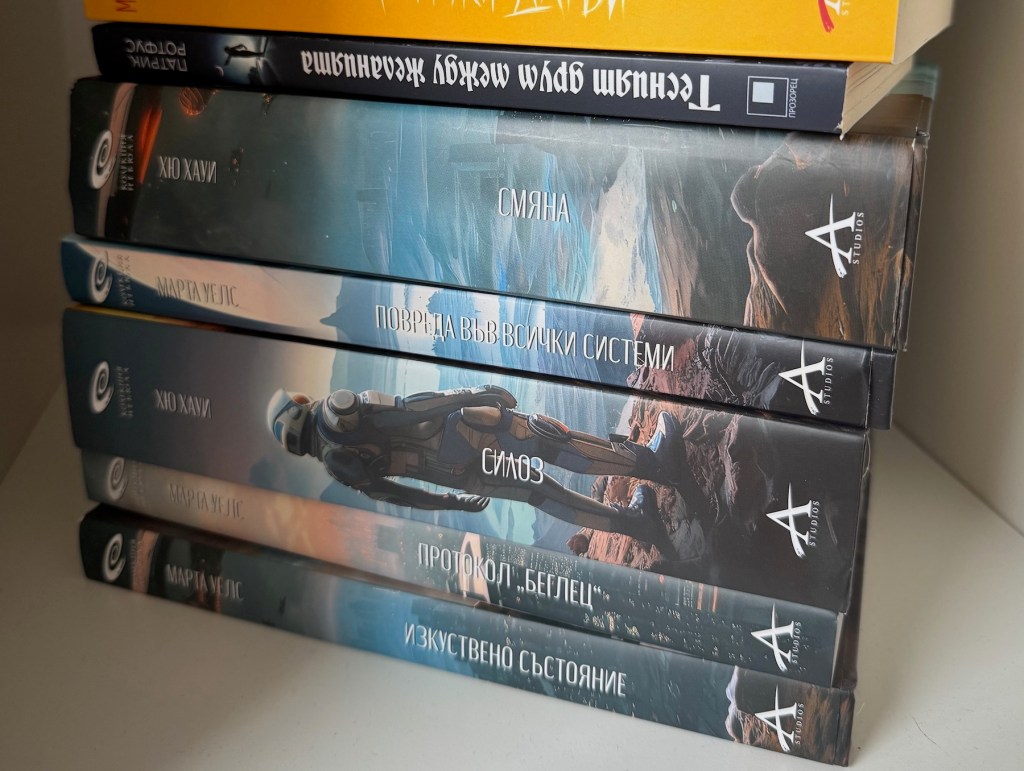
Exit Strategy by Martha Wells

I feel a bit silly reading a book that just turned into a TV show.

In book 4 of the series, the Murderbot flies between space stations and faces several attempts to be stopped. However, it has no clear goal or understanding what’s going on, and it’s also not clear why the rich corporations are trying to stop it. We’ll have to wait more books to reach that clarity. Alien artifacts are involved, so it is promising.

This and the previous sci-fi book I read made me think about something else.

The Murderbot is flying through wormholes. Sten in The Wolf Worlds is also flying through wormholes. Assume a wormhole existed, and I flew from point A to point B through a wormhole. No object in space is stationary. Galaxies move towards gravitational attractors, star clusters orbit around the center of the galaxy, and planets orbit around stars. Flying to the other side of the galaxy through a wormhole means that my spaceship will suddenly be accelerated to incredible speeds, compared to the local objects, speeds from which the deceleration may take years. The spaceships in both books do not address that.

There is no plausible space flight, unlike what we see in true 5* sci-fis like Legion or Project Hail Mary. And if we remove the space flight, this book turns out to be a short cyberpunk novel, similar to Gibson’s world, where a heavily modified human surfs the Internet like if it’s a water slide.

For that, I think I’ll allow myself to score this book 4/5, still a great little adventure. The sci from the sci-fi doesn’t add up, otherwise very nice.

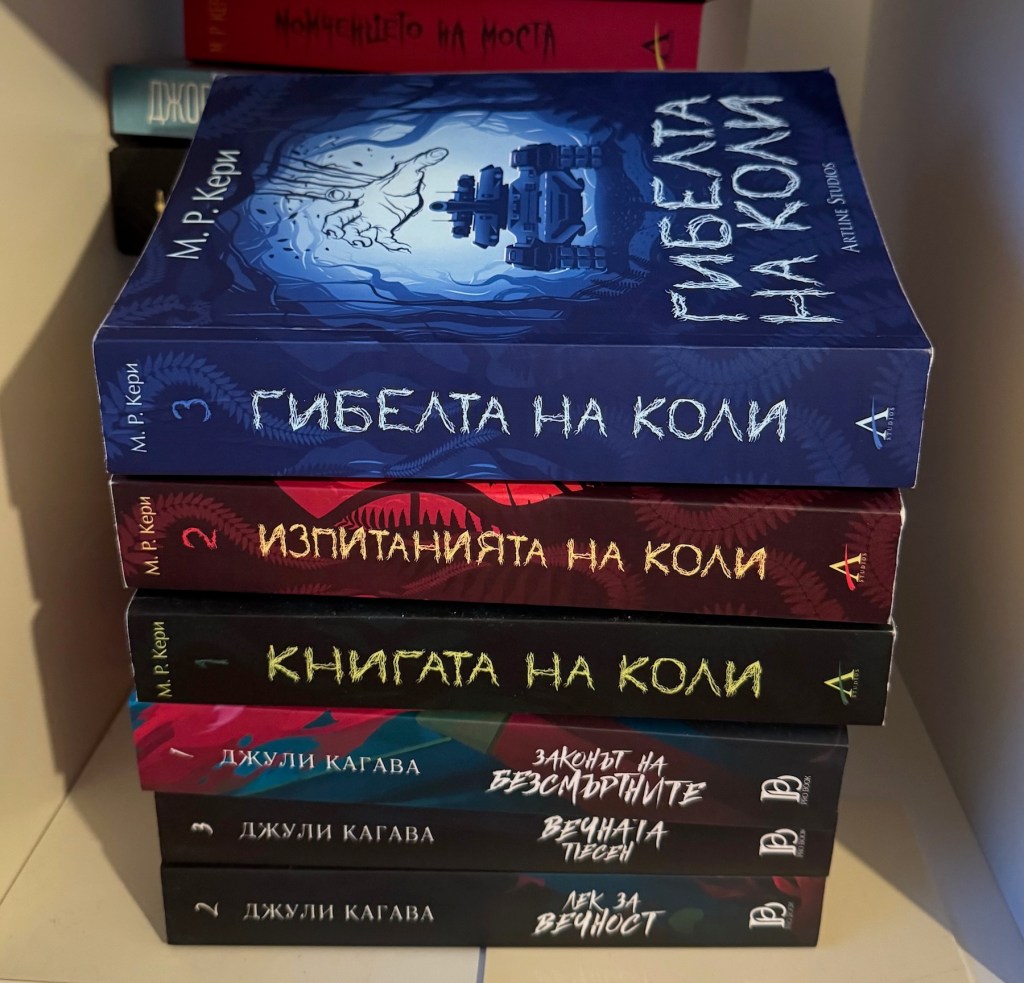
The Fall of Koli by M.R. Carey

I’m sometimes hesitant to complete book series. Some stories are better left open. We need to be thankful to M.R. Carey for closing this one even though objectively, a two-book series would’ve been even better.

The Trials of Koli left us with Koli finding a functioning ship in the ocean. In book three, he has to deal with what this ship represents, which is difficult to imagine. Whatever it is, it will be the key to solving the puzzle in some way, thankfully not as awful as in The Girl with All the Gifts.

I’d say the book is good, worth reading, and an honorable way to end the series. I’m ready for something else, where the world is thriving, and there are no ghosts.

4*/5

Wool & Shift by Hugh Howey

The two big books from this small pile are Wool and Shift. I still don’t have the final, third book about The Silo.

It looks like I’m altering between post-apocalyptic books and fantasies about necromancers. Could it be me or just that writers are currently only succeeding if they imagine a future with simplicity and grave destruction? In the Silo trilogy, humans have obtained the technology to end the world and it was race for who does it first. When rather than if. The second part gives details about the technologies used to destroy the world, and they’re already a bit off from the modern trends.

The main protagonist is Juliette, a 34-year-old master mechanic with a free spirit. Most of book 1 is dedicated to her and it is fantastic – she solves one problem after another. However, book 2 chooses another path. It is about a bunch of secondary characters from book 1 and explains what happened in the past. Although this might be important to completely understand the story, some of the story lines are not pleasant.

Overall, the first part was a solid 5*/5 for me, and the second was a mixed bag of great and not so great stories for an average of 4*/5. Juliette is featured, which is probably the best part of the book.

My May in Books

Wrapping up the month with 8 books.

Best

  • Dragonfired by J. Zachary Pike – rich in ideas, full of intelligent creatures, and an epic conclusion of the trilogy about the dark profits. It has cobolds and everyone is greedy, except maybe Gorm Ingerson.
  • Silo by Hugh Howey – a mechanic has to survive in a plausible post-apocalyptic anti-utopia where all remaining humans are stuck in a bunker and tied in lies. I should’ve blogged a book review about because I really liked it, it had this Andy Weir feel I love in books. However, I never got to it. Maybe I’ll write one once I complete book two, which is already at home.
  • Necromancer by Gordon Dickson – I awarded 3 stars to it but it has an AI that kills all human creativity. It was a great visionary idea for a 1960s book I was surprised to find there, between the future full of old tech. It is one of the main risks I see for humanity when adjusting to the LLM boom.

Worst

  • Think Twice by Harlan Coben – after my repeated failures with Lee Child, I start wondering if I outgrew the entire genre. Jack Reacher turned into Steven Seagal, and now Myron Bolitar and his buddy Win are turning to Paw Patrol. I can’t read another one that silly and think about getting rid of my Harlan Coben shelf like I did with Lee Child. It will open space for gems like the next one.
  • Don’t look back – a gamebook that got a well-deserved average of 2* on Goodreads. It was silly in a very disturbing way.

Both books had a moment where the main protagonist just enters a room, kills 3-4 NPC characters, and leaves the room without ever mentioning that again. I should’ve awarded both with 1* for being disturbing and 0 for their editors, if they had any.

Other

  • The Golem and the Jinni, Diablo, and Bion 3 were fine. I may read the continuation of Diablo because it may have necromancers, the continuation of Bion to support the publisher, and would not read the continuation of the Golem and the Jinni. I think the story concluded well and should remain like that in my mind.

Julie Kagawa in Sofia

I had the opportunity to get a signed copy of Julie Kagawa’s The Immortal Rules. It’s very rare to see a popular writer here in Sofia and I’m thankful for the opportunity to see her for a few moments in person.

She’ll also be giving autographs tomorrow afternoon at the Pro Book booth. It is the first tent looking from the pylons of the National Palace of Culture.