Should I trust my intuition?

We make decisions many times per day. Most of them are quick, automatic, and unimportant. However, some choices can have a dramatic impact over our future. For example, a choice of one university over another can determine the career path. The choice of a partner. Buying one house over another, and particularly the financial aspect of that choice. Buying an old car with cash vs a new with credit. We are made in a way that follows the heart, which is essentially using intuition rather than judgement.

The problem with fast decisions

Our brains have an incredible capacity to produce quick, intuitive, and wrong answers to any problem. Once our action doesn’t solve the problem, we often have a bigger problem and a new chance to try solving it. Repeating the same approach can lead to a chain of bad choices. Feelings appear to be a force multiplier and can make any situation much worse than the original problem.

Is it true and why why is that? One theory that I liked comes from the work of Daniel Kahneman, Thinking Fast and Slow, which I read in 2016. It’s been quoted before on this blog as it’s essential to how I see the world.

The theory is that we are adjusted to living in the bush where a lion can hide and eat us. The intuitive response to anything moving in the bush has to be quick in order to prevent us from being eaten. There’s absolutely no need to have a quick and intuitive response when the car dealership makes an offer to us. In the past, you only make one mistake and you get eaten. In the modern world, the movement in the bush is not a lion.

Kahneman says that our brains have two modes. System 1, Intuition, produces quick and wrong decisions. System 2, slow thinking, can sometimes produce not wrong solutions.

For every complex problem there is an answer that is clear, simple, and wrong.

Another famous book, called Crucial Conversations, explores the area of arguments. The recurring theme is that you won’t drive if you’re drunk. Don’t drive under the influence [of alcohol]. Just like driving, the choice of words during an important conversation can be of lasting consequences. Don’t make important choices under the influence [of emotion]. Our boss wrongs us. Intuitive response? Something with the F word. A quote from the book:

Speak when you are angry and you will make the best speech you will ever regret.

To make the matter worse, not only is the emotional response bad for us, but it’s also predictable on a group level. It gets exploited by politicians, marketers, grifters, and more ordinary humans who’ve learned how to do it. It’s an appeal to emotion, which makes you susceptible to mistakes. Enter that car, hold the wheel, feel the smell. You’ll love it. It can be yours.

Productive emotions have been used by mass media to increase the sales since at least the discovery of the tabloids (Ryan Holiday, Trust me, I’m lying). A fear-mongering title sells the newspaper. Anger, Fear, Greed, Guilt, Lust can make us respond in a certain way as a group. These switch us into System-1 mode and we make decision not in our favor based on intuition. We can be fooled and negatively impact our or our group’s future.

The problem with slow decisions

It not possible to switch our reptile system-1 brain off and it’s also unsafe. Gavin de Becker explores the fear and anger in his book The Gift of Fear. He lists pre-incident indicators in a long list of possible violent outcomes. For example, a group of young men hang out by an pedestrian underpass. One of them peaks at me and my heart drops. It’s the lion in the bush of our modern world. There’s no time, just turn around and run for help.

The book also covers the area of domestic violence and the tendency of people to ignore clear signs of coming attacks. A possible conclusion from that book is that when people show you who they really are, trust them.

Dr. Albert Ellis classifies the underreaction to incidents as Rationalization, one of the three groups of thinking errors from his book How To Keep People From Pushing Your Buttons. The modern day understanding of Rationalization classifies under it a group of behaviors that justify violence and wrongdoing by making up reasons for the violent behaviors where rational reasons do not exist.

So, all in all, ignoring the intuitive response is not good either.

How do I make the difference

Perhaps most decision making in the area of physical safety should use the intuitive brain first. Take ourselves out of danger and turn on the System-2. Anything in the area of purchases, investments, money, work, business, programming, health should use the slow brain. Any classification like that is prone to exceptions but the bare awareness of it can help, particularly when a manipulation tactic is being used on us. A countdown timer. A limited time offer. It’s just one, now or never, “I have five other offers for this apartment”. Yeah, sure you do.

None of the quoted books speaks about guaranteed good decisions. They all speak about probabilities. You can meet someone, say yourself “Oh, I’ll spend my life with them” 15 seconds later, and proceed to actually do it, and have a happy life. It’s not likely but it happens.

Ending with a reminder about an old post. Never miss an opportunity to be kind. The world is harsh and we can’t change it. We can only change our responses to events. Love and kindness make everything more tolerable.

March in Books

I completed 8 books in March.

Best

  • The Book of Koli by M.R. Carey – a teenager leaves the safety of his village to explore a hostile post-apocalyptic world where trees move and eat humans. The trees won’t eat Koli but have managed to do eradicate our society. 5/5
  • Rogue Protocol by Martha Wells – The Murderbot, who is a little bit human and a lot more a bot, moves around to find the truth about something. We don’t remember what exactly but it’s cool and the pages turn themselves quickly.
  • Retribution Falls by Chris Wooding – an airship and its strange crew run around to get through the day. The crew gets involved in battles and death. 4/5
  • The Girl With All the Gifts by M.R. Carey – a zombie apocalypse, followed by more zombie apocalypse, from the point of view of a teenage zombie. She isn’t really threatened by zombies. 4/5

Worst

  • The Cipher by Isabella Maldonado – A tiny FBI agent will face off against a giant serial killer with incredible reflexes, intellect, and combat skills, who has made it his goal to finish her off. The killer is so smart that he constantly streams and provides clues but everything goes through so many servers that it becomes untraceable 🙄. 3/5, barely read it.
  • The Alchemyst – two kids have the same very special gift. We’d expect something like playing a piano, speaking languages, or being good at math? No. They have strong auras. The idea isn’t bad but the book was hard to read. 3/5
  • The Boy on the Bridge by M.R. Carey – DNF. Suffered through about 100 pages with nothing happening. After all, what can happen so much given that the world is over, and then over again in The Girl with All the Gifts. End again? It’s just pointless and whatever the idea is, it doesn’t reveal itself within the first 100 pages. 1/5 DNF. My first DNF for 2025.

Reading Challenge Update

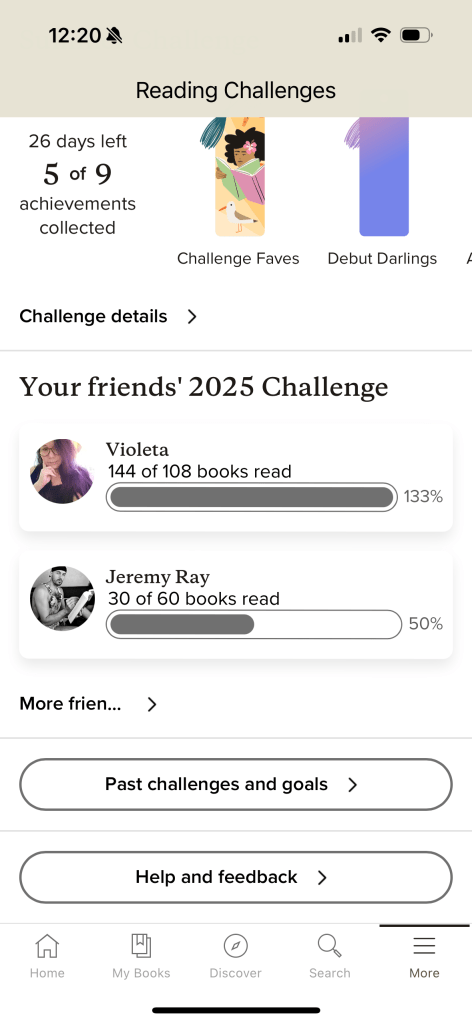
I read 27 books this quarter, a bit less than last year. I still try to read every evening after 10pm but seems to fail on some days. I haven’t been able to find a good new series to make achieving the goal easier. Chris Wooding’s Ketty Jay and Sten were both 4s, and nothing else had enough books to matter.

The Trials of Koli by M.R. Carey, Book Review

I’m not sure how I feel about M. R. Carey’s work. I purchased five books by this author. Two are fantastic 5 sci-fi, one was a 1 ⭐ DNF. Now comes The Trials of Koli, my fourth out of five.

Published in 2014, it’s a book about the survivors of a terrible war that changed the ecosystem. The trees are on a hunt for people, the animals are insanely dangerous, and old drones are still flying and killing people. The much larger populations of the past couldn’t resist all of that but the barely existing current populations seems to holding, although still in a decline. It helps that most of the old drones broke down or ran out of ammo.

The book is engaging, the trope is a form of the leaving-the-small-village-to-discover-the-world, well known from LOTR, The Wheel of Time, and so on. The type of demons out there are not unheard of either, we’ve seen them in The Mist, and The Finisher, and maybe even The Day of the Triffids.

What makes this book unique? Not sure, maybe nothing. But it is very interesting and sucks you in, you want to have more of it, and when you reach the end, you want to start reading the continuation immediately.

The two main characters, Koli and Spinner, are well-developed, though some of the supporting cast feels less successful. The story features two AI demigods—had they existed 200–300 years earlier, they might have either prevented the apocalypse or ensured its total devastation, leaving no survivors. In that sense, The Trials of Koli falls short when compared to The Book of Koli and the more recent Infinity Gate.

That’s enough for 4/5. Looking forward to reading the final chapter.

The Book of Koli by M.R. Carey, Book Review

A post-apocalyptic world where trees have come to life and eat people. Something like a mix of The Mist, The Day of the Triffids, and the story of The Finisher Vega Jane. Koli is a kid forced by circumstances and ambition to take the path through the man-eating forests.

In King’s The Mist, the story ends before it even begins. In The Day of the Triffids, the triffids are completely harmless and only dangerous because all the people are blind. The Finisher is boring and lacks any intrigue. Koli is not boring, the story doesn’t end prematurely, and the trees are organized and man-eating, while the problems, in general, are unsolvable.

Of course, just like in The Girl with All the Gifts by M.R. Carey, none of the details in this story make any sense. If you want an apocalypse that is logical—this one isn’t. If you’re looking for a happy ending—that’s not possible. Everything ended a long time ago, and all the action is just ripples in a sandy desert where nothing living remains.

Despite that, The Book of Koli is at least a full star ahead of The Day of the Triffids and The Finisher, and that’s no small accomplishment. Koli has character and will probably make it at least 200 miles from the starting point, leaving behind a trail of blood and horror.

5*/5 – it’s only the second 5* book I read this month out of seven.

Rogue Protocol by Martha Wells

I got stuck with The Boy on the Bridge, a deeply uninteresting book by M. R. Carey. The more time passed, the less time I spent reading, and I ended up not reading at all for days.

A breath of fresh air in whole the reader block was Rogue Protocol by Martha Wells. As one of the Goodreads reviews says, the Murderbot can have a mission to rescue kittens and it would still be interesting.

Rogue Protocol is about finding evidence against the corporation GrayCris. Bot will go to a space station that’s haunted and scary, and it has no armor. We have some Alien moments but of course, Bot is no weakling. It’s clear who should scream in space.

If there’s one downside of the whole series, it’s that the books are so short. The top three are the ones published in Bulgarian. Their total volume is about equal to the red book under them, which is The Boy on the Bridge by M. R. Carey, which got me stuck.

I’m still stuck though. I don’t want to get back to the red book.