In Bulgaria’s olden days, Boza was a popular drink for kids. Ours was a fermented, slightly alcoholic beverage made from cereals. It’s a high-calorie drink, and I guess we were fed with it so we’d grow up faster.
It fell out of fashion, and by the early 2000s I’d stopped seeing it in fast-food places, almost fully replaced by Ayran and Coca-Cola.
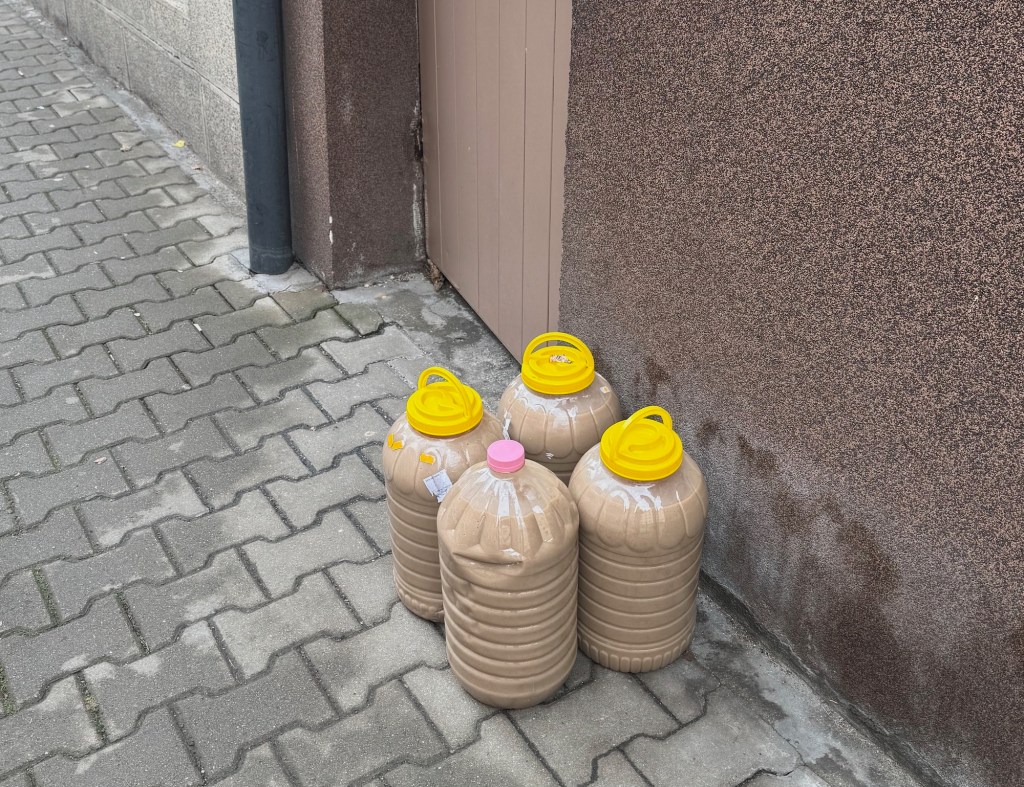
So imagine my surprise when I saw the nearby confectionery loading up on these giant bottles of Boza. They must be serving it by the glass. But it’s usually very thick, almost cream-like. how do they even fill glasses from these 10-liter bottles? Is it fermented? The one from my childhood wouldn’t even last a full day. I doubt these will be consumed within a day of delivery.
I see you’re reading these so, allow me to take us on a journey back to 1986. Turn on the imaginary Sepia filter, because it’s both time and location appropriate.
Football was very big at the time, partially because our team played fine, but also because we didn’t have much else to do. Kids would collect photos of strong teams, cut out of newspapers, and adults would gather near the park to agressively discuss games. We also played it, many of us, even some fathers.
1986 was a World Cup year. The same World Cup that Maradona dominated and eventually single-handedly decided by scoring a dubious goal with an arm, the Hand of God, as he said.
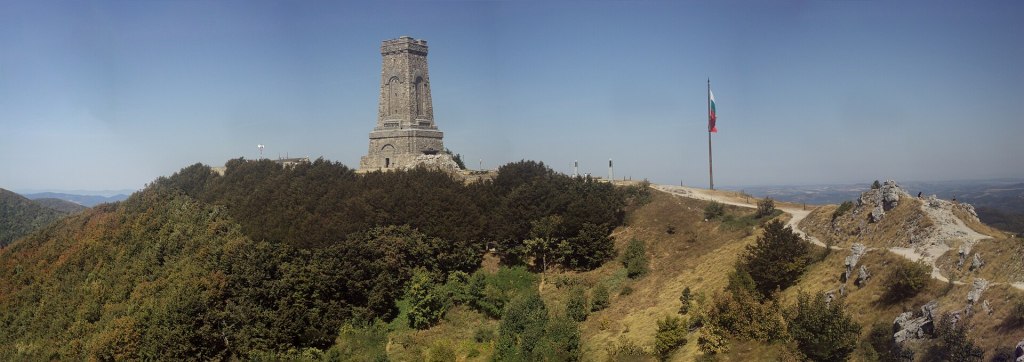
The World Cup was during the summer break, and we were not at home. My grandfather booked a 20-day vacation with the kids in a mountain hut-like “resort”, called Eagle’s Nest, where there was supposed to be a TV. I was excited to go there because it was close to two very famous places – Shipka and Buzludzha.
However, to everyone’s surprise, Eagle’s Nest was affected by the electricity shortage, common for the Communist Bulgaria. It had no power most of the time. No electricity meant no TV, and no World Cup. We had other fun things to do, like preparing oil lamps.
Thankfully, the adults discovered that the nearby hut Temenuga somehow solved the problem, perhaps had a generator. Their TV worked. We could be their guests.
So every day with games, a large group of adults of all ages, their children and grandchildren, would walk to the other hut, now closed, to watch the games. We would gather around the CRT TV, and watch players with colorful jerseys, exotic stadiums, and listen to commentary that sounds like coming from a tube.
Bulgaria drew two games and lost to Argentina, which made the championship a bit less interesting but then we rooted for Argentina because, if we lost, at least we lost to the World Champion.
I had lots of fun at these late evening trips through the forest. My memories for the individual games are gone. But the forest stayed with me. I’m sure I’ll find the paths between Shipka, Eagle’s Nest, Temenuga, and Buzludzha even today. I can close my eyes and be there.
It took decades for me to discover that the World Cup was a month after the Chernobyl disaster and we should’ve stayed inside. The dark forest wasn’t safe.
My kids go to school with backpacks. Their backpacks tend to be large and capable capable of carrying over 10kg of weight. The modern education system in Bulgaria relies on thick, glossy textbooks and lots of printed material, which makes them heavy. I also go everywhere with a large backpack, full of necessary items.
Back in the 80s, as true commies, we had another solution to the problem of how to bring all of our items to school, apart from not having much to carry. We used nylon bags like the one below (found for sale on a local marketplace site). The more colorful it was, the better. I had the exact same as the screenshot, and I’m pretty sure it lasted almost a year. Changed many while in school, and wasn’t picky.
Of course, they couldn’t carry 10 kg like modern backpacks, but they didn’t need to. We had far fewer schoolbooks and used light textbooks. We also didn’t need to carry everything to class. Books were usually only needed at home, for the brave ones who ever opened them. I don’t think many of my classmates did.
As for the images on the bags, foreign cigarette brands were the most popular. The more colorful and unfamiliar, the better. These bags were worth serious money and could be purchased from the flea market “Bitaka”. Getting a new one was a big event. I just don’t see any dopamine high in modern kids’ lives that’s similar to this experience, perhaps getting an iPhone.
Speaking of cigarette brands and why Marlboro of all things. We grew up with access to smoking. My classmates smoked since a very young age, probably under 10. However, the cigarettes available were local, and everyone wanted the foreign, which weren’t officially available anywhere. So, Marlboro, Camel, JPS and such were primarily imported by tourists, truck drivers, and visitors from the West. Even if you could get your hands on an empty pack, it still had value. I found 10-ish such packs thrown in the wild as trash and kept them in a glass display cabinet. You could trade them with other kids. And the packs were pretty, unlike the ugly things from the modern times, covered with photos of injuries and dying people.
So the true “socialist look” of the 80s was cheap, fake jeans top to bottom, white local leather sneakers, and a Marlboro bag in hand.
This post is part of the series about communist Bulgaria between 1979 and 1989. I already wrote posts about my cat and about ice cream. Now it’s time for a revenge trope.
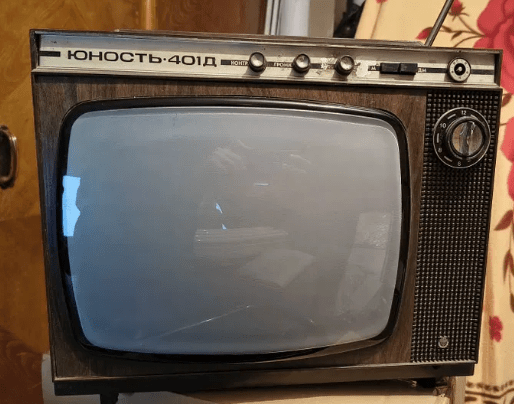
My parents had a Junost TV. This beast is 12.2″, black and white. It had two inputs for antenna cables on the back.
Bulgaria during my childhood had two TV stations, called First and Second Program. Both were part-time: they aired for 5–6 hours on workdays and full days (8 am to midnight) on weekends, with the Second Program being shorter. Both had maybe 1–2 watchable kids’ movies per week, and maybe another 1–2 watchable regular movies, usually on Saturday or Sunday. You had to switch between the channels to find the good stuff, and we always had the TV program published in the newspaper to guide us through this, so we didn’t miss anything foreign.
But I wanted to talk about switching between channels.
The way switching with this TV worked was:
You pulled out the antenna cable on the back of the TV from one of the sockets and put it into the other
Then you pushed a button indicating which antenna was in use
And then this big rotary dial, I think it was also used to click a few times, but maybe not. Why would it exist otherwise?
Whatever the ritual was, I mastered it quickly and did it thousands of times.
Then my parents and grandparents got color TVs and moved the Junost to the kitchen. My parents didn’t let me touch their TV, but my grandparents didn’t mind. My grandfather was nearly blind and couldn’t do it himself, so I had the right kind of encouragement. These TVs had a more complicated system with stored channels that was essentially the same dial and the same button, multiplied by 16 stored “channels” through 16 dials.
So, by the end of the 80s, I was the master of setting up TVs to play First Program, Second Program, the Russian TV, and, in some parts of the country, the Serbian TV. Now I’ll have a short break, and please don’t switch the channel.
The way people went on vacation during communism and shortly after was mostly through “cards” provided by their employer or another institution. My parents got a card for 20 days in the mountains, in a health resort with mineral water in Velingrad. By health resort, think of a 4-story building with modest rooms, with four single beds each, a canteen on the ground floor, baths with a pool in the basement, and a TV area on the second floor. The TV had 30-ish soft chairs arranged in front of it. The area was comfy, and the kids spent lots of time playing there. Given that TV mostly aired in the afternoon and evening, there were no people watching TV before, let’s say, 4 pm.
It’s a weekend day, and the kids’ movie will be at 3 or 4, on channel one. An hour later, an episode of some soap opera will air on channel two. The TV is an older model with a dial, a cable that needs manual moving, and a button that needs to be pushed to switch the antenna, not that much different than our old Junost. So all the old people were already there by 2, even before our kids’ episode, so they could get good seats for the soap opera later. There weren’t enough seats, but kids would leave after our movie, freeing some.
So when the time came, the king of the dial executed the clicking, pulling, and rolling sequence to change the channel so the kids’ show would show up. By the time I was done, my seat was taken. “Hi, I was sitting here?” “Oh, you’re so young, you can sit on the floor.” Uh. True. I can. I sat there, and when the kids’ show was over, I ran back to our room.
One hour later there was a revolt in the TV area. None of the adults had any clue how to switch the channel. The TV got all messed up. The adults figured out that I was upset because someone took my seat and that’s why I left the area without switching the channel. So they freed it, and sent a delegation of a few friendly grandmothers to our room to invite me to take my seat back, and please switch the channel. I switched it two minutes before their episode started. Not sure if any lessons were learned but the kids didn’t have problems with watching our afternoon episodes after that.
I’m mildly embarrassed by the story but we can’t change the past.
In a brief moment of insanity, I went over the strings for WordPress Mobile iOS and translated most of them. They are getting more and more difficult as the translation percentage approaches 100%. No surprise there that the people maintaining the Canadian language were unable to translate the final 2% 😜.
I may be able to get that number to 98 as well but 100 looks out of reach. Some strings in the app mean absolutely nothing to me and even the translations to other languages make no sense. I’ll post an update once the next Jetpack Mobile appears with these translations. Really curious to see if I got it sufficiently right to make the UI feel Bulgarian. Bulgarian has lots of gendered words, transliterated terminology, plurals where one expects singulars and so on.



 Veselin.blog
