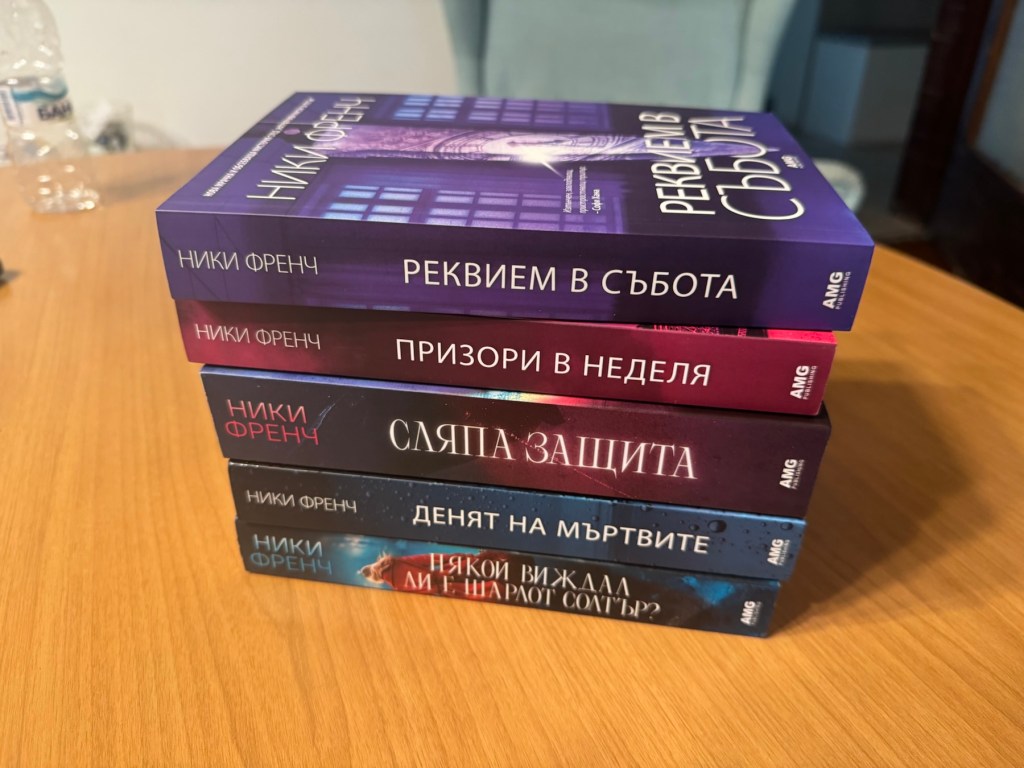
I’m reading the series about Frieda Klein by Nicci French.
It’s a series of 8 books, 7 named after days of week, and one final. Frieda is a psychologist with a medical degree who always has a murder case to solve. She has the persistence of Harry Bosch and uses intuition and advanced questioning to untangle the ball of lies in each book.
The only downside of the series is that it has main antagonists who remain untouched over the series, like some kind of comic book supervillains.
I already finished the first 6 books of the series, having 2 left, and a few more with other protagonists. I gave 5*/5 to 5 of the 6 books and 4*/5 to one, which is pretty high for a series like that.
The smart homicide detective Naia Thulin has to supervise her colleague Hess, who messed up at Europol. They are faced with a case involving a serial killer who leaves rivers of blood and signature little chestnut figurines.
The book is engaging, well-written, but at the same time unnecessarily gory and disgusting. The main characters are repeatedly praised for being intelligent and brilliant, yet they constantly make silly mistakes that reek of foolishness and overconfidence. Real police officers probably make similar errors, but sometimes it becomes too much. Some of the mistakes feel like they’re straight out of a comedy horror movie—like when someone sits in front of a slowly moving steamroller for 15 minutes without taking the one necessary step to avoid getting hit.
The style is a mix of Chris Carter’s blood-soaked descriptions and the demigod hidden villain trope from The Mentalist. The Chestnut Man is excessively elusive, like Red John, but slightly more believable. His motivation is fully revealed and obvious almost from the beginning of the book. In this regard, The Mentalist falls short. Also, Hess is nowhere near as gifted as his TV counterpart, which makes the story far more interesting.
Naia Tulin is supposedly the lead character, but overall, Hess gets more page time and does more of the actual investigating.
Objectively, I’d rate the book around a 4.5—about 150–200 pages longer than it needed to be for a solid 5. What I didn’t like doesn’t make it a bad book, just slightly incompatible with my tastes.
I’d read other books by this author but maybe not right now.
A Deadly Influence is a crime thriller about Abby Mullen, a hostage negotiator assisting with a kidnapping case. Somehow, the kidnapping is linked to a cult. Abby Mullen grew up in a cult and is still haunted by the massacre that brought it to an end.
Overall, the book is fantastic—well-written, unpredictable, and somewhat logical. I don’t often read fiction about events that could actually happen.
The only issue was that the publisher used a very tiny font size to save from paper. It was painful to read. They squished a 450-page book into 300 pages.
3 people died over the last years in a small but flourishing Australian town. It’s all written off as accidents but a body is missing and Aaron Falk will start digging. Most of the book it’s not even clear he’s investigating. He doesn’t do much other than enjoy the hospitality of his friends, and whenever he notices something, the writer doesn’t tell us what. However, he’ll find clues and solve all of the cases. It’s all hidden in front of our eyes.
The big issue? This town is way too good. Can Aaron go back to the big city as a federal agent after seeing how all these people live?
I give it 4*/5 and despite the sub-optimal score, I enjoyed it and would read a continuation if one is ever written.
The shelf naturally formed with other low-stress books like Travis Baldree’s Legends and Lattes, two Brandon Sandersons and 3 gamebooks. I have some reading ahead of me.
When I write book reviews, I often mention the level of realism. Imagine a scale from 0 to 10. 0 is complete BS, things that can’t happen, heroes that can’t exist, and a path from start to finish that’s like a fairy tale. 10 is a boring autobiography by a boring person who doesn’t lie to put themselves in a good light. Realism is not required to have fun, a good story can be 0 or 10 on the scale.
Let’s rank some pop culture on the realism scale.
0: Avengers: End Game – a complete disconnect with reality, written entirely to be like that. The characters are only visually human
1: Star Wars Episodes 4-6 – a complete disconnect with reality but some of the characters make sense, like Jabba the Hutt. I’d put here most of the fantasy I read like Thraxas, Joe Abercrombie, Raymond Feist, the LOTR universe, Robin Hobb, Brandon Sanderson, Harry Potter
2: Matthew Reilly, often featured here, writes about cars flying at a speed of 700km/h and crashing with no harm. Not far off from F1, although the characters are inhuman. I feel like he deserves the number 2 spot for himself.
3: Stephen King plugs in plausible humans and outcomes in impossible fantasy settings. His work is incredible and diverse work but let’s average it to 3. 3 would be fantasy with a possible story or with possible characters but maybe not both
4: The Foundation, Andy Weir – the classic sci-fi where the people look real and the events could eventually happen
5: Song of Fire and Ice – lots of that happened in medieval times, or at least people imagined it did. Not the dragon eggs but the other stuff that fills 95% of the pages. Realistic fantasy, dystopia
6: Alexandre Dumas. The Three Musketeers has a solid foundation in reality and the characters are likely based on real humans, perhaps from later periods
7: Cinderella. That probably happened and was later decorated with some magic
8: OMG ❤️, Stephanie Plum, Harry Bosch’s universe, Harlan Coben, the true crime stories
9: Historical fiction, books like Wolf Hall that are as connected to the real events as they could be, autobiographies with some level of commerce
10: Boring autobiographies
On that scale, Jane Harper enters the territory of boring autobiographies. There’s “No way” and “Oh, that’s why, yeah, damn”. Reading it is like reading the continuation of Cinderella, the happily ever after where the prince turned into a king, and the king was drunk and cheated.
So, I won’t tell you what the Force of Nature is about, but it’s sad and depressing in a beautiful way. Do not touch if you want an orthodox crime story.


 Veselin.blog