Found this gem on Facebook. Fresh humor on yellow pages that barely hold. I enjoyed it very much. Not sure if it can endure another read without starting to fall apart. But the book was cool, well written, short, and brought me good memories.
I finished the monumental Six of Crows by Leigh Bardugo yesterday and my original plan was to blog about it today but then I read the above book to fix the my tastebuds. The Goblins deserve a post, and the Six of Crows can be left to less critical book bloggers.
I bought this book because I wanted to read something like Terry Pratchett or Douglas Adams. The book wasn’t that. It’s a very serious epic fantasy, closer to George R.R. Martin than Pratchett.
Gorm Ingerson is a dwarf and a fallen hero, who abandoned his mission years ago. Once an unstoppable slayer of monsters, he now lives under the radar of the major treasure-hunting enterprises. He must join forces with others like him to chase stolen, powerful artifacts and return them to an owner of their choosing.
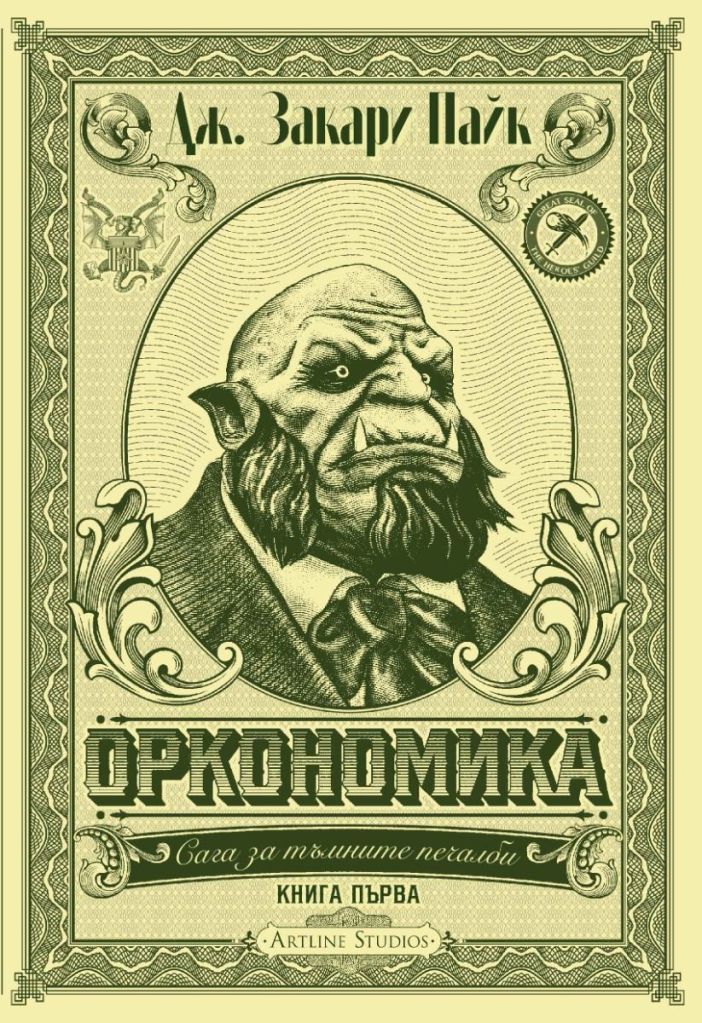
While the mission is so-so, the world is wow. It’s a boiling can of worms that can’t possibly exist. J. Zachary Pike describes at least 20 smart humanoid species with some dominant over the others, like a fantasy version of Star Wars. The issue is that most of these races would naturally become endangered unless they have some form of habitat isolation, which they don’t. Here’s scientific proof:
The Witcher series has a similar setup with all the possible folklore and Tolkienist fantasy races. Humans meticulously exterminate the “monsters”, making the Witchers less and less needed
LOTR has habitat isolation with different races living in separate areas and not mixing much, apart from occasional wars to make the story worth telling
Discworld has a situation in which the races are not fighting with each other, somehow evolved together
Song of Fire and Ice has isolation but also has Dragons that are endangered species
Raymond Feist’s Midkemia world has the evil Valheru, which were wiped out from the universe before the books even began
In Orconomics the mess of intelligent fantasy species was created by magic and the Discworld-like mixture suffers from the Witcher-like problems. Most races are endangered and suffer from a Moriori-style future. The book doesn’t offer a plausible explanation for why or how these species still exist.
A well-written and engaging book with many charming characters, though it’s grimdark and lacks humor. The world is both the best and the worst part of it.
Viv is a lady orc, giant and strong. She wants to retire from the bounty-hunting business and open a coffee shop. There will be challenges, mainly from doors to the past that are not closed.
This book is written with the intent of being sweet. The author got tired of Epic Fantasy and wrote an un-epic Fantasy. There’s nothing dramatic in opening a coffee shop. It’s like the first Thraxas, just that the city of Thule is far more ordered than Turai. It feels like an American suburban area.
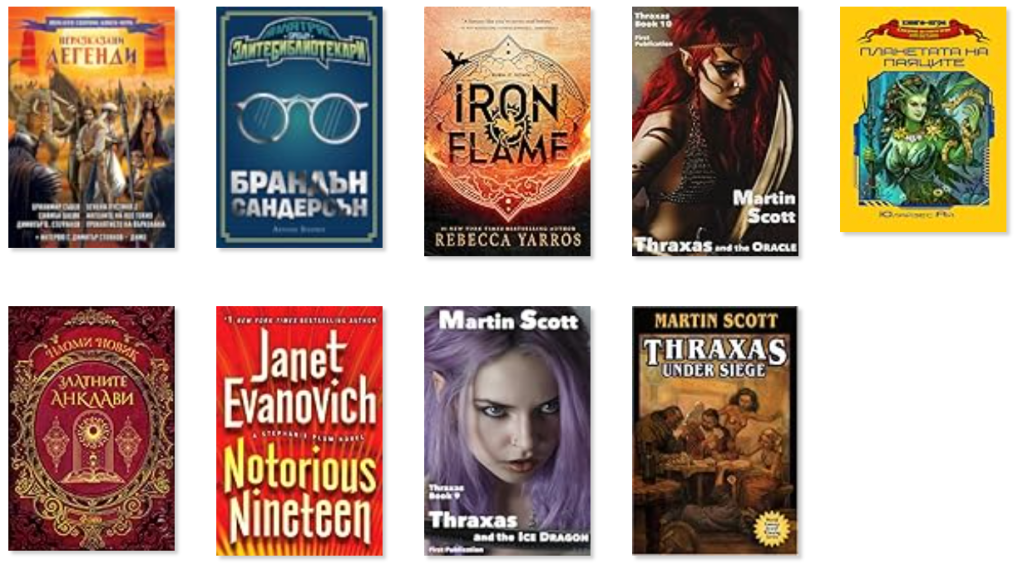
Thraxas Under Siege. It’s 5/5 and overall great. “Thraxas and the Ice Dragon” and “Thraxas and the Oracle” are not far behind. Turai is about to fall and Thraxas will have to help Lisutaris any way he can, which varies between failing miserably and saving the day. Makri is not far as well.
Notorious Nineteen by Janet Evanovich and The Golden Enclaves by Naomi Novik were also good reads and 5/5s. The Golden Enclaves concluded the Scholomanse series and explained the Maw-Mouths. Notorious Nineteen was a nice bubblegum. Stephanie Plum doesn’t age.
Worst books for the month
Alcatraz Versus the Evil Librarians – a parody where the author talks to the reader from the author’s position. It wasn’t fun in the way “The Carpet People” was. The only reason to complete it was my respect for Brandon Sanderson and the hope that Book 2 would be better. Brandon Sanderson is known to have some flops. I gave it a fair 3/5 because it was readable.
Iron Flame – the sequel to The Fourth Wing had 760 pages of people talking and moving around in a world that makes no sense but closely resembles other fantasy worlds that do. I gave it 4/5 because it was still interesting, but objectively, it was worse than Alcatraz. Brandon Sanderson built a unique steampunk magical system that could sustain excellent sequels, which isn’t the case with Iron Flame.
Honorable Mentions
I read one standalone gamebook and one collection of 3 gamebooks. The local community keeps printing these, and the artwork inside is above and beyond. Some adults are having fun and publishing stuff because they can. None of the writing is Brandon Sanderson’s quality but it carries the spirit of the 80s and 90s.
I finished this monumental work by Rebecca Yarros and have mixed feelings. I considered not writing a review but at the same time the book is is divisive and engaging. So here are my thoughts. Let’s start with the good. It’s readable and I read it!
The magic system is not good and it doesn’t get better in this part of the series. The nagging feeling that the system was borrowed by Naomi Novik remained, even though it’s likely unfair.
Naomi Novik develops a Mana/Malia magic system in the Scholomance series, which I recently reviewed and appreciated highly. The Mana is a magical energy that’s earned by work and owned by life. The Malia is mana stolen from others, often by draining their life. Rebecca Yaros uses the same system but doesn’t use the names Mana and Malia. Good energy comes through Dragons and bad energy – from Earth directly, no Dragons. This becomes a critical problem in book 2 as the main conflict in the book is between the magicians who use dragons and those who don’t. But why are the dragon-users good? They don’t strike to be particularly kind or merciful. What generates the Dragon mana? Is it dead sheep?
Naomi Novik develops a dragon rider university in the series Temreire and chases the history of dragons, how they fly, how they fight, how they eat, what they eat, numbers, shepherds, fields, cows, and so on. Rebecca Yarros drops “I’ll eat a flock of sheep” in book 1, and “he moved a flock of sheep to the valley” in book 2. What we get instead is the description of how baby dragons sleep for months and grow while sleeping. I wish those baby dragons at least ate some food like baby birds.
I still found it interesting despite these serious flaws. The book is engaging in the way Matthew Reilly writes. Yeah, there are dragons, which make no sense. They are connected to humans for no reason, generate unlimited energy with no source, and the love story exists despite the constant lies and intolerable deception by the main male protagonist. But it is still a page-turner. I might even consider reading the third part, although it won’t be high on the list.



 Veselin.blog