Books I Read in April

April was not a great month for reading for me. I missed the first 10 days and then read a few short ones for the number. Nevertheless, some mind blowing books came out of it. Few but good.

Best Books

  1. Gideon the Ninth by Tamsyn Muir – the sad story about necromancers who face too much magic and a universe that’s 10K years after the apocalypse. I think some love is lurking in there but it’s not a romance. It’s deeply touching, well written, engaging, interesting, and memorable. It was by far the best book I read this month, and I keep thinking about it.
  2. Careless People by Sarah Wynn-Williams – a former director from Facebook reveals dark secrets from her past work. Mixed feelings here. Her story is awful and at the same time, the genie is not going back to the lamp.
  3. Harrow the Ninth by Tasmyn Muir. A book where the imaginary and the reality are so mixed that I needed Wikipedia to explain the events to me. However, despite the 4*, I feel this book was far more memorable than the next books on the list that I can forget quickly. I plan to get the 3rd part as well but maybe after a break.
  4. The Narrow Road Between Desires – Patrick Rothfuss is a modern classic with his incredible skill of arranging small and tiny events into a larger puzzle. I’d say, a good member of the Cozy Fantasy family.
  5. Cursed by Alex Kosh – 5* but pretty much unavailable anywhere, I was the lucky first reviewer on Goodreads. And also, thematic, it is about ghosts and in line with Gideon, Harrow and the unfortunate sixth book.

Worst Book

  1. Five Broken Blades – ironically, almost identical plot with Gideon the Ninth, which I liked so much. The story is about 6 (no kidding) people trying to assault an immortal king who is both the enemy and the ally. However, unlike Gideon the Ninth, it’s constantly annoying, and none of it makes sense. For example, why 5 blades if it’s about 6 people, and why broken, if nothing is broken? The book doesn’t answer. Maybe the sequel will.

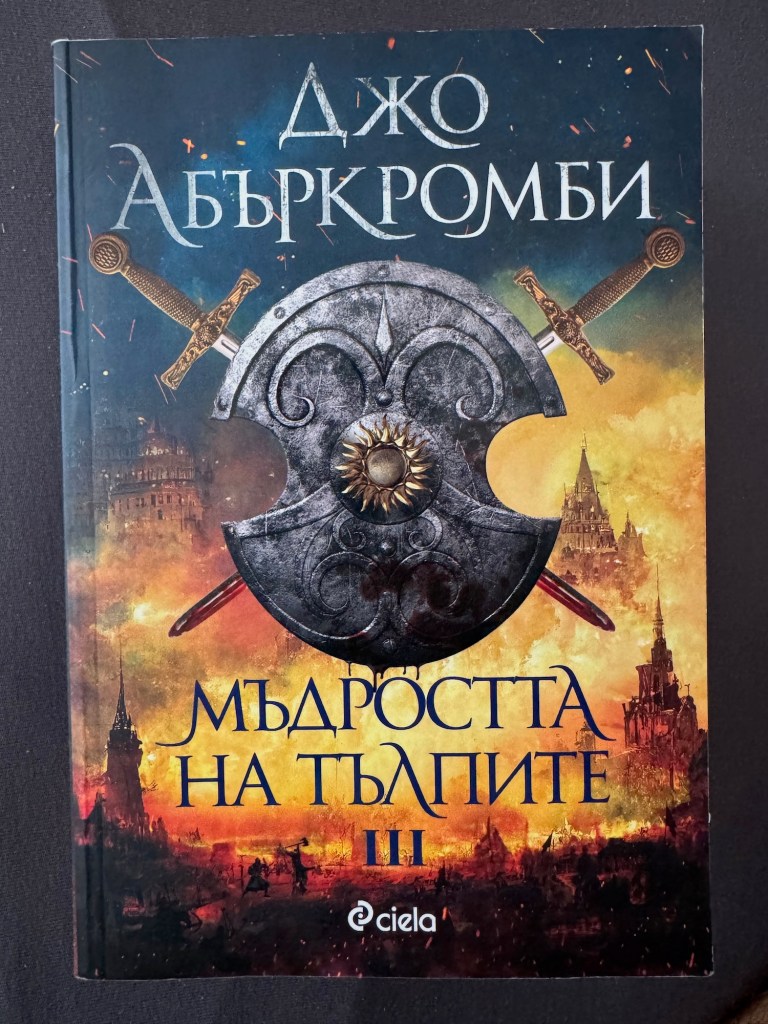
The Wisdom of Crowds by Joe Abercrombie, Book Review

The book is long. It’s as long as least three different books intertwined with each other. It ends with a full novella after it seems to be already over. The characters drop memorable wisdom, full of logic, all the time. I don’t remember them exactly, but you get the idea—those kinds of insights. About the right moment, survival, and common sense in everything.

The revolution is vividly described, resembling the Bolshevik Revolution, the purges after World War II, and the Great Bourgeois Revolution from a more distant past. There is a lot of bloodshed, and it’s tragic. Somehow, the inquisitors from the previous regime are at the heart of it because the big change can’t go that deep.

I recently published a post which featured Savine dan Glokta as one of the most badass female fictional characters. She’s the only likable person in The Wisdom of Crowds. She would try to make the right things, although not too hard. After all, according to almost everyone in the book, survival is more important than fairness. Those who believe otherwise tend to leave the series quickly.

I’d say Joe Abercrombie managed to surprise me with his long-term planning because the seeds of this story were planted thousands of pages earlier. The format breaks away from the pattern of the previous ten or so books. In my opinion, this final installment—at least for now—is the best. Leaves a lasting memory and makes you think.

5*/5

The Chesnut Man by Søren Sveistrup

A Chesnut Man

The smart homicide detective Naia Thulin has to supervise her colleague Hess, who messed up at Europol. They are faced with a case involving a serial killer who leaves rivers of blood and signature little chestnut figurines.

The book is engaging, well-written, but at the same time unnecessarily gory and disgusting. The main characters are repeatedly praised for being intelligent and brilliant, yet they constantly make silly mistakes that reek of foolishness and overconfidence. Real police officers probably make similar errors, but sometimes it becomes too much. Some of the mistakes feel like they’re straight out of a comedy horror movie—like when someone sits in front of a slowly moving steamroller for 15 minutes without taking the one necessary step to avoid getting hit.

The style is a mix of Chris Carter’s blood-soaked descriptions and the demigod hidden villain trope from The Mentalist. The Chestnut Man is excessively elusive, like Red John, but slightly more believable. His motivation is fully revealed and obvious almost from the beginning of the book. In this regard, The Mentalist falls short. Also, Hess is nowhere near as gifted as his TV counterpart, which makes the story far more interesting.

Naia Tulin is supposedly the lead character, but overall, Hess gets more page time and does more of the actual investigating.

Objectively, I’d rate the book around a 4.5—about 150–200 pages longer than it needed to be for a solid 5. What I didn’t like doesn’t make it a bad book, just slightly incompatible with my tastes.

I’d read other books by this author but maybe not right now.

Annie Bot by Sierra Greer, Book Review

We have to start imagining a world in which sentient robots exist.

We’ve had I, Robot and R. Daneel Olivaw. We now have Annie Bot. Lots of others in between. I read about a smart spaceship not long ago (We Are Legion). The main issue I have with all these books is that the robots are really immortal humans with some computer assistance.

Sierra Greer asks the question – what will a sentient robot be first used for? There are two obvious answers, weapons and sex toys. She starts her exploration with the unlikely choice. Annie Bot is a sentient sex toy. What happens is as likely as the movies with highly intelligent dogs. A sentient robot will not be that. However, an imprisoned human in a robot body can be that. We’ve had enough Mechanical Turks already – androids being remotely controlled by humans – to make that theory likely.

So is Annie Bot a a sentient robot or a human, imprisoned in a robot body? Sierra Greer leaves that question open to interpretation.

I give a 5*/5. The book is disturbing, it’s terrifying that this could be done one day.

We Are Legion By Dennis E. Taylor, Book Review

“We Are Legion” is an Expanse style space opera by Dennis E. Taylor. This was the first book by Dennis Taylor I read. Pleasantly surprised by how good it was.

Bob is turned into a space ship who can replicate and travel with speeds close to the speed of light. Humans cannot withstand this type of acceleration but Bob is a spaceship, not a human. This innovation is so radical and fundamentally different for Earth that hell breaks loose. Bob tries hard to recreate Star Trek for the good of humanity but the humanity isn’t necessarily ready.

I’ve not had such a wow moment with a science fiction novel since Andy Weir’s Project Hail Mary. “We Are Legion” is without a doubt one of the best books I read in 2024.

5*/5

Here’s also a song that features “We Are Legion”. I find it appropriate to describe the book.