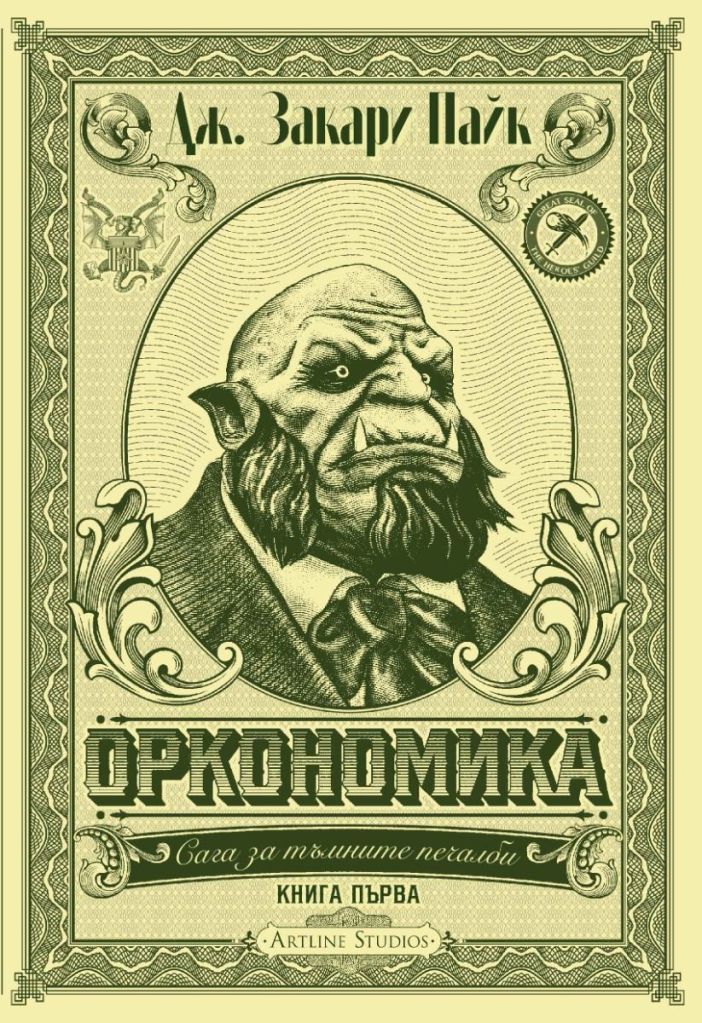
Orconomics

Cover by Artline Studios

I bought this book because I wanted to read something like Terry Pratchett or Douglas Adams. The book wasn’t that. It’s a very serious epic fantasy, closer to George R.R. Martin than Pratchett.

Gorm Ingerson is a dwarf and a fallen hero, who abandoned his mission years ago. Once an unstoppable slayer of monsters, he now lives under the radar of the major treasure-hunting enterprises. He must join forces with others like him to chase stolen, powerful artifacts and return them to an owner of their choosing.

While the mission is so-so, the world is wow. It’s a boiling can of worms that can’t possibly exist. J. Zachary Pike describes at least 20 smart humanoid species with some dominant over the others, like a fantasy version of Star Wars. The issue is that most of these races would naturally become endangered unless they have some form of habitat isolation, which they don’t. Here’s scientific proof:

  • The Witcher series has a similar setup with all the possible folklore and Tolkienist fantasy races. Humans meticulously exterminate the “monsters”, making the Witchers less and less needed
  • LOTR has habitat isolation with different races living in separate areas and not mixing much, apart from occasional wars to make the story worth telling
  • Discworld has a situation in which the races are not fighting with each other, somehow evolved together
  • Song of Fire and Ice has isolation but also has Dragons that are endangered species
  • Raymond Feist’s Midkemia world has the evil Valheru, which were wiped out from the universe before the books even began

In Orconomics the mess of intelligent fantasy species was created by magic and the Discworld-like mixture suffers from the Witcher-like problems. Most races are endangered and suffer from a Moriori-style future. The book doesn’t offer a plausible explanation for why or how these species still exist.

A well-written and engaging book with many charming characters, though it’s grimdark and lacks humor. The world is both the best and the worst part of it.

4*/5

The Fourth Monkey by J.D. Barker

The Fourth Monkey is a serial killer thriller where a psychopath avenges the past by murdering women. A team of dedicated police officers races with time to save a teenage girl who was kidnapped. Objectively, it’s a good serial killer horror thriller, although it’s unlikely that I’ll dare to read the sequel.

Here’s the TL;DR of the story and an honest ranking:

๐Ÿ™ˆ, ๐Ÿ™Š, ๐Ÿ™‰, ๐Ÿ’€ / 5

Van Troff’s Cylinder by Janusz Zajdel – an AI Vision from the 80s

An exploration spaceship returns from a distant star with a 200-year delay. They find the Earth and the Moon in shambles. Earth is inhabited by stupid people, and the Moon has a smart but unsustainable population, suffering from radiation, depression, and a shortage of oxygen.

Zajdel explores how climate and genetic manipulation can destroy Earth. Humans decided to replace trees with machines, and it didn’t work very well. They also decided to resolve the overpopulation crisis by changing the DNA so that very few girls were born. That also didn’t work well.

Both disasters are overshadowed by the impact of AI. Robots do everything and people don’t need to learn how to count. They communicate with 50 words and don’t develop even basic feelings. It’s a utopia modern people can imagine – the world ending not because of a war or climate change but because of obedient robots doing all the work.

4.5*/5

Takedown Twenty by Janet Evanovich

Some writers start with a bestseller, then it’s all downhill. You’re lucky to get the same bestseller repeated a few times with a slightly different plot. Others get better book after book. Michael Connelly is in that group, and Janet Evanovich seems to be there as well. Takedown Twenty was one of the best from the Stephanie Plum series. There were exploding cars, a bit of grimdark comedy, and a stray giraffe but it was balanced and Stephanie did well.

Stephanie should’ve been 50 by now. Technology ages but she stays 30. Other than this little glitch in the Matrix, itโ€™s a great series.

Do you remember your favorite book from childhood?

Daily writing prompt
Do you remember your favorite book from childhood?

Looking back, it has to be one of these 3:

  • Pippi Longstocking
  • The Three Musketeers
  • Winnetow

Pippi was one of the books that hooked me to reading, Winnetow introduced me to adventure books – pirates, Wild West, and such. The top choice, however, must be The Three Musketeers.

Athos, Porthos, Aramis, and D’Artagnan are unlikely friends, united by their shortage of money and willingness to duel. They are all extreme in some way and represent a few distilled qualities that complement one another. Their paths briefly cross, create beautiful moments of courage and bravery, and drift apart because of tragedies and traumas. It’s written in small chunks, chapters that have their own merit as short stories. This made it a good book for a 7 or 8-year-old with a limited attention span.

I’m not sure if I read The Three Musketeers more times than Pippi, Winnetow, or the other 4-5 books I would read each summer break but it aged well. The last time I got it in my hands and read a few chapters, they were captivating and great. It was less than a decade ago.