Combating Anxiety with the Five Whys

Wars, inflation, health, aging, deadlines, death, AI, work woes – the adult life has no shortage of triggers for anxiety. These worries appear to stick around for a long time with sudden spikes that make them worse. Yet, anxiety rarely feels useful – we are not changing the course of history by worrying about it. How can we tone it down without solving world’s hunger?

I’ve tried a variety of tactics and each has its own place. I never miss the chance to include the subject of thinking errors. They are a major source of anxiety and self-fulfilling prophecies. However, today I’d like to share about the Five Whys, a method of using your non-intuitive slow thinking. The whole reason why I wrote my previous long post about intuition was so I can write this one without explaining what’s a slow brain and why intuition can work against us.

What Are the Five Whys?

When faced with a problem, you ask “why?” at least five times, using the answer from the previous question as the basis for the next. Originally developed by Toyota as a problem-solving tool in manufacturing, it seems to work well for self-discovery. It forces us to goo several layers deeper than the shallow obvious reason for a problem. Here’s a current made-up example.

  1. “I’m worried that the USA import tariffs may trigger a global crisis”“Why does that bother you?”
  2. I’m worried it might affect my job” – “Okay, it may or may not, Why does that bother you?”
  3. “I’m worried I may lose income” – “This doesn’t sound great but still, why are you worried about it?
  4. “Because I may be unable to provide and my family may suffer” – “Family is there for good and bad. Why does a loss of income, even for a longer term, worry you?”
  5. “Because I tie my self-worth to how others (or family) perceives me”

And we find something deeper than just “Oh no, Trump”. We’ve reached a core fear that’s fueling the anxiety.

The Core Fears

Asking the five whys for fears appears to bring us down to the same one or two true fears and these seem to be similar for most people. For example (absolutely not a complete or scientific list):

  • Fear of failure
  • Fear of judgment
  • Fear of rejection
  • Fear of being alone
  • Fear of being a burden

The process of tying one or more of these (or a similar core fear) to some uncertainty-inducing current event can make us panic essentially for nothing. No, Trump won’t make your significant other stop loving you, neither can a potential risk coming to life take away your past experiences. Other things can do that, like being mean, or not listening, but not Trump.

Have I recently shared that we should always be kind? The past acts of kindness, for example, cannot be taken away if you get run over by a car, get sick, encounter dangerous people, communists, experience inflation, or a are attacked by a foreign army.

Why it helps

Anxiety thrives in ambiguity.

Bringing light to the true fears can take away some of their power. The news will never stop blasting the horrors of the day and they will always be awful because this is what makes us watch news. But our deepest fears can be nearly constant for decades, like old friends we don’t really like or want. Nothing is ever going to be perfect.

Brene Brown wrote a book called “The Gifts of Imperfection” where she describes the loss of self, direction, purpose, meaning, safety, certainty, and future. She asks us to seek for our internal self-worth. We are worthy and should accept that, should find reasons for it, and should also not undermine it too much. There is always a need to improve but never a need to be perfect, risk-free, or error-free.

I summarized that book in 2019 with the following text:

If you’re a mess and vulnerable, you are not alone. We are all together in this.

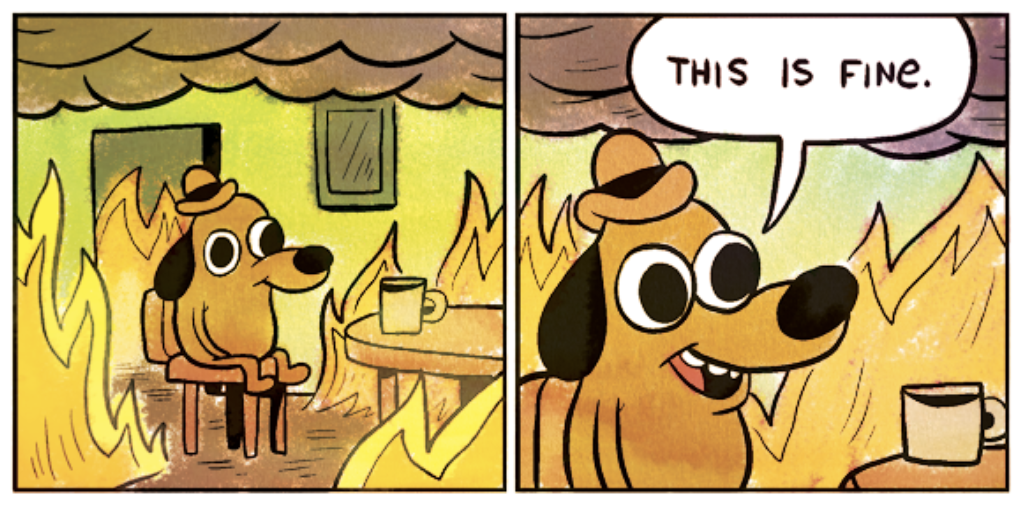
So, to tie it all together, The Five Whys is a method to get anxiety to a point where the level is within Brene Brown’s “This is fine”.
Should I trust my intuition?

We make decisions many times per day. Most of them are quick, automatic, and unimportant. However, some choices can have a dramatic impact over our future. For example, a choice of one university over another can determine the career path. The choice of a partner. Buying one house over another, and particularly the financial aspect of that choice. Buying an old car with cash vs a new with credit. We are made in a way that follows the heart, which is essentially using intuition rather than judgement.

The problem with fast decisions

Our brains have an incredible capacity to produce quick, intuitive, and wrong answers to any problem. Once our action doesn’t solve the problem, we often have a bigger problem and a new chance to try solving it. Repeating the same approach can lead to a chain of bad choices. Feelings appear to be a force multiplier and can make any situation much worse than the original problem.

Is it true and why why is that? One theory that I liked comes from the work of Daniel Kahneman, Thinking Fast and Slow, which I read in 2016. It’s been quoted before on this blog as it’s essential to how I see the world.

The theory is that we are adjusted to living in the bush where a lion can hide and eat us. The intuitive response to anything moving in the bush has to be quick in order to prevent us from being eaten. There’s absolutely no need to have a quick and intuitive response when the car dealership makes an offer to us. In the past, you only make one mistake and you get eaten. In the modern world, the movement in the bush is not a lion.

Kahneman says that our brains have two modes. System 1, Intuition, produces quick and wrong decisions. System 2, slow thinking, can sometimes produce not wrong solutions.

For every complex problem there is an answer that is clear, simple, and wrong.

Another famous book, called Crucial Conversations, explores the area of arguments. The recurring theme is that you won’t drive if you’re drunk. Don’t drive under the influence [of alcohol]. Just like driving, the choice of words during an important conversation can be of lasting consequences. Don’t make important choices under the influence [of emotion]. Our boss wrongs us. Intuitive response? Something with the F word. A quote from the book:

Speak when you are angry and you will make the best speech you will ever regret.

To make the matter worse, not only is the emotional response bad for us, but it’s also predictable on a group level. It gets exploited by politicians, marketers, grifters, and more ordinary humans who’ve learned how to do it. It’s an appeal to emotion, which makes you susceptible to mistakes. Enter that car, hold the wheel, feel the smell. You’ll love it. It can be yours.

Productive emotions have been used by mass media to increase the sales since at least the discovery of the tabloids (Ryan Holiday, Trust me, I’m lying). A fear-mongering title sells the newspaper. Anger, Fear, Greed, Guilt, Lust can make us respond in a certain way as a group. These switch us into System-1 mode and we make decision not in our favor based on intuition. We can be fooled and negatively impact our or our group’s future.

The problem with slow decisions

It not possible to switch our reptile system-1 brain off and it’s also unsafe. Gavin de Becker explores the fear and anger in his book The Gift of Fear. He lists pre-incident indicators in a long list of possible violent outcomes. For example, a group of young men hang out by an pedestrian underpass. One of them peaks at me and my heart drops. It’s the lion in the bush of our modern world. There’s no time, just turn around and run for help.

The book also covers the area of domestic violence and the tendency of people to ignore clear signs of coming attacks. A possible conclusion from that book is that when people show you who they really are, trust them.

Dr. Albert Ellis classifies the underreaction to incidents as Rationalization, one of the three groups of thinking errors from his book How To Keep People From Pushing Your Buttons. The modern day understanding of Rationalization classifies under it a group of behaviors that justify violence and wrongdoing by making up reasons for the violent behaviors where rational reasons do not exist.

So, all in all, ignoring the intuitive response is not good either.

How do I make the difference

Perhaps most decision making in the area of physical safety should use the intuitive brain first. Take ourselves out of danger and turn on the System-2. Anything in the area of purchases, investments, money, work, business, programming, health should use the slow brain. Any classification like that is prone to exceptions but the bare awareness of it can help, particularly when a manipulation tactic is being used on us. A countdown timer. A limited time offer. It’s just one, now or never, “I have five other offers for this apartment”. Yeah, sure you do.

None of the quoted books speaks about guaranteed good decisions. They all speak about probabilities. You can meet someone, say yourself “Oh, I’ll spend my life with them” 15 seconds later, and proceed to actually do it, and have a happy life. It’s not likely but it happens.

Ending with a reminder about an old post. Never miss an opportunity to be kind. The world is harsh and we can’t change it. We can only change our responses to events. Love and kindness make everything more tolerable.

Why fear

Fear makes you click. But does it end with clicking and reading? Found this gem on the Reader today:

French surgeon and neurobiologist, Henri Laborit (1914-1995) drew a clear connection between learning and emotion, showing that without the latter the former was impossible. The stronger the emotion, the more clearly an experience is learned.

Nescafé Japan and Imprint Theory

Triggered productive emotions also help you learn the wrong things because learning is associated with emotion. Previously wrote about this in 2018.

Another reason to be kind

In each instance, we readily forgive our own minds but look harshly upon the minds of other people.

I found this nice 2012 article on r/psychology about how our experience and intuition fool us into making wrong predictions. The emphasis in the article is on underestimating others and overestimating ourselves. It says that there’s no amount of knowledge about the thinking errors and biases that will make our thinking quality better but it can make us slow down and invest more effort when we recognize that we would like good results.

Not sure if the article is worth a $6 subscription but is definitely worth the read, and so is the main source for it – the book Thinking, Fast and Slow by Daniel Kahneman.

The biggest challenge over the next 6 months

Daily writing prompt
What is the biggest challenge you will face in the next six months?

An easy answer would be some individual problem, like health, loss, or work. The hard answer is – dealing with uncertainty without dwelling on the endless negative outcomes. I need my imagination to be helpful.

People have come to many ways to calm their fortune-telling never-ending internal narrator:

  • Meditation. Whatever the future, focus on the present. Life is simple in the now. Ignore the past.
  • Religion. If God will take care of all of us after all, why worry about the future? Study the very distant past.
  • Psychology. Whatever the future, nobody can take away your past.
  • Capitalism. Imagine this fantastic new car, don’t bother with the other things. Go shopping for dopamine highs.
  • News. Be afraid, be very afraid. We will use your internal narrator to make you come back and buy things.

And so on. It is a long search.