The Obelisk Gate by N. Jemisin

Essun is going after her missing daughter Nassun, while the world is slowly ending. Ash and acid are falling from the skies and the wildlife is eating people in unusual ways.

She finds an old friend instead.

Earth is clearly no place for humans in this series and I don’t need the third book to see where it’s all headed. But there’s a tiny bit of hope that this very unstable world can provide home to humans. So I think I’ll continue with it.

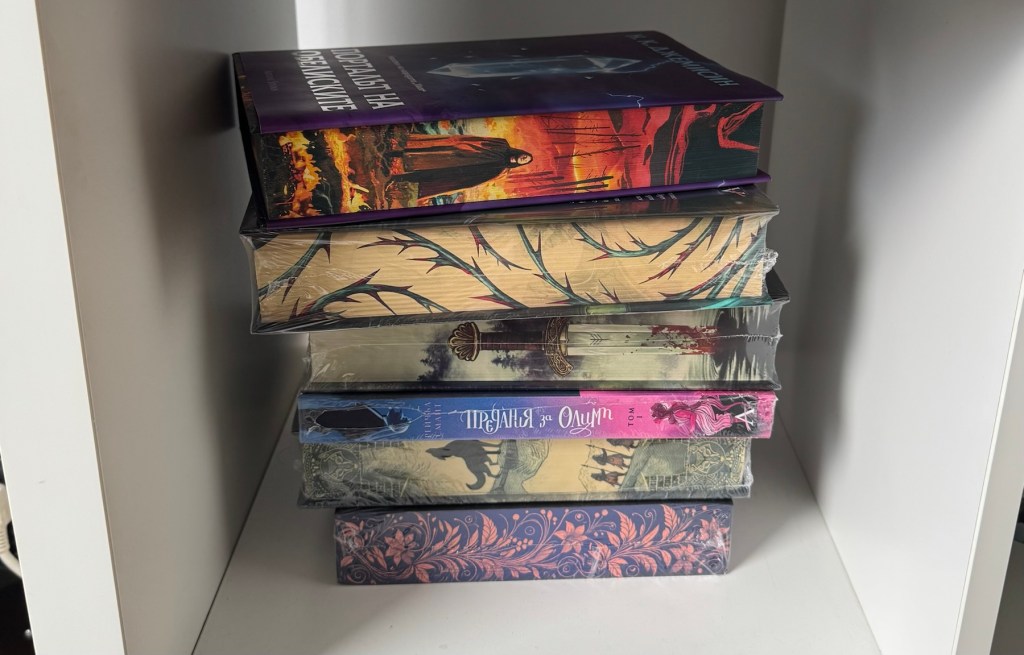
⭐️⭐️⭐️⭐️⭐️ out of 5. Also, the copy is beautiful.

Exit Strategy by Martha Wells

I feel a bit silly reading a book that just turned into a TV show.

In book 4 of the series, the Murderbot flies between space stations and faces several attempts to be stopped. However, it has no clear goal or understanding what’s going on, and it’s also not clear why the rich corporations are trying to stop it. We’ll have to wait more books to reach that clarity. Alien artifacts are involved, so it is promising.

This and the previous sci-fi book I read made me think about something else.

The Murderbot is flying through wormholes. Sten in The Wolf Worlds is also flying through wormholes. Assume a wormhole existed, and I flew from point A to point B through a wormhole. No object in space is stationary. Galaxies move towards gravitational attractors, star clusters orbit around the center of the galaxy, and planets orbit around stars. Flying to the other side of the galaxy through a wormhole means that my spaceship will suddenly be accelerated to incredible speeds, compared to the local objects, speeds from which the deceleration may take years. The spaceships in both books do not address that.

There is no plausible space flight, unlike what we see in true 5* sci-fis like Legion or Project Hail Mary. And if we remove the space flight, this book turns out to be a short cyberpunk novel, similar to Gibson’s world, where a heavily modified human surfs the Internet like if it’s a water slide.

For that, I think I’ll allow myself to score this book 4/5, still a great little adventure. The sci from the sci-fi doesn’t add up, otherwise very nice.

The Golem and the Jinni by Helene Wecker, Book Review

The struggle with the story of the golem and the jinni was real. Over the course of 620 pages, two theoretically enslaved magical creatures fight for building their identity, freedom, and personal growth. The writing style reminds of the tales of Scheherazade. It’s slow-paced and enchanting.

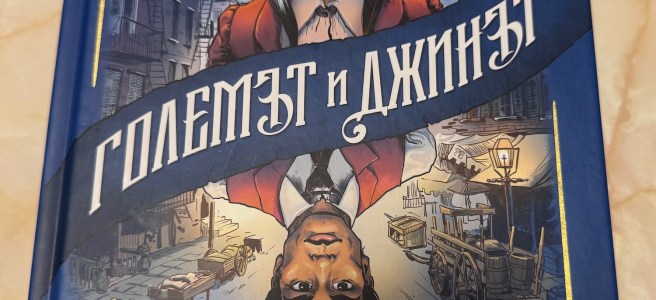
The book itself is a work of art: hardcover, high-quality paper, large print, and beautiful full-color page edges. It’s definitely one of the most beautifully designed books I’ve read recently. Many thanks to everyone involved in its production.

The story unfolds slowly. For a five-star rating, the plot could’ve been trimmed down to 300 pages. Most secondary characters didn’t need to die.

4*/5 but thanks to the beautiful print, the book already has a new home.

Books I Read in April

April was not a great month for reading for me. I missed the first 10 days and then read a few short ones for the number. Nevertheless, some mind blowing books came out of it. Few but good.

Best Books

  1. Gideon the Ninth by Tamsyn Muir – the sad story about necromancers who face too much magic and a universe that’s 10K years after the apocalypse. I think some love is lurking in there but it’s not a romance. It’s deeply touching, well written, engaging, interesting, and memorable. It was by far the best book I read this month, and I keep thinking about it.
  2. Careless People by Sarah Wynn-Williams – a former director from Facebook reveals dark secrets from her past work. Mixed feelings here. Her story is awful and at the same time, the genie is not going back to the lamp.
  3. Harrow the Ninth by Tasmyn Muir. A book where the imaginary and the reality are so mixed that I needed Wikipedia to explain the events to me. However, despite the 4*, I feel this book was far more memorable than the next books on the list that I can forget quickly. I plan to get the 3rd part as well but maybe after a break.
  4. The Narrow Road Between Desires – Patrick Rothfuss is a modern classic with his incredible skill of arranging small and tiny events into a larger puzzle. I’d say, a good member of the Cozy Fantasy family.
  5. Cursed by Alex Kosh – 5* but pretty much unavailable anywhere, I was the lucky first reviewer on Goodreads. And also, thematic, it is about ghosts and in line with Gideon, Harrow and the unfortunate sixth book.

Worst Book

  1. Five Broken Blades – ironically, almost identical plot with Gideon the Ninth, which I liked so much. The story is about 6 (no kidding) people trying to assault an immortal king who is both the enemy and the ally. However, unlike Gideon the Ninth, it’s constantly annoying, and none of it makes sense. For example, why 5 blades if it’s about 6 people, and why broken, if nothing is broken? The book doesn’t answer. Maybe the sequel will.

Careless People by Sarah Wynn-Williams, Book Review

Sarah Wynn-Williams wrote a memoir about her times as a very ambitious young executive, working on international policies at Facebook. She was close to but not close with Mark Zuckerberg, Joel Kaplan, Sheryl Sandberg, and Elliot Schrage.

First half of the book describes her work. It was what I hoped to read when I took that book. It describes hard-working people, self-absorbed, ambitious, awkward, making honest mistakes, stupid mistakes, moving on, forgiving. Lots of internal politics, relationships, some favoritism and harassment. I managed to extract a positive idea out of it and wrote a post- Think Wrong, Move Fast and Break Things. I wish the book stopped there and the shocking airplane bed was the last chapter.

The second half is like swimming in a pool full of excrements with an occasional crocodile. All of the mentioned names lose their souls in the pursuit of goals, which seems to be humanly random and randomly human but completely unacceptable. One wants to promote a book probably filled with lies. Another wants to sleep with everyone from the opposite gender using his authority as a leverage. A third wants to be the emperor of Rome but realizes he’s already surpassed that. And all of them show the empathy of a hungry crocodile. But that’s only the beginning of the dreaded second part.

Then Sarah Wynn-Williams goes into details about election meddling, promoting violence and confrontation as an engagement tool, helping the far-right politicians and dictators around the globe because that would allow a better growth for the company, and even accuses Facebook for treason with their activities in China. She describes individual poops from the poop pool.

I knew Facebook is used that way – every time I watch more than 10 Facebook shorts, one will be by a pro-Russian troll account and maybe 3-4 will use other people’s content. They don’t hesitate to block my posts when I link to this blog but have never positively responded to a hate speech report or removed a fraudulent advertisement that I reported to my memories. Their moderation for Bulgaria has always been oddly biased in favor of anti-democratic forces. But the events from the book describe that in a world-level scale, engineered to be that way for money and power.

I don’t know if the book is true. I found Sarah Wynn-Williams’s Senate hearing, trying to get an impression. I can’t quite relate to any of these people, the author, the interviewers but it matches my expectations. It’s a cautionary tale about why the free, independent, and decentralized web is important, why and how the walled gardens are harming our society, and why kids should not be allowed to use social media.

I’m on Facebook, my friends are there. What do I do?