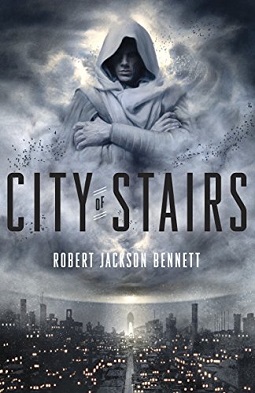
City of Stairs by Robert Jackson Bennett, Book Review

I started my review of the last book by comparison to other books. I’ll start this with a quote.

I learned very early on not to speak to my folk from on high, but to get down with them, beside them, showing them how to act rather than telling them. And I suggested that they should do the same with one another: that they didn’t need a book of rules to tell them what to do and what not to do, but experience and action.

Robert Bennett builds not just a fantasy world but a wisdom system for his series. It doesn’t need to be correct, to be appealing.

The gods were killed 80 years ago. With their deaths, most of their miracles vanished as well, including a large number of buildings from the sacred city of Bulikov. Eighty years later, the gods are forbidden. They can’t be mentioned, studied, hinted, their religions practiced, and the leftovers of their miracles cannot be used. People pretend they never existed, or at least most people.

Someone is breaking these rules. A top spy, the mighty Shara, is sent to Bulikov to figure out the conspiracy. Who killed the expert of the divine past, Efrem Pangyui? Why? Why do miracles still exist?

Dense and likable characters, a rich world, and an endlessly long ending, just like The Tainted Cup. Would I have been able to read this book if I hadn’t read The Tainted Cup? Unsure. But it’s a clear 5*/5 and a great fantasy. Ending with a quote as well.

Forgetting… is a beautiful thing. When you forget, you remake yourself… For a caterpillar to become a butterfly, it must forget it was a caterpillar at all. Then it will be as if the caterpillar never was & there was only ever a butterfly.

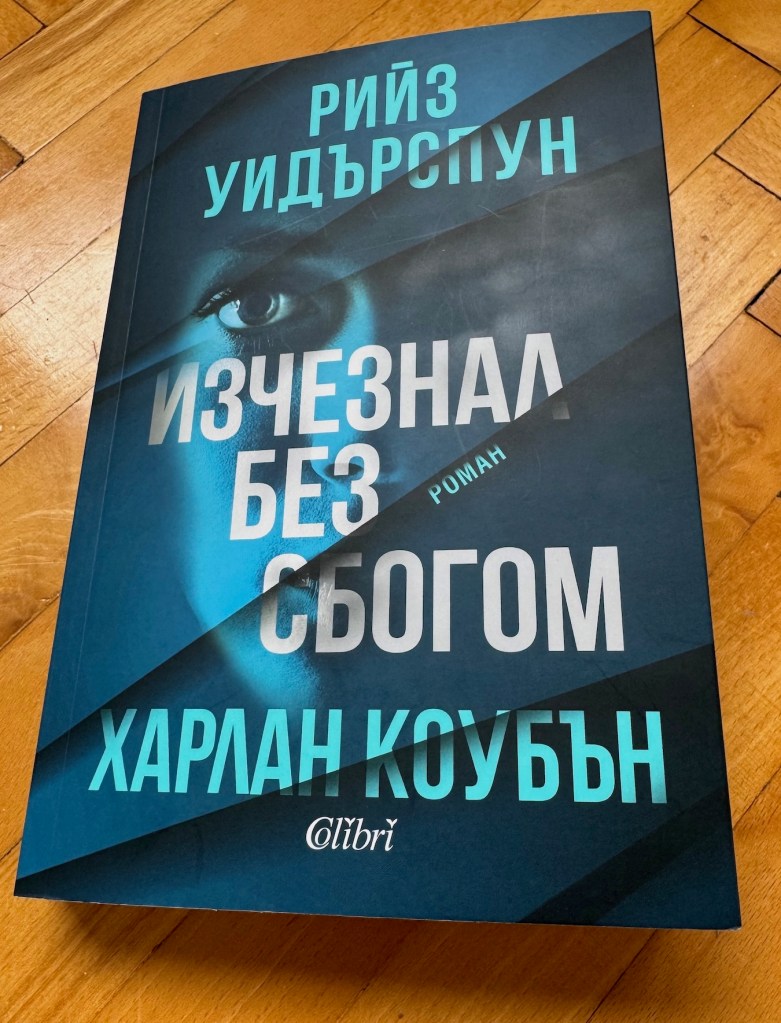
Gone Before Goodbye by by Reese Witherspoon and Harlan Coben, Book Review

I knew it will be a tough book to read because it had bad reviews. It wasn’t easy but wasn’t too bad either.

Alexander Belyaev has a story about a man who is essentially dead but his head is attached to a machine and is still talking. The head is waiting for a compatible headless body so it can be reattached. The story is called Professor Dowell’s Head. You would expect that Gone Before Goodbye is a crime mystery thriller, where we are trying to figure out what happened to the missing person (who’s gone). But it is, in reality, something similar to Belyaev’s stray head.

The book is very well written in most parts, and well translated too. The first 100 pages were excellent; then chaos set in. Maggie, a surgeon who lost her license, is offered redemption if she performs a difficult and illegal surgery. Once she accepts and sells her soul to the devil, people start flying around the globe like there’s no tomorrow and for no clear reason. Perhaps to show off how rich they are.

The resolution is like the head I mentioned. It’s sci-fi and ridiculous. We also have an avatar, living inside a phone, a common trope in present-day sci-fi. These AIs are usually demigods, who can do everything, and so is Maggie’s AI app. Also ridiculous.

Why three stars and not four, for example? Because it is never really clear why anything really happens. The book contains all kinds of cataclysmic and dramatic moments, and not a single one of them is actually necessary for the story. The explanation for everything is that a head is trying to find a body. Characters fly to Russia, billionaire balls are held, some people chase others, while committing grand acts of bravery without any relation to this problem. It’s not exactly a head but you’ll see if you read it. So I felt a disconnect between the great writing style, nice characters, the grandiose scenes, and setup, and the missing link to the actual story.

I could have given it two stars as well because of the publisher’s decision to compact the 350-page book into 300 pages by making the letters tiny and squeezing the letter spacing.

Despite the review, I enjoyed the individual fragments of good writing. 3/5 because of that.

The Obelisk Gate by N. Jemisin

Essun is going after her missing daughter Nassun, while the world is slowly ending. Ash and acid are falling from the skies and the wildlife is eating people in unusual ways.

She finds an old friend instead.

Earth is clearly no place for humans in this series and I don’t need the third book to see where it’s all headed. But there’s a tiny bit of hope that this very unstable world can provide home to humans. So I think I’ll continue with it.

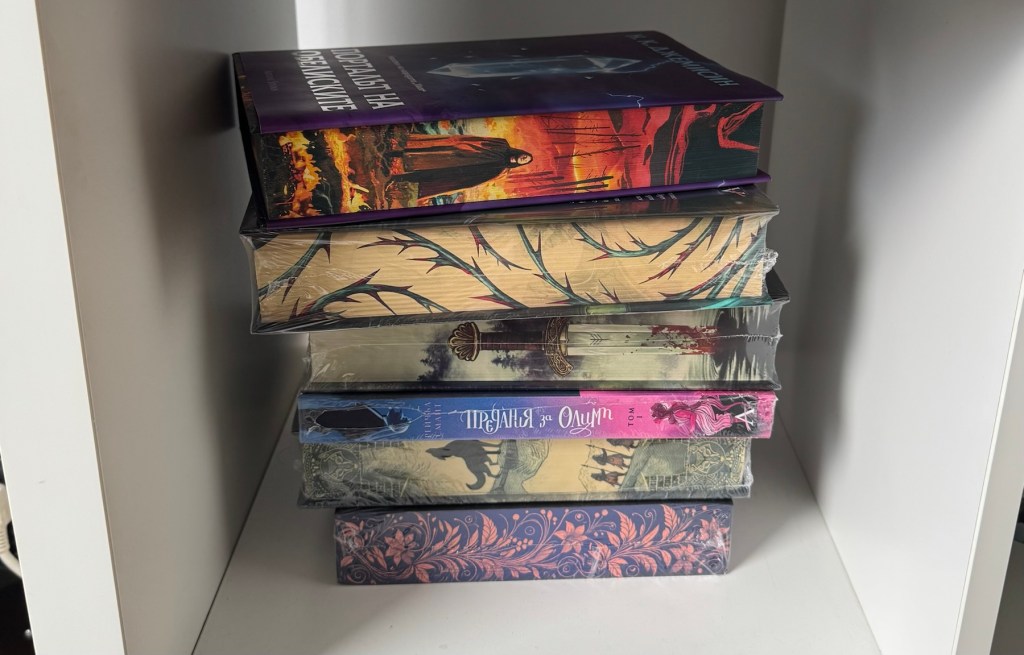
⭐️⭐️⭐️⭐️⭐️ out of 5. Also, the copy is beautiful.

Exit Strategy by Martha Wells

I feel a bit silly reading a book that just turned into a TV show.

In book 4 of the series, the Murderbot flies between space stations and faces several attempts to be stopped. However, it has no clear goal or understanding what’s going on, and it’s also not clear why the rich corporations are trying to stop it. We’ll have to wait more books to reach that clarity. Alien artifacts are involved, so it is promising.

This and the previous sci-fi book I read made me think about something else.

The Murderbot is flying through wormholes. Sten in The Wolf Worlds is also flying through wormholes. Assume a wormhole existed, and I flew from point A to point B through a wormhole. No object in space is stationary. Galaxies move towards gravitational attractors, star clusters orbit around the center of the galaxy, and planets orbit around stars. Flying to the other side of the galaxy through a wormhole means that my spaceship will suddenly be accelerated to incredible speeds, compared to the local objects, speeds from which the deceleration may take years. The spaceships in both books do not address that.

There is no plausible space flight, unlike what we see in true 5* sci-fis like Legion or Project Hail Mary. And if we remove the space flight, this book turns out to be a short cyberpunk novel, similar to Gibson’s world, where a heavily modified human surfs the Internet like if it’s a water slide.

For that, I think I’ll allow myself to score this book 4/5, still a great little adventure. The sci from the sci-fi doesn’t add up, otherwise very nice.

The Golem and the Jinni by Helene Wecker, Book Review

The struggle with the story of the golem and the jinni was real. Over the course of 620 pages, two theoretically enslaved magical creatures fight for building their identity, freedom, and personal growth. The writing style reminds of the tales of Scheherazade. It’s slow-paced and enchanting.

The book itself is a work of art: hardcover, high-quality paper, large print, and beautiful full-color page edges. It’s definitely one of the most beautifully designed books I’ve read recently. Many thanks to everyone involved in its production.

The story unfolds slowly. For a five-star rating, the plot could’ve been trimmed down to 300 pages. Most secondary characters didn’t need to die.

4*/5 but thanks to the beautiful print, the book already has a new home.