What I Read in November 2024

I read 7 books, 1 gamebook, and 1 comics in November.

Best books for the month:

  1. Thraxas 11 and 12 – The march to free Turai is over, and the series didn’t end. Some serious questions are left for the unwritten book 13, like why are Thraxas and Makri glued together? Both books were 5/5s, and also short and easy to finish.
  2. Shadow of the Fox #1 – a human with fox features starts a journey to secure a world-dominating scroll. LOTR in a magical ancient Japan. Book 2 relied on superheroes and deux ex machina, and is closer to the bottom of this post than the top but was still interesting.

Worst books for the month:

  1. Claw of the Dragon – a gamebook where the choices don’t matter and you just read a few pages in a non-linear order to reach the final. Probably targets 7-8-year-olds from the pre-computer age.
  2. Monk and Robot – clever and thought-provoking but not as interesting as the other books I read in November.

Monk and Robot, Book Review

I hated this book but it shook me, so it can’t be bad. Can it?

In a future so good that everyone is mostly satisfied, and so bad that it’s post-apocalyptic, a monk goes to the forest in a search for crickets. Finds an intelligent robot with a child-like curiosity. What happens next is a journey with no trouble, where both parties share their beliefs and try to uncover their purpose.

I can’t compare this work of art to anything else from my reading list. It’s more childish than Barbapapa or Paw Patrol. At the same time, it touches deep human needs, like Winnie-the-Pooh. The world is simpler than a cartoon, and the characters are stripped to their essence. Some scenes are romantic so in a sense, it’s not a fairytale and not appropriate for children. What is it then? Comfort Sci-Fi?

Objectively, this book is likely a 5 because the simplified and thought-provoking world is no coincidence. It was built the way Brandon Sanderson builds his magic systems. But I didn’t like how sterile everything is. There’s no jealousy, disease, or consequences for people’s actions.

So, comfort, innovation, philosophy, sci-fi-ness, and stickiness to my brain – 5/5. Print quality – 5+/5. But I gave it 4/5 on Goodreads because it didn’t make me feel good. There were no recognizable humans in there. I felt like each character can be a Paw Patrol puppy.

October in Books

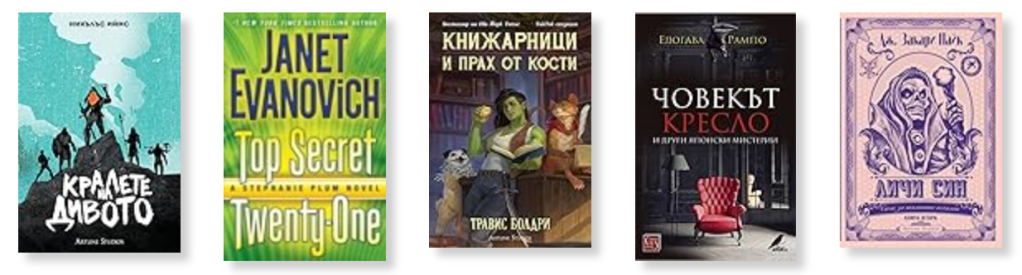
First time this year, a monthly recap post with only 5 books. 4 were good, and 1 was okay.

Best

  • Kings of the Wyld by a wild margin. The book felt like a mix between LOTR and Ready Player One but with a much broader variety of creatures, like Centaurs, Kobolds, undead, humans with wings and so on.
  • Top Secret Twenty-One – a bubblegum. Stephanie Plum catches some scary people.
  • Bookshops & Bonedust – Travis Baldree scored another win, kind of related to Kings of the Wyld by the type of intelligent creatures who participate
  • Son of a Liche – the continuation of Orconomics felt much more interesting and balanced than the first part but it still feels too long

Worst

  • Japanese Tales of Mystery and Imagination by Edogawa Rampo. The book is not bad but it felt slow.

Why Doesn’t Offler Forbid Chocolate?

Offler is the Crocodile God from Discworld. He is known for his crocodilian features, mumbling speech, and pragmatic rules. He knows how to keeps his followers. One of the pillars of his faith is that he wouldn’t impose a ban on chocolate because people wouldn’t listen anyway.

Nuggan, the God of paperclips and unnecessary paperwork, forbids Chocolate. Chocolate, among other 100s of things, is an abomination, perhaps because it stains the unnecessary paper. Funnily, as a result of that, his country is a main exporter of chocolate.

The book, although I don’t quite remember which one, implies that a God who forbids chocolate will eventually be forgotten and replaced by another God who doesn’t forbid chocolate. Nuggan, as of the last Discworld novel, is still around. He outlived his creator, Sir Terry Pratchett, and the spiritual disconnect between him and Offler remained unresolved.

Why I’m writing all of that? Spent last 24 hours wtf-ing with Bulgarian election news. There’s no Offlers in our political scene.

Kings of the Wyld by Nicholas Eames, Book Review

Clay Cooper is a retired mercenary, part of a group of 5+1 named Saga. His band was once the best group, known for defeating countless monsters, even a dragon. The plus one is the bard, which Saga could not keep alive, so they had to replace him or her so many times that the band members don’t even remember the individuals. Until one day they met an undead bard.

This book shares a world with another 2 series I recently read – it has the similar swarm of different fantasy creatures from Orconomics and Legends & Lattes. It has bands and heroes, harvesting monsters for profit. But it also has the epic-ness of LOTR (and its overall general structure), and the drama of Ready Player One.

Most characters both positive and negative (who aren’t bards) are nearly immune to anything the author can throw at them. This makes the story more like a fairytale than an actual fantasy. But it’s cool and somewhat balanced. A reader should particularly like it if they’ve not read any of the books I mentioned earlier.

5/5, I like it and recommend it but you need to have zero expectations of realism. Realistic it is not.