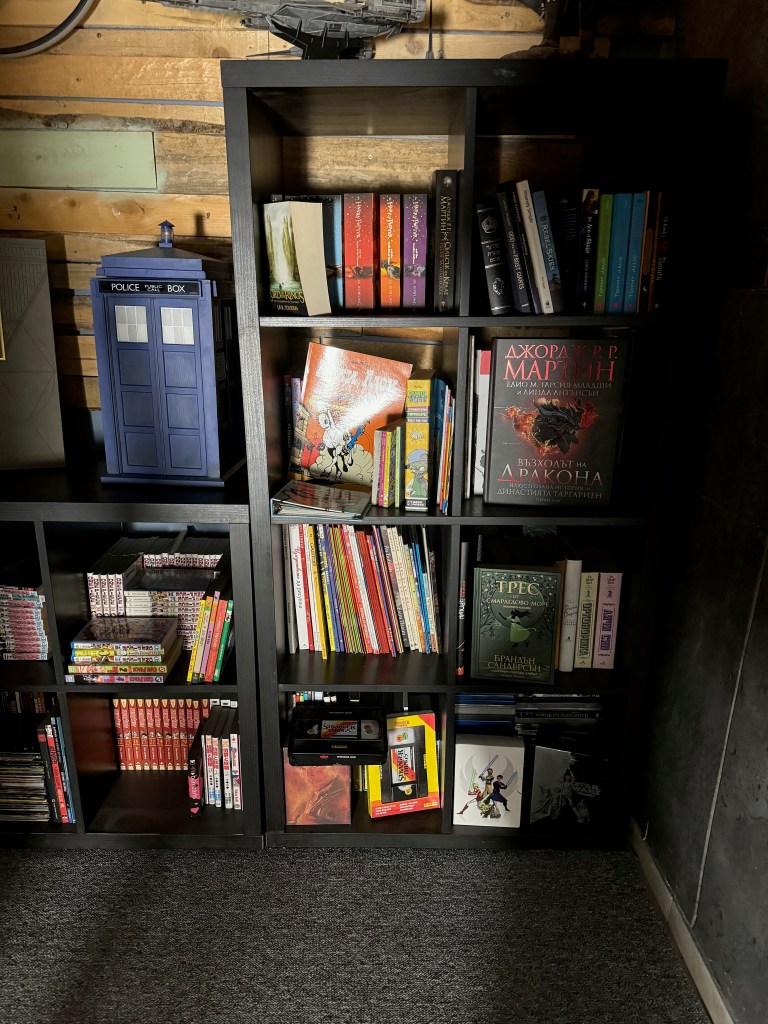
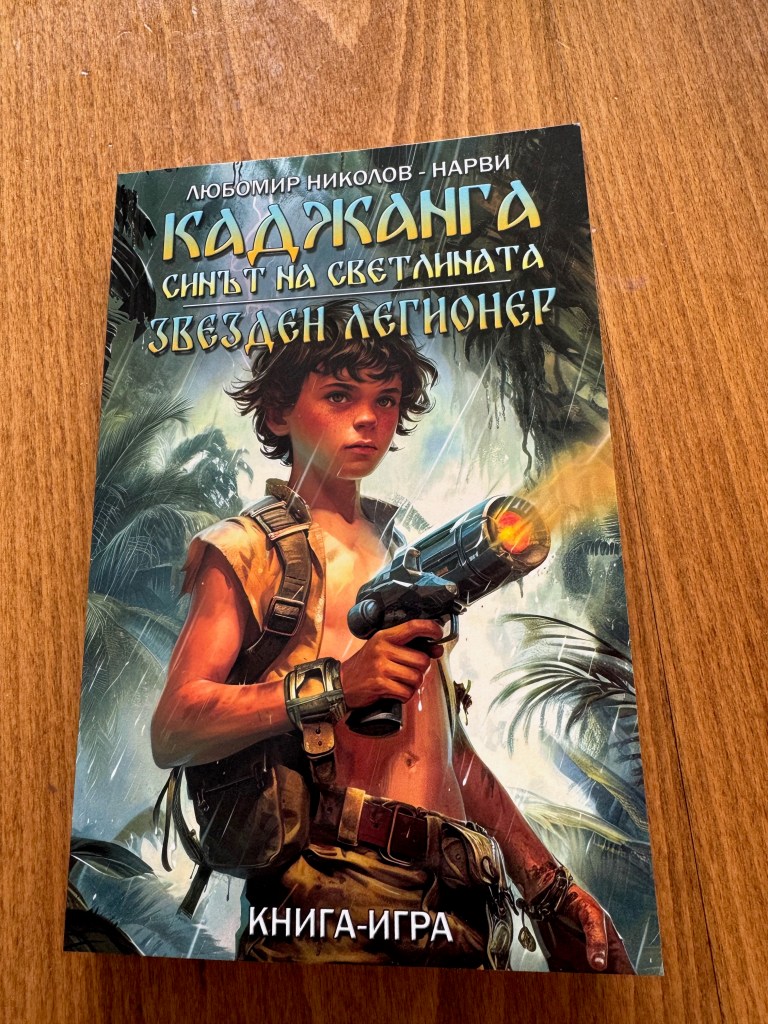
5pm on a warm Sunday. I’m about to visit a book signing for a genre of books that almost ceased to exist in the late 90s. It’s in Lozenets, an expensive neighborhood located on a hill, in what looks like a residential building. There are no signs. I’m looking left and right. Am I at the right place? I see a door open and decide to get in. 10-15 meters after, there is another door that appears to be locked and a staircase leading downstairs to the right. I see bookshelves everywhere seemingly unattended. Perhaps I’m at the right place. Shall I keep going down to page 17? Or perhaps I should force the door (page 27)? In case I carry a little angry dog in my backpack, turn to 7.
This is the wiring style of gamebooks, and the new one is a 2nd edition of a rare book published in the 90s by Lubomir Nikolov, most copies of which have been lost or thrown away.
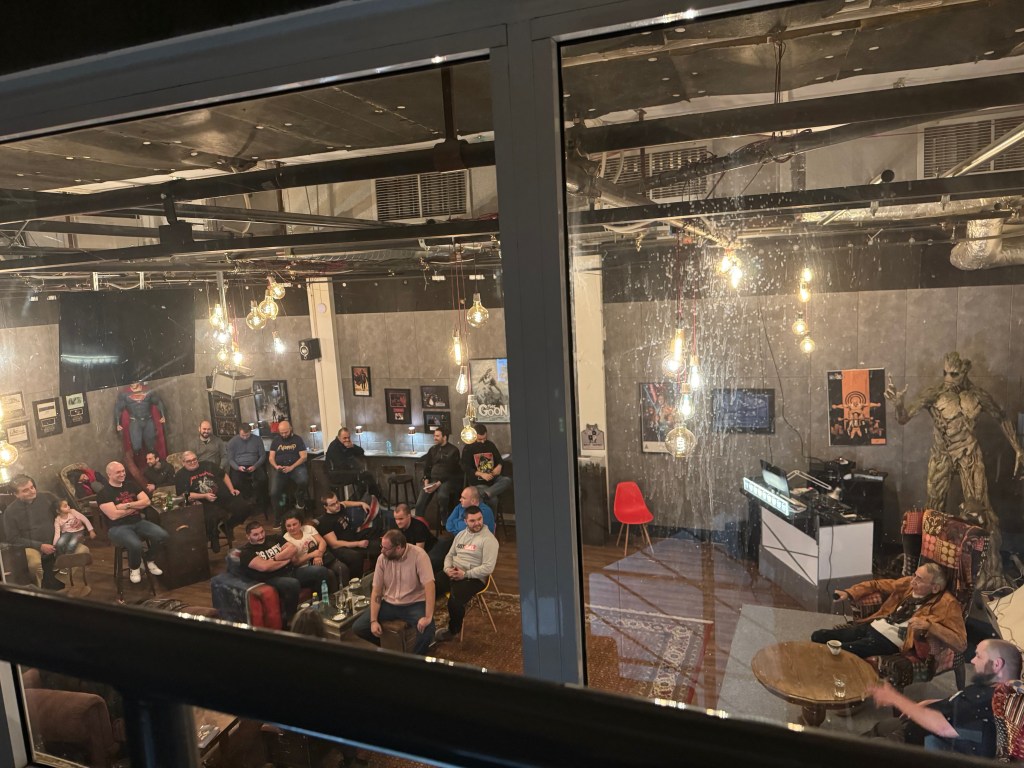
I kept walking down and found a large room, perhaps a bar, full of folks about my age. Why would anyone build such a large room 2-3 floors under a residential building?
I entered, got my book with an autograph, chatted with people, and it was fine.
The first game book published in Bulgaria was by the same author Lubomir Nikolov – Fire Desert. It started a genre and a community that inspired me to write and later to code. I’m not a very active member of this community but I buy the new books to support it and read some of them. If you want to try that but don’t speak Bulgarian, try Blood Sword.
The WordPress.com Reader found me this story from 2023 on a site with almost no visitors. It imagines a utopia where AI does almost all the work except for some. Like Human Resources. Why is that spared? Check the story.
I don’t believe the current boom in generative AI will push us toward UBI, but it is important to imagine the threads of the future and see what we like and what we don’t so we can act accordingly.
This is a simple book and part of a series I hope to finish. It comes with promises – there will be races with fighter-jet fast homemade cars. Whatever happens in the race will be decided milliseconds before the finish line. There will be crashes, of course, with speeds that would make the F1 cars look like they don’t move.
This book will teach you nothing. Not even a grain of rice of usefulness. Not a grain of anything that could possibly happen. It’s fantastic, pure joy. 5/5
I find it funny that every time a very clear statement is explained or exaggerated with an adverb, the explanation is a hint that the opposite is present or the statement is not entirely true.
He absolutely doesn’t drink alcohol. I will totally buy a ticket for the next Taylor Swift concert. The students will use ChatGPT entirely for research purposes.
ChatGPT and “(Ethically)!” in one sentence, in a paid ad.
The first time I encountered the moral dilemma around the use of AI was in the Robots series by Isaac Asimov. I read that long before I owned a computer and totally bought the idea of a positronic brain. Asimov saw that robots if allowed to do whatever they wanted would just start killing. He envisioned a set of forced limitations that AI never hurts humans (the full list of 3+1 laws is here) as the only way for robots to be useful. Asimov noticed in his books that robots would replace human labor and eventually cause stagnation but that was only partially addressed in his series after centuries of expansion.
Who could’ve imagined that the first appearance of any resemblance of AI would need a very different set of laws than Asimov’s first 3? The present-day AI already appears in multiple forms, each of which has its own ethical challenges. The prompt-based tools tend to use human content and present it as their own with no citation or link to the author. They’re awesome for faking homework. The image generation tools copy artists’ work and make it semi-unique, filling the need for cheap illustrations on spam websites that would slip undetected by Googlebot. The chatbots and robocalls automate tasks that were once reserved for humans, causing unemployment. There has to be a fine line between what’s okay and what isn’t.
Any statement by AI should cite the sources of information and provide links
AI should not present slight modifications of human content as its own
AI should not use the prompts of one human outside of the context of the interaction with that human.
But after writing this, I had a lightbulb moment. If anyone put a thought on this, it has to be the EU administration. And yes, the EU agreed on a much longer document, where Generative AI is just one type of risk and contains an Asimov-like masterpiece:
Generative AI, like ChatGPT, would have to comply with transparency requirements:
Disclosing that the content was generated by AI
Designing the model to prevent it from generating illegal content
Publishing summaries of copyrighted data used for training
Generative AI is not even considered a high-risk type of tool. EU considers AI tools as high-risk if they classify humans, analyze emotions, collect faces, provide advice on health or legal matters, talk to children, and so on. How didn’t Asimov think about that? The existential dangers of a toy that can explain dangerous activities to children.
Overall, the definition of an ethical use of AI is taking some shape but I wonder how much damage will be caused to human content creation and creativity until any of that’s adopted.
At least, none of these risks is Skynet and Asimov’s laws are not yet relevant.
A world, surrounded by flying broken machinery. Humans, hiding underground, and under constant attack by alien spaceships. The future is grim but for the youngsters, it all looks like a game and plays like a game. And they, Spensa in particular, will try to game the system. The brand new book 4, published over the last couple of days, might be the conclusion where they’ll defeat at least some of the evil.
The Bulgarian edition is on a very hard cover. Like hardwood cover. I’m not very sure what material they’re made of but it is wood-like, very thick. It’s rough and painful to hold. Perhaps gypsum plasterboard? It is pretty if you don’t look from the side. Paperback was also available but I paid respect to the weird choice by the publisher and bought the strange one. I should remind myself to ask them about the material at the next book fair.
It’s one of the better series by Brandon Sanderson, I recommend it, although I’ve not started “Defiant” yet and don’t know the end. I hope it’s not a tragedy.