Wars, inflation, health, aging, deadlines, death, AI, work woes – the adult life has no shortage of triggers for anxiety. These worries appear to stick around for a long time with sudden spikes that make them worse. Yet, anxiety rarely feels useful – we are not changing the course of history by worrying about it. How can we tone it down without solving world’s hunger?
I’ve tried a variety of tactics and each has its own place. I never miss the chance to include the subject of thinking errors. They are a major source of anxiety and self-fulfilling prophecies. However, today I’d like to share about the Five Whys, a method of using your non-intuitive slow thinking. The whole reason why I wrote my previous long post about intuition was so I can write this one without explaining what’s a slow brain and why intuition can work against us.
What Are the Five Whys?
When faced with a problem, you ask “why?” at least five times, using the answer from the previous question as the basis for the next. Originally developed by Toyota as a problem-solving tool in manufacturing, it seems to work well for self-discovery. It forces us to goo several layers deeper than the shallow obvious reason for a problem. Here’s a current made-up example.
- “I’m worried that the USA import tariffs may trigger a global crisis” – “Why does that bother you?”
- “I’m worried it might affect my job” – “Okay, it may or may not, Why does that bother you?”
- “I’m worried I may lose income” – “This doesn’t sound great but still, why are you worried about it?“
- “Because I may be unable to provide and my family may suffer” – “Family is there for good and bad. Why does a loss of income, even for a longer term, worry you?”
- “Because I tie my self-worth to how others (or family) perceives me”
And we find something deeper than just “Oh no, Trump”. We’ve reached a core fear that’s fueling the anxiety.
The Core Fears
Asking the five whys for fears appears to bring us down to the same one or two true fears and these seem to be similar for most people. For example (absolutely not a complete or scientific list):
- Fear of failure
- Fear of judgment
- Fear of rejection
- Fear of being alone
- Fear of being a burden
The process of tying one or more of these (or a similar core fear) to some uncertainty-inducing current event can make us panic essentially for nothing. No, Trump won’t make your significant other stop loving you, neither can a potential risk coming to life take away your past experiences. Other things can do that, like being mean, or not listening, but not Trump.
Have I recently shared that we should always be kind? The past acts of kindness, for example, cannot be taken away if you get run over by a car, get sick, encounter dangerous people, communists, experience inflation, or a are attacked by a foreign army.
Why it helps
Anxiety thrives in ambiguity.
Bringing light to the true fears can take away some of their power. The news will never stop blasting the horrors of the day and they will always be awful because this is what makes us watch news. But our deepest fears can be nearly constant for decades, like old friends we don’t really like or want. Nothing is ever going to be perfect.
Brene Brown wrote a book called “The Gifts of Imperfection” where she describes the loss of self, direction, purpose, meaning, safety, certainty, and future. She asks us to seek for our internal self-worth. We are worthy and should accept that, should find reasons for it, and should also not undermine it too much. There is always a need to improve but never a need to be perfect, risk-free, or error-free.
I summarized that book in 2019 with the following text:
If you’re a mess and vulnerable, you are not alone. We are all together in this.
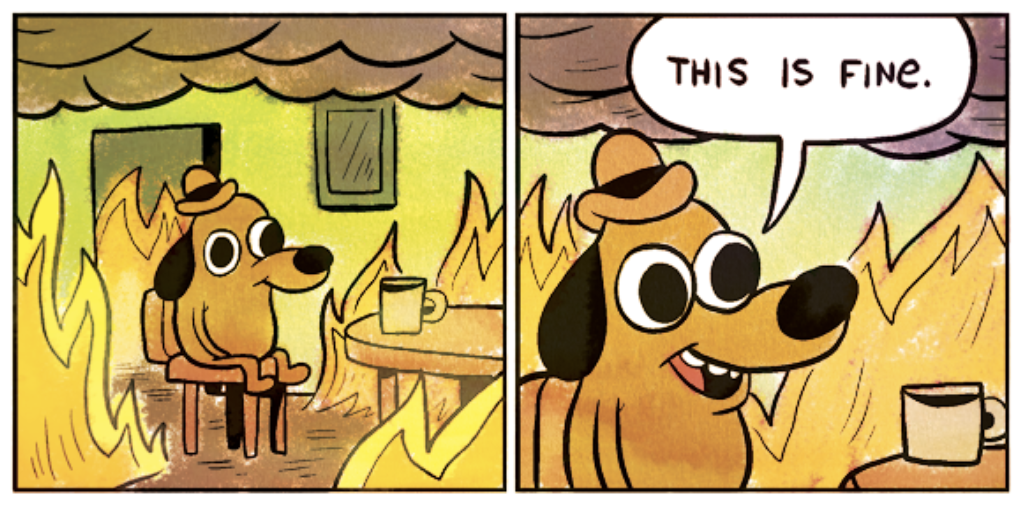
So, to tie it all together, The Five Whys is a method to get anxiety to a point where the level is within Brene Brown’s “This is fine”.

 Veselin.blog
Thank you so much for expanding on the topic, I’ve tried practicing the approach since you first mentioned it.
What I’m noticing is it makes it easier to contextualize events/fears, bringing you closer to the “this is fine” state of mind.
LikeLiked by 2 people
For me, that was like arranging a puzzle with fragments of information. Identifying the core fear and not trusting the intuition are two puzzle pieces out of several but not too many. Some others are identifying A purpose in life, and knowing the basics of thinking errors. For me, personally, spirituality is also a puzzle piece.
I had an Aha moment once it all tied together in my mind but it took me like 4-5 months from it to actually feeling “This is fine”.
LikeLiked by 3 people
Many of us have little fear of being alone, being an only child is good training, in some respects. One fear that is missing from your list is fear of death.
Fearing death is fearing something inevitable. Not necessarily your own death but the death of those you love, not simply because you don’t want to be alone but because you don’t want them to suffer in any way and selfishly, because they enrich your life so much that the hole left behind would be impossible to fill. I would argue whether that anxiety is resolved by any logic or anxiolytic.
LikeLiked by 2 people
Yes, I agree, I removed the fear of death on purpose. I feel like if you say you’re afraid of death, it warrants another why.
LikeLiked by 1 person
Not talking about resolving it here, talking about making it better. We are humans, we feel anxiety by design. We need it for survival. But it doesn’t need to be crippling, it can be just a thing we can live with without thinking too much about it.
LikeLiked by 2 people
I would argue though that above all the others that are controllable, the one I mentioned is the one that has you searching frantically for the sertraline…or some such, at 4 am.
LikeLiked by 2 people
It’s probably why I have insomnia.
LikeLiked by 1 person
At least you know your core fear. Then you can use your knowledge about thinking errors to start fighting with it. I’ve not yet met the fear of death. I’m sure it will get me one day.
LikeLiked by 1 person
Wow. This is quite some blog. However did you come up with it? I like Brene Brown’s concept of imperfection. For some, it doesn’t matter; for others, like me, it applies pressure to improve. When all is said and done, life is a work in progress.
LikeLiked by 1 person
Thanks a lot! Fragments of this came from a variety of books which I didn’t quote but Feeling Good, How to Keep People From Pushing Your Buttons, The Gifts of Imperfection, How to Win Friends and Influence People, and probably others. I also did therapy with a psychologist around 2021, which helped me a lot to figure it out for myself.
LikeLiked by 2 people
Trump is a disaster, it sickens me he’s playing the tariff game, make countries gravel for a lesser tariff. What’s worse is who’s going to follow him. It stresses me out, I can only imaging who other countires feel. We’re headed for a recession.
LikeLiked by 2 people
The idea is that people have somehow managed to live through incredible disasters and still have families and achieve purpose in life. Viktor Frankl is an example. Where’s Trump on that scale? Barely existing.
LikeLiked by 2 people
I read Man’s Search for Meaning and he is one amazing individual. Strength like I’ve never seen.
LikeLiked by 1 person
Why are you worried about Trump’s successor?
LikeLiked by 1 person
At the moment their’s not a strong Democrate that can win against a Republican. Chaces are Vance will run and he’s just a vicious. The Republican Party is not following what the judges say. and in tun have them loss their seat. It’s lawless up there.
LikeLiked by 2 people
Why does that worry you (why 2)? The USA has had all kinds of weird presidents. Vance may not even be top 5 craziest.
LikeLiked by 1 person
None as weird as Trump unless you go way back in history. Vance is a vicious street dog and typical the VP runs for President after the Predent leaves office. I don’t get that worked up about the future because all I can do is write my leaders and vote.
LikeLiked by 1 person
We can’t control who’s the president. We can’t even fully control our feelings about it. But we can challenge the worry but asking why and being honest to ourselves with the answers.
LikeLiked by 1 person
I think we all have the right to be fearful for the future today, no matter where we are in life and on the globe. However, I do like what you’re saying here. Most of this fear is probably rooted in nothing. Let’s hope that it stays that well. Better to be safe than sorry, right?
LikeLiked by 2 people
Why do I have the right to be fearful for the future?
LikeLike
I don’t know. It’s a feeling and we all have a right to them, don’t we? So far nobody has suppressed them – yet.
LikeLiked by 2 people
Yes but we also have the right to know why we feel that way
LikeLiked by 1 person
Of course! Good point!
LikeLike
We are all here for a very short time. Find what is special within yourself and celebrate that.
LikeLiked by 1 person