Press Enter is a novella by John Varley about a disabled war veteran who inherits his neighbor. The neighbor was a powerful hacker. So powerful that he could make money out of thin air. Another hacker comes to investigate. Unfortunately for all parties involved, the story is a horror and they’ll not have a bright future.
What impressed me is that there are AI prompts, just like the ones we use to talk to ChatGPT. There’s also prompt hacking. By 1984, AI development had apparently advanced enough for John Varley to foresee a trajectory.
An exploration spaceship returns from a distant star with a 200-year delay. They find the Earth and the Moon in shambles. Earth is inhabited by stupid people, and the Moon has a smart but unsustainable population, suffering from radiation, depression, and a shortage of oxygen.
Zajdel explores how climate and genetic manipulation can destroy Earth. Humans decided to replace trees with machines, and it didn’t work very well. They also decided to resolve the overpopulation crisis by changing the DNA so that very few girls were born. That also didn’t work well.
Both disasters are overshadowed by the impact of AI. Robots do everything and people don’t need to learn how to count. They communicate with 50 words and don’t develop even basic feelings. It’s a utopia modern people can imagine – the world ending not because of a war or climate change but because of obedient robots doing all the work.
Some writers start with a bestseller, then it’s all downhill. You’re lucky to get the same bestseller repeated a few times with a slightly different plot. Others get better book after book. Michael Connelly is in that group, and Janet Evanovich seems to be there as well. Takedown Twenty was one of the best from the Stephanie Plum series. There were exploding cars, a bit of grimdark comedy, and a stray giraffe but it was balanced and Stephanie did well.
Stephanie should’ve been 50 by now. Technology ages but she stays 30. Other than this little glitch in the Matrix, it’s a great series.
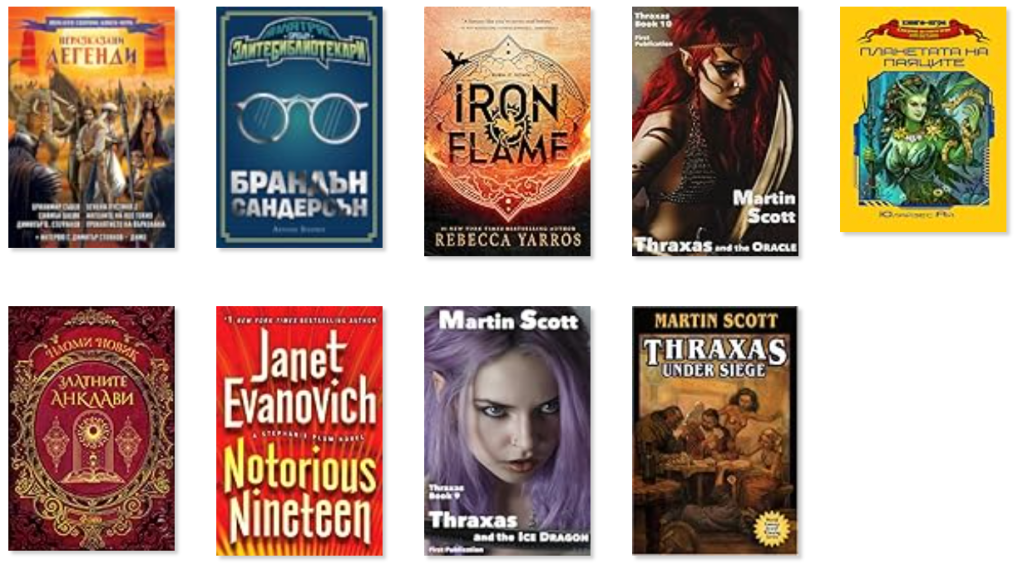
Thraxas Under Siege. It’s 5/5 and overall great. “Thraxas and the Ice Dragon” and “Thraxas and the Oracle” are not far behind. Turai is about to fall and Thraxas will have to help Lisutaris any way he can, which varies between failing miserably and saving the day. Makri is not far as well.
Notorious Nineteen by Janet Evanovich and The Golden Enclaves by Naomi Novik were also good reads and 5/5s. The Golden Enclaves concluded the Scholomanse series and explained the Maw-Mouths. Notorious Nineteen was a nice bubblegum. Stephanie Plum doesn’t age.
Worst books for the month
Alcatraz Versus the Evil Librarians – a parody where the author talks to the reader from the author’s position. It wasn’t fun in the way “The Carpet People” was. The only reason to complete it was my respect for Brandon Sanderson and the hope that Book 2 would be better. Brandon Sanderson is known to have some flops. I gave it a fair 3/5 because it was readable.
Iron Flame – the sequel to The Fourth Wing had 760 pages of people talking and moving around in a world that makes no sense but closely resembles other fantasy worlds that do. I gave it 4/5 because it was still interesting, but objectively, it was worse than Alcatraz. Brandon Sanderson built a unique steampunk magical system that could sustain excellent sequels, which isn’t the case with Iron Flame.
Honorable Mentions
I read one standalone gamebook and one collection of 3 gamebooks. The local community keeps printing these, and the artwork inside is above and beyond. Some adults are having fun and publishing stuff because they can. None of the writing is Brandon Sanderson’s quality but it carries the spirit of the 80s and 90s.
I finished this monumental work by Rebecca Yarros and have mixed feelings. I considered not writing a review but at the same time the book is is divisive and engaging. So here are my thoughts. Let’s start with the good. It’s readable and I read it!
The magic system is not good and it doesn’t get better in this part of the series. The nagging feeling that the system was borrowed by Naomi Novik remained, even though it’s likely unfair.
Naomi Novik develops a Mana/Malia magic system in the Scholomance series, which I recently reviewed and appreciated highly. The Mana is a magical energy that’s earned by work and owned by life. The Malia is mana stolen from others, often by draining their life. Rebecca Yaros uses the same system but doesn’t use the names Mana and Malia. Good energy comes through Dragons and bad energy – from Earth directly, no Dragons. This becomes a critical problem in book 2 as the main conflict in the book is between the magicians who use dragons and those who don’t. But why are the dragon-users good? They don’t strike to be particularly kind or merciful. What generates the Dragon mana? Is it dead sheep?
Naomi Novik develops a dragon rider university in the series Temreire and chases the history of dragons, how they fly, how they fight, how they eat, what they eat, numbers, shepherds, fields, cows, and so on. Rebecca Yarros drops “I’ll eat a flock of sheep” in book 1, and “he moved a flock of sheep to the valley” in book 2. What we get instead is the description of how baby dragons sleep for months and grow while sleeping. I wish those baby dragons at least ate some food like baby birds.
I still found it interesting despite these serious flaws. The book is engaging in the way Matthew Reilly writes. Yeah, there are dragons, which make no sense. They are connected to humans for no reason, generate unlimited energy with no source, and the love story exists despite the constant lies and intolerable deception by the main male protagonist. But it is still a page-turner. I might even consider reading the third part, although it won’t be high on the list.

 Veselin.blog