Think Wrong, Move Fast and Break Things

I’m currently reading Careless People by Sarah Wynn-Williams. I’m less than halfway through, but it already feels like this book deserves more than one post. So far, it doesn’t paint Mark Zuckerberg and Sheryl Sandberg as supervillains, and I’m getting a glimpse into Facebook’s early culture.

One of the big ideas from Facebook’s early years was Move Fast and Break Things. This mantra has been both confirmed working and disproved many times – often by engineers like me, who’ve lived through its successes and catastrophic failures. .

Moving Fast and Breaking Things Works

It works because the software industry can be like a gator-infested pool. When a new idea drops like a piece of meat in the pool, everyone jumps on it. The biggest reward goes to the fastest gator that ships first and markets well. There’s often no time to make things well.

Facebook won the social network race in large parts of the world. Twitter and a few others got the leftovers. But this principle applies beyond tech giants – down to much smaller scales. It’s a form of the Pareto principle: 80% of the outcomes stem from 20% of the causes. If you can roughly identify the 20% and validate an idea quickly, you’ve already won even if it doesn’t work. You saved the effort for something that may work.

On an individual level, it also feels like it works. You get a task, you ship something quickly – it shows up in your weekly update, your team’s update, maybe even the leadership sees it. You’re productive, visible, and valuable.

But It Also Doesn’t Work

Once an idea is validated, it gains users, traction, and revenue. A bug that shows up once in 1000 runs might never happen with 10 users/day. Once you have a million users, it happens 1000 times a day. Also, one broken user profile may be easily fixable but a million? Not so much.

Zuckerberg himself cited this kind of thinking when Facebook moved away from the motto around 2014. You can’t keep patching the same issues over and over at scale. Stability becomes a requirement.

From an individual contributor point of view, it looks that profitable ideas attract many layers of heavily invested people – technical, marketing, finance, data, legal, executive, investors. And when something breaks, you’re not just dealing with bugs. You’re affecting dashboards, KPIs, morale, and your own job security. Blame becomes easier to assign. 10 of these people will know how things work and won’t blame you but the eleventh may have a bad day and push the button.

How to make a difference?

In early-stage product development or during moments of intense change, moving fast and breaking things can be the right move. But in mature projects, where uptime matters and stakeholders are many, the priority shifts. It’s more about stability, reliability, and trust.

Ultimately, Mark Zuckerberg hung that motto on Facebook’s wall – and eventually took it down. He may put it back up if he recognizes a need for it. Recognizing the moment is a key part of leadership.
How many days are left to earn from Revolut?

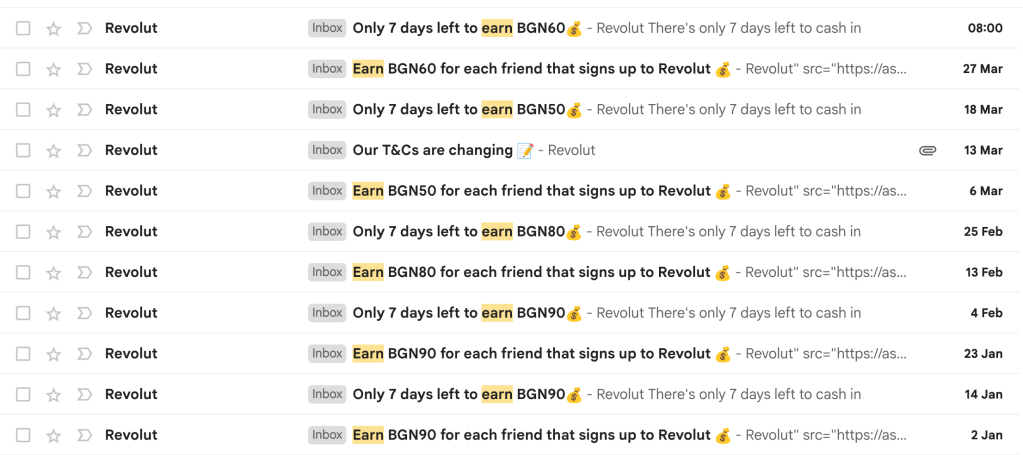
I keep getting emails that I have 7 days left to earn from referring my friends to use Revolut. Is it really 7?

So, they appear to have a recurring campaign that invites people to their referral program every 21 days, then a reminder email on day 12 that 7 days are left. Then the amount changes (or doesn’t) and I get a new email.

The amounts vary between 50 and 200 BGN (25 to 100 Euro) with the 50 being the default, 80-90 offered when the bot felt happy, and 200 – about once or twice per year. I couldn’t find any seasonality.

These emails go back to 2022 when I probably signed up for Revolut. I’ve not yet tried the service because it wanted too much private data so I don’t know if it’s good or bad. I just admire how they never considered me an inactive user despite not having the app.

This email title only appeared once. Fellow MarTech folks on Revolut probably recognized it as something that doesn’t sit quite right.

The Power of Old GitHub Issues

I’m starting believe that a rule exists such that if you file an issue on GitHub, the older it is, the more weight it has and the probability it’s taken seriously increases. As it gets older, the issue either gets randomly closed, or becomes like a space-twisting gravity well.

Let’s imagine a task like visiting the dentist. The more I postpone it, the more I’ll want to do it now as it reaches a nerve and hurts. Something like that happens with issues as well. When a bug report (or a request) is submitted, it starts living its own life, and the clock of decay starts ticking.

  • The problem will be noticed by others and they’ll refer to it (due to the Single Cockroach Rule)
  • Embarrassment may start building up. Why is this still hanging?
  • Familiarity happens. People checking the list of open issues will read that one and postpone it many times, turning it to an old friend.

So even mildly unreasonable issues may eventually get done by the gravity of their own age.

Cool Tips With Images on WordPress.com

I have some ideas to share with you, based on my last 24 hours of blogging.

Add Images as Galleries

Have you noticed that when you blog a single image, it’s not clickable and stays small? Like this:

It’s a very large and pretty image but nope, can’t click.

And this is clickable (well, at least clickable from the website veselin.blog):

I used the Image block for the first and the Gallery for the second. So if you want your image to be clickable, use the Gallery instead of Image for single images as well.

You can type /gallery in the editor to quickly find the block. It will appear after /ga or /gal.

You Can Post Photo Comments

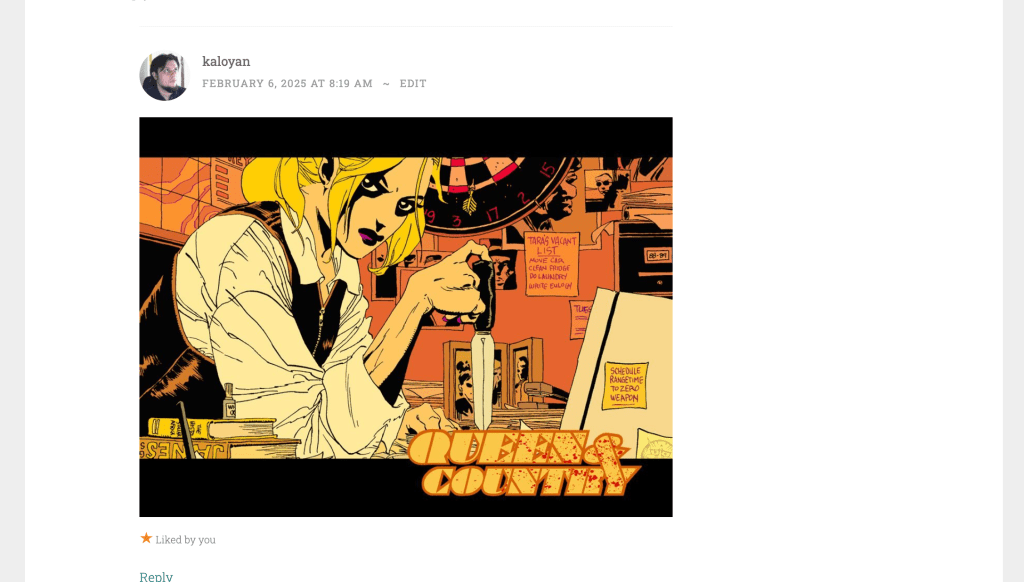
This only works when you go to the person’s site and post a comment from WordPress, and not the Reader or the comment notification. The Gutenberg Editor for comments supports adding an Image block where you can copy/paste an address pointing to an image. Just select reputable sources for your images or they might go away soon.

Use Featured Images for Your Posts

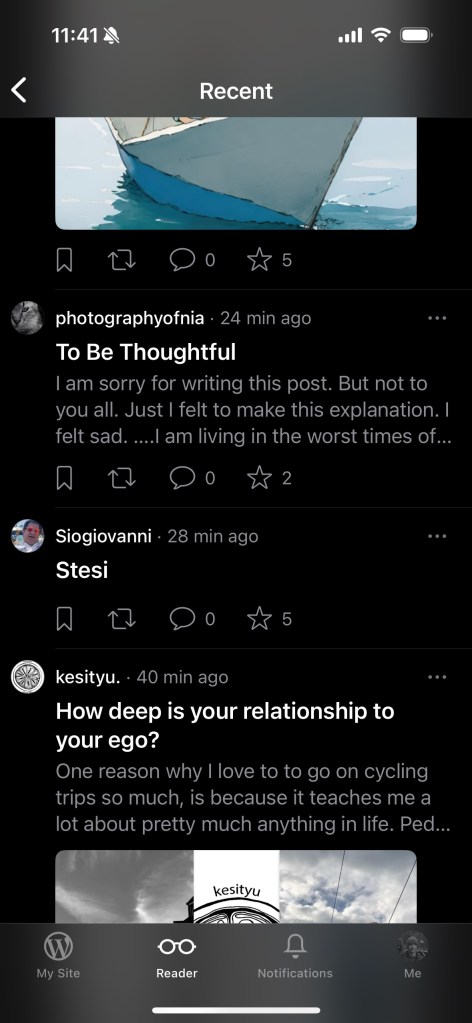
The latest version of the Jetpack Mobile app no longer uses the first image from the post on the Mobile Reader and this will likely cause lower engagement with your posts on Mobile if you don’t manually add featured images. The following screenshot shows 2 posts with a featured image, and two without. Despite having a photo on your site, it will only be viewed after a click. Will anyone click a post called “Stesi” with no explanation and no photo? Probably not.

Note that the web Reader is unaffected and will still show your first image as featured without doing this.

Resize Images Before Uploading

It’s very easy to consume all of your space if you don’t resize the photos before uploading them. The default photos that my phone generates are 5-9MB each. Scaling them down to 2000x1500px makes one photo under 1MB and I can upload more than 1000 photos per GB of used space.

Do you have any tips about using images on your blog?

The Single Cockroach Rule

Seeing one cockroach under the sink usually means an infestation. Roaches like to hide. It only showed up because the hiding spots were overcrowded.

I like to apply this generalization to software engineering—especially over beer.

  • If you receive a single bug report about a feature you just launched, it likely means the feature is completely broken. Users tend to work around UX issues and only reach out to support when things are really bad and they have no other options.
  • That one security, usability, or other issue you noticed in a pull request? If there’s one in the PR, there are probably more in the adjacent code.
  • A missing space in a code change? That usually means there’s no linting in place.
  • A missed edge case? It might indicate something is off in our testing process.

The way I defined this Cocroach Rule matches the definition of a Hasty Generalization. After all, one cockroach—or one bug—is a sample size of one. There’s always a chance that a reported issue is an extreme outlier, something no one else will ever encounter. Maybe a high-energy particle hit a chip somewhere. It happens.

But my long-term experience shows that the Single Cockroach Problem largely holds true. It applies in many areas where the difference between zero and one is significant.