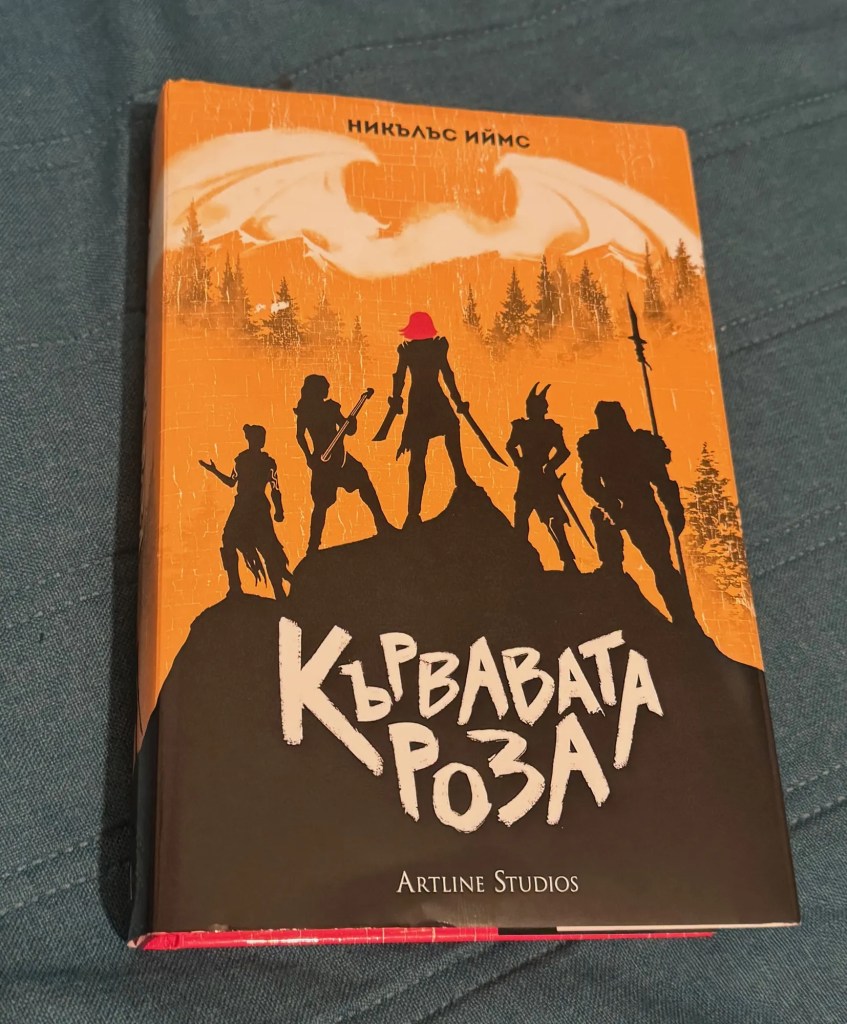
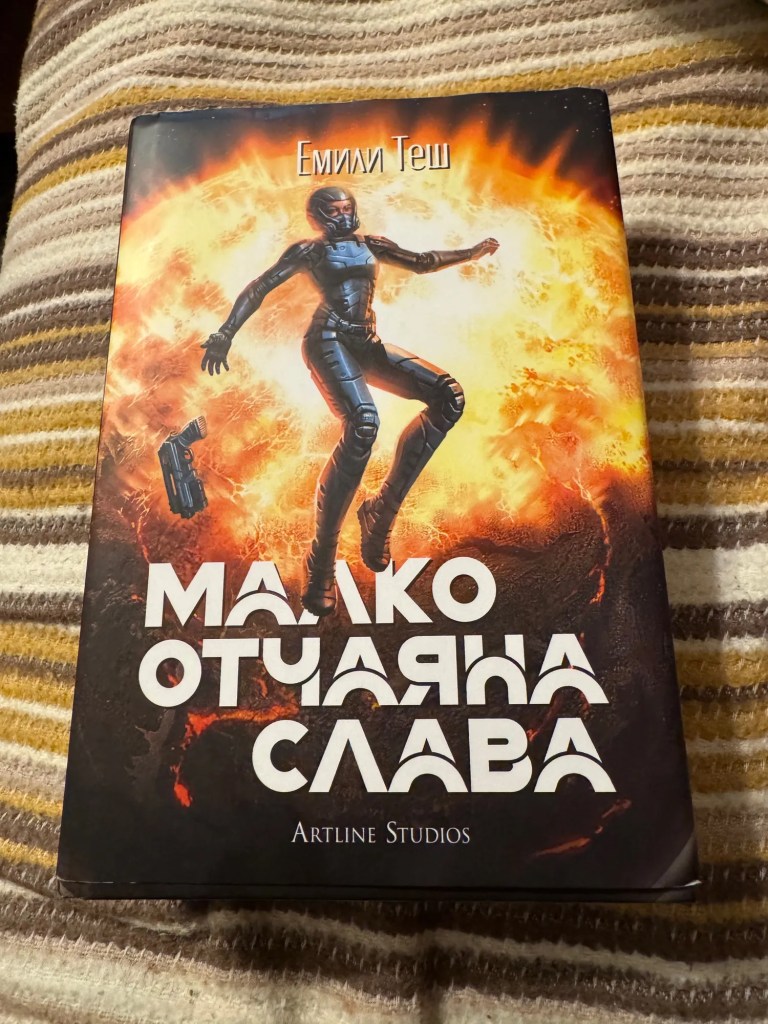
Star Wars: Thrawn by Timothy Zahn

Thrawn is a highly creative blue humanoid smurf-like creature from the Star Wars universe.

You can’t take this book too seriously, knowing it’s part of the Star Wars universe. However, Zahn gave his best here and the story significantly exceeded my expectations. It is a fine quality space opera, with a charismatic main character, whose superpower is his military skill. He’s a mix of Ender and the Stainless Steel Rat.

The supporting characters aren’t two dimensional and I suspect we’ll see some of them again in the sequels. Vanto, in particular, could have his own book. There is no mention of the force anywhere, no midichlorians, no magic at all. The storm troopers are able to hit their targets. This is an improvement over the usual trope in the Star Wars universe I’ve seen so far, where the final battle is decided by use of the force, rather than skill.

The print quality is superb and despite that it’s possibly targeting teenage readers, I enjoyed it. 5*/5 and will order the continuation soon.

Lost in Math: How Beauty Leads Physics Astray, Book Review

It’s been awhile since I completed a popular science book. This one was good. It was about the process of exploring new physics but you can replace the physics with software engineering and it remains relevant, or at least it remains relevant for me. I enjoyed it and I feel full of ideas.

My main takeaway from Sabine Hossenfelder’s work is that our perception of beauty is frequently holding progress back. All progress in Physics was achieved by sacrificing the old understanding of what’s beautiful in favor of something that’s temporarily perceived as ugly, illogical, but better explains the world. It seems to me that this statement could be extended outside of science to Software as well, where progress is also usually done in random leaps, when new (or even old and failed) ideas suddenly break through.

What’s beautiful? My take from the book is that beautiful is something that’s symmetric, simple, understandable, familiar, and makes sense to our simple brains. Intuitive.

Let’s say we have the following series:

1, 2, 4, 8, 16

What’s the next number? Trivial answer would be that the series represents the powers of two, so next one is 32. A 6th grader will quickly point out to 32 as the obvious answer. However, 31 is also a less obvious next, because it appears in Moser’s circle problem. If we look at the number of divisors of n!, the next number is going to be 30. These options appear less and less natural but they’re not far off our intuitive expected answer, and we would not hesitate to accept them with the right context.

What if the next number is -1,031*10-17? We have a strictly positive series with natural numbers (positive integers), and we suddenly get a negative, and very tiny fraction, and no obvious explanation why? This can’t be right, right?

1, 2, 4, 8, 16, -1,031/10^17, ...

If that’s what we get from our data, our internal alarm rings a bell, and we would be looking for an error. And if we look for an error or a reason to give up, Hossenfelder says, we are going to find it. There’s a bias that comes from our expectation of what’s natural, because we won’t use the same rigor in verifying the results if the next number was 31 or 32. Of course, this isn’t the only bias that prevents us from seeing what’s right in front of our eyes. She summarizes multiple others, and even provides an appendix with advice on avoiding that in our line of work.

Data contradicting with our expectations is not a bad thing. There can be truth in the unexpected or disappointing data, if we know how to look at it. There can be lies in data particularly if we don’t know how to look at it. My next math-adjacent book, sitting right next to me, is called Everything is Predictable (such a clickbait-y title). I’m already deep into it and it’s quite complimentary to Sabine’s work.

Overall, Lost in Math is a great popular science journey. I also enjoy watching Sabine’s critical YouTube videos and recommend them too.

5*/5

None of This Is True by Lisa Jewell, Book Review

This is such a good book title. You can hardly come up with anything better than it. It can apply to anything. Get a speech or a news announcement or even a billboard, you say the title and it gets a new meaning.

In our case, the book is an unusual thriller. Think Freida McFadden but with a very different tempo. Radical show, don’t tell.

Alix is a podcaster who thinks she found a hidden gem. Josie is a mom of two and in the middle of some kind of a tragic situation, living with a probable elderly molester. Josie is the gem Alix found. Josie will reveal a career-defining story. But what part of the story is true and what will be the consequences?

This summary sounds pretty ordinary. This book isn’t ordinary. The story doesn’t follow any familiar or common patterns. I can give you some cringe or rare examples of similar books but don’t want to as I don’t want to spoil anything. It is weird and a bit slow, or at least has a slow start, but it will not disappoint if you give it a chance and stay with it long enough.

On my records, it gets a full 5*/5, a rare jewel in a genre, dominated by strong law enforcement people, tricking the evil.

Print and translation were also great.

I already purchased another book by the same author.

Some insights from Sabine Hossenfelder’s book Lost in Math

I’m reading the book Lost in Math by the famous Youtube content creator and scientist Sabine Hossenfelder.

The author shares stories around a common theme – beauty shouldn’t be an argument in science. According to Sabine Hossenfelder, scientists have the tendency to chase beautiful ideas and dismiss hacky, unnatural solutions that explain the world very well due to their ugliness. She gives the heliocentric model as an example. Scientists from the past had difficulties accepting that stars are as far as we know they are because the numbers were too large, which felt unnatural. I’m encountering this type of problems relatively often, with beauty being used as an argument for expensive ideas, for example new standards, or second systems / rewrites.

Who could’ve imagined that this is where I’ll find cues on my quest on figuring out web experimentation (yeah, I’ve not blogged about that, but maybe it’s a good moment to start). I’ll just share two quotes.

…you could go most of your life without having to confront [the results of an] experiment”

Apparently, physicists sometimes run experiments that take a really long time, like decades. For example, particle accelerators that are expecting to produce a new particle in decades, meanwhile postponing decision making and facing the realities of known models not producing the expected results. In my world, where experiments are run on web, I’ve also encountered long-running web experiments. Usually because the sample size is small or because we expect some distant future event to happen, which never comes.

“If you are an honest physicist, 99.99 percent of your ideas, even good ideas, are going to be ruled out, not by new experiments but already by inconsistency with old experiments.”

Same applies to web experimentation as well, although the share is probably not 99.99% (as it isn’t for theoretical physics either). Verifying ideas against prior experiments can filter out many of them quickly. But there’s always the problem – does that old experiment still apply even if we ran it X years ago? What if something in the setup was wrong and it works now?

This book touches my chords despite being unrelated to my work. Something in the area of process is overlapping. I don’t know why yet but I’ll keep reading.

May in Books

I didn’t read much in May. The month started with Christopher Paolini’s To Sleep in a Sea of Stars, a monumental 1200-page space opera. I think that wore me down and I mostly chilled without books after that.

Best

  • To Sleep in a Sea of Stars – 5/5, a book I enjoyed and touched me, despite its absurd size.
  • Howl’s Moving Castle – 5/5, a sweet low-stakes fantasy story. It’s not the type of book you can binge but it is kind of cool the way Legends and Lattes is. Something that can flush your brain a bit if you feel down.
  • City of Blades by Robert Jackson Bennett – 5/5, an epic dark fantasy, almost steampunk, where tech faces miracles and gods. It has an unique world and even better developed characters than City of Stairs. Robert Bennet is clearly a very strong fantasy author. Looking forward to finding his other works.

Worst

  • The Belgariad #2 – DNF at around 30%.

I think this is is the worst month for reading since I started writing the monthly reports here. However, the 3 books I completed were all great, so it evens things out a bit.