How do you overcome reader’s block?

The short answer? TL;DR.

I’ve noticed a pattern with people who start reading. They would pick a book that they really want to read and get stuck with it. A book that makes a statement. For example, I started reading The Engineering Leader by Cate Huston about 6 months ago, and I’ve not reached 30% yet. Not giving up on that one. I know the author, she gave me a copy with an autograph. I will complete that book. But then, I could’ve had a 6-month reader’s block with it, turning me from a person who reads to a person who doesn’t. The same can happen with fiction. I started Brandon Sanderson’s Rhythm of War twice. He’s great, I met him in person, his books are fantastic. But then, why did I get stuck between page 200 and 300 both times?

I think that it’s not about the book itself. The right person at the right moment would not get stuck. But we do get stuck, particularly when we want to have read something rather than enjoy the act of reading it.

Solutions

  • Treat it like a schoolbook. 10 pages/hour, small rewards for each chapter (like a candy). I may end up doing that for Cate Huston’s book because it feels useful and will eventually get through it. This method works well with short-form and non-fiction.
  • Give yourself permission to DNF (Did Not Finish). This is my recommended approach for most books that cause Reader’s Block. Rhythm of War goes here. Works perfectly with long books and fiction. If you can’t get to 20% within 5 days, time to call it a DNF.
  • Don’t start books that will cause it. The probability of getting stuck on a book increases with the length of the book. Too long? Don’t start.
  • Read two books at the same time, for example one on paper, and one e-book. When you get stuck with one, the other will keep the habit of reading alive.
  • Dedicate a block of time for reading. For me, that’s typically 9:30pm to 11pm.

There are still challenges I haven’t figured out. For example, how do I consistently find books I’ll actually enjoy? No clue. I have a pile of unread books at home. Most of them don’t seem as appealing as they did when I bought them.

The Fifth Season by N. K. Jemisin, Book Review

In 2006, Liu Cixin became famous with his book The Three-Body Problem. An alien planet struggles with non-periodic but frequent mass extinctions due to the unstable planetary orbit. The Fifth Season is exactly that kind of extinction in the world of The Broken Earth. While the visible causes are usually volcanic in origin rather than solar, the results are similar. Endless civilizations, species, and empires have been wiped out—just like in The Three-Body Problem. Society’s main goal is to prepare for the next extinction, but of course, it is never the same as the previous one. How bad can an apocalypse be to countries which had tens of thousands of years to prepare and lots of experience? We’ll see.

Unlike The Three-Body Problem, N. K. Jemisin chooses to tell the story in a chaotic and confusing way. It is not always clear who exactly the main character is, where the story is headed, or what they are fighting for. The book is written as if I am the protagonist, similar to choose-your-own-adventure gamebooks. All this confusion is likely to make the reading experience more unique and to compensate for the similarity with The Three-Body Problem and the excessive superheroism.

Fantasy has a very limited number of clichés, and the trope of constantly dying and reborn civilizations is relatively new—perhaps inspired by science fiction stories about alien artifacts, like 2001: A Space Odyssey, Rama, The Expanse, Gateway, Alien, etc. While we’ve seen fragments of this book elsewhere, the combination is somewhat innovative. The magic felt fresh—bordering on science fiction. The closest system I can think of is the Midi-chlorians from Star Wars.

Despite the off-putting style, which reminds us a two-page Reddit post without new lines or punctuation, the book is interesting and overall great. I hope the sequel gets translated as well. Curious to see how Jemisin will solve the boringly overpowered superhero problem.

5*/5

The Chesnut Man by Søren Sveistrup

A Chesnut Man

The smart homicide detective Naia Thulin has to supervise her colleague Hess, who messed up at Europol. They are faced with a case involving a serial killer who leaves rivers of blood and signature little chestnut figurines.

The book is engaging, well-written, but at the same time unnecessarily gory and disgusting. The main characters are repeatedly praised for being intelligent and brilliant, yet they constantly make silly mistakes that reek of foolishness and overconfidence. Real police officers probably make similar errors, but sometimes it becomes too much. Some of the mistakes feel like they’re straight out of a comedy horror movie—like when someone sits in front of a slowly moving steamroller for 15 minutes without taking the one necessary step to avoid getting hit.

The style is a mix of Chris Carter’s blood-soaked descriptions and the demigod hidden villain trope from The Mentalist. The Chestnut Man is excessively elusive, like Red John, but slightly more believable. His motivation is fully revealed and obvious almost from the beginning of the book. In this regard, The Mentalist falls short. Also, Hess is nowhere near as gifted as his TV counterpart, which makes the story far more interesting.

Naia Tulin is supposedly the lead character, but overall, Hess gets more page time and does more of the actual investigating.

Objectively, I’d rate the book around a 4.5—about 150–200 pages longer than it needed to be for a solid 5. What I didn’t like doesn’t make it a bad book, just slightly incompatible with my tastes.

I’d read other books by this author but maybe not right now.

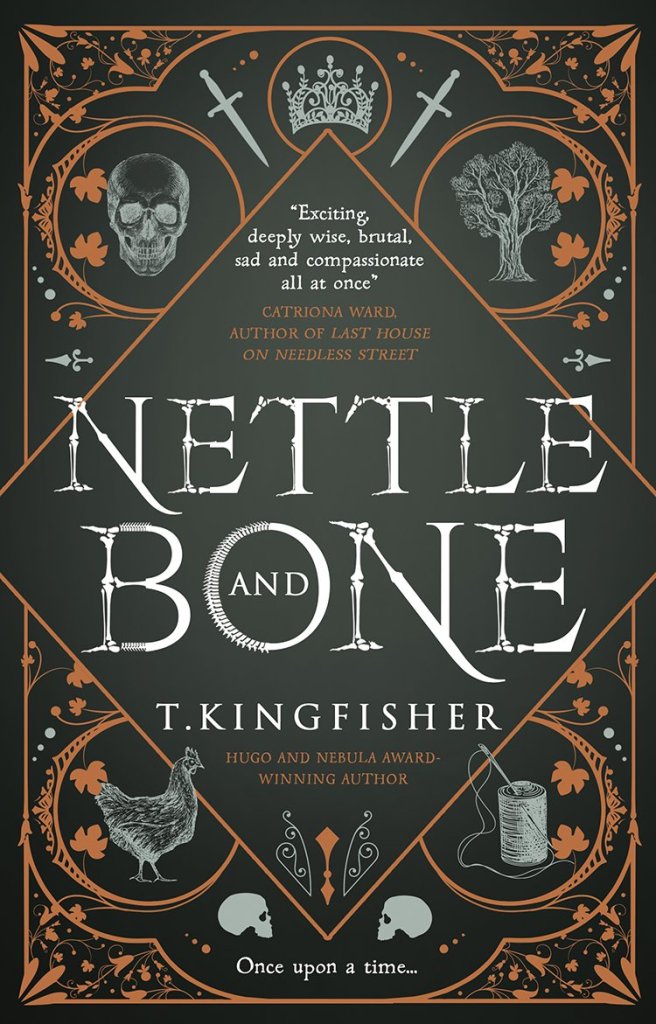
Nettle & Bone

Nelson Mandela once said that it always seems impossible until it’s done. This book is a fairy tale about an impossible adventure in which princess Marra seeks to help her sister. The sister is stuck into a forced marriage with a king who is torturing her. He is protected by an immortal and almighty fairy godmother and other less visible forces, like an army, and is untouchable. Marra will start a decades long journey where he’ll find support by people and entities with magical powers. Will they succeed on time? After all, a recurring theme in the book is that you can’t help someone who doesn’t want to be helped.

If I were to compare it to other books, Nettle & Bone is reminiscent of Uprooted by Naomi Novik and the first Witcher novel.

Nettle & Bone is an excellent little fantasy with a simple idea and a complex magical system based on millenias of superstition and fairytales. It’s written in a young adult style but covers adult themes like domestic violence. Not sure how to classify it. Fantasy, I guess.

5*/5

January 2025 in Books

2025 starts well, as if the Goodreads challenge is still usable. I completed many good books last month.

Best books

  1. A Deadly Influence by Mike Omer – I had to read a book that says Instagram is evil. Well written, a bit heavy. 5/5
  2. The Waiting by Michael Connelly – Michael Connelly only gets better with time. His “new” character Renée Ballard is even cooler than Harry Bosch. 5/5
  3. Prisoner of Tehran by Marina Nemat – Liquid anger against the oppressive regime in Iran. 5/5
  4. Night of the Dragon by Julie Kagawa – A slightly romantic finish of a great artifact disposal fantasy. 5/5
  5. Completely nuts by Gilles Legardinier – Low-stakes bubblegum. 5/5

Worst books

  1. Defiant by Brandon Sanderson – Spensa gets misbalanced nerfs and OPs, nothing to read there. 4/5 but really lower.
  2. Rainbow (Дъга 1) – a comic book about the dark twists of ordinary fantasy events. 4/5